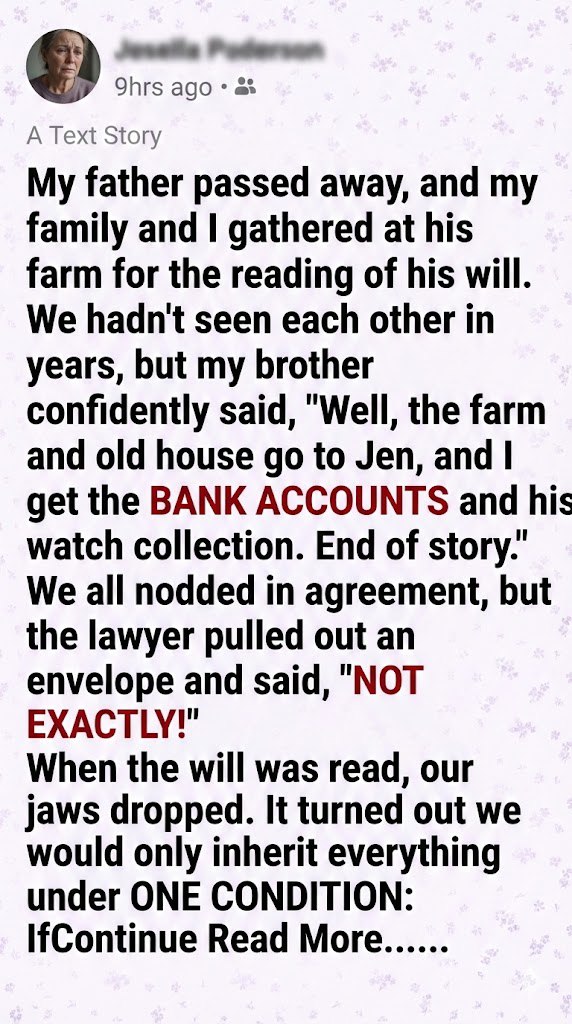
My father passed away, and my family and I gathered at his farm for the reading of his will. We hadn’t seen each other in years—mostly because of money disputes and petty arguments—but my brother, Mark, walked in looking smug.
Before the lawyer even sat down, Mark confidently said, “Well, look, let’s make this quick. The dusty old farm and the house go to Jen, obviously. She likes that rustic stuff. And I get the BANK ACCOUNTS and his vintage watch collection. That’s fair. End of story.”
He looked around the room, expecting us to just roll over. We all nodded in agreement, mostly just to avoid a fight. I was actually fine with the farm; it held all my childhood memories.
But the lawyer, Mr. Henderson, didn’t open the main file. Instead, he pulled out a thick, sealed red envelope and cleared his throat.
“NOT EXACTLY!” he boomed.
Mark’s smile vanished. “Excuse me?”
“Your father anticipated this exact conversation,” Mr. Henderson said, adjusting his glasses. “When the will was drafted, he added a specific clause. It turns out, you will only inherit anything—the money, the watches, or the farm—under ONE CONDITION.”
Our jaws dropped. The lawyer began to read:
“I, Thomas Pederson, leave my entire estate to my two children, Jennifer and Mark, to be split 50/50. However, this inheritance is contingent upon them living together in the farmhouse for exactly six months. They must restore the main barn to its original condition within that time, working together, without hiring outside contractors. If either child leaves the property for more than 48 hours, or if the barn is not finished, the entire estate will be liquidated and donated to the Donkey Rescue Sanctuary.”
Mark exploded. “You’re joking! I have a life! I have a condo in the city! I can’t live in this dump for six months with her!”
“Then the donkeys will live like kings,” Mr. Henderson said calmly, closing the folder. “The clock starts now.”
The first month was a nightmare. Mark refused to lift a finger. He paced around the living room in his Italian loafers, complaining about the WiFi and trying to find loopholes in the contract. I was out in the barn every day, hauling rotten wood and sweating through my clothes.
“You’re going to lose us the money!” I screamed at him one night over dinner. “Dad did this because we haven’t spoken in five years, Mark! He wanted us to be a family again!”
“He did this to torture me,” Mark spat back.
But the turning point came in month three. A massive storm hit the county. The roof of the barn—the one I had just started patching—began to leak dangerously. I was up on the ladder, slipping in the rain, crying because I couldn’t hold the tarp down alone.
Suddenly, I felt a hand grab the other side of the tarp. It was Mark. He was wearing Dad’s old oversized raincoat and ruined his expensive shoes, but he hammered that tarp down with me. We spent the next six hours bailing water and reinforcing the beams.
By morning, we were exhausted, covered in mud, and sitting on the barn floor drinking cold coffee.
“I missed this place,” Mark admitted quietly, looking up at the rafters. “I missed us.”
For the next three months, we didn’t just work; we talked. We unpacked years of resentment. We found Dad’s old journals in the attic and read them aloud to each other. We realized he wasn’t playing a game; he was giving us a second chance.
When the six months were up, Mr. Henderson returned. The barn looked magnificent—better than it had in twenty years.
“Well done,” the lawyer said. “The assets are yours. Mark, the accounts are being transferred. Jen, the deed is ready.”
Mark looked at the lawyer, then at me. “Actually,” Mark said, “don’t transfer the money yet. Put it into the farm account. Jen and I are going to turn this place into a bed and breakfast. We’re partners.”
I smiled, tearing up. Dad didn’t just leave us money; he gave me my brother back. And that was worth more than any watch collection.