People think grief gets smaller with time.
It doesn’t.
Life simply grows around it.
My name is Henry.
I’m seventy-two years old.
For thirty-eight years, my wife Margaret and I built a quiet, ordinary life together.
We never had children.
Not because we didn’t want them.
Life simply never unfolded that way.
Instead, we filled our home with books, backyard birds, Sunday morning pancakes, and enough laughter to make the silence afterward almost unbearable.
Margaret adored Christmas.
Every November first, she’d insist on decorating the tree.
Every December she’d bake enough cookies for half the neighborhood.
She had one rule.
“No one who crosses our path should feel forgotten at Christmas.”
Five years ago, cancer took her.
She fought with every ounce of strength she had.
But some battles cannot be won.
After the funeral, I packed away most of the decorations.
The lights remained in their box.
The ornaments stayed wrapped in tissue paper.
Christmas became another date to survive.
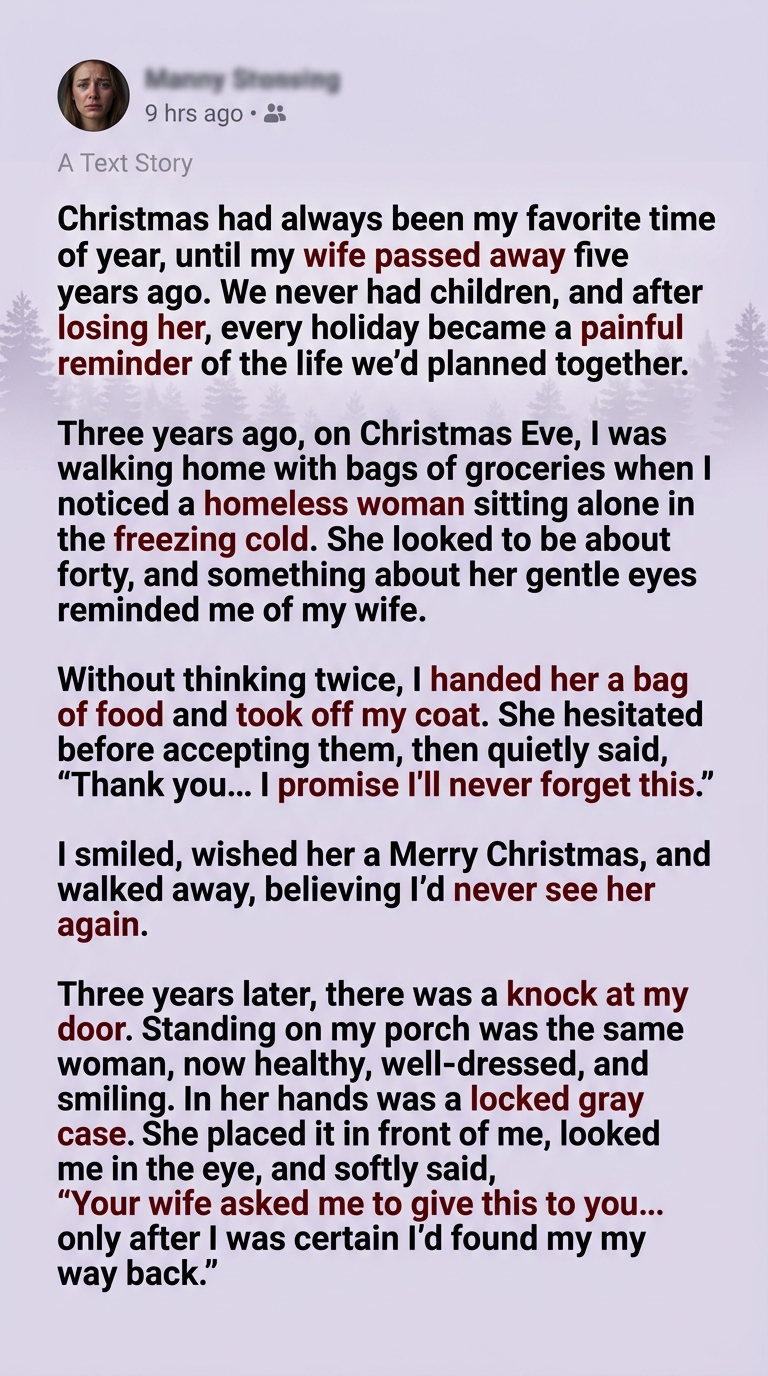
Three years after losing her, on Christmas Eve, I forced myself to shop for groceries.
The streets were crowded.
Families hurried home carrying gifts.
Children laughed beneath glowing storefront windows.
I carried two bags of groceries through the falling snow.
Halfway home I noticed a woman sitting beneath the awning of a closed pharmacy.
She looked about forty.
Her coat was too thin for the weather.
A small backpack rested beside her.
Her cheeks were red from the cold.
What stopped me wasn’t her appearance.
It was her eyes.
They carried the same quiet kindness Margaret had always possessed.
She wasn’t asking anyone for money.
She simply sat there, trying not to shiver.
Without thinking, I walked over.
“I bought too much food.”
It wasn’t true.
“But I was wondering if you’d help me solve that problem.”
She looked up cautiously.
“I couldn’t…”
“You can.”
I handed her one of the grocery bags.
Then I removed my winter coat.
“You’ll need this more than I do.”
She immediately tried to refuse.
“I can’t take your coat.”
“My wife would’ve been angry if I walked past you.”
That made her smile for the first time.
She accepted both.
Tears gathered in her eyes.
“Thank you.”
“I promise…”
“I’ll never forget this.”
“Merry Christmas.”
“Merry Christmas.”
I walked home wearing only a sweater.
For the first time since Margaret died…
Christmas didn’t feel completely empty.
I never expected to see that woman again.
Three years passed.
Life settled into its quiet routine.
Then, one rainy October afternoon…
Someone knocked on my front door.
Standing on my porch was a well-dressed woman wearing a navy coat.
Healthy.
Confident.
Smiling.
For several seconds I couldn’t place her.
Then she spoke.
“You probably don’t recognize me.”
“I recognize your eyes.”
It was her.
The woman from Christmas Eve.
Before I could say anything, she carefully placed a locked gray metal case on my porch.
“I’ve carried this for almost three years.”
She looked directly at me.
“Your wife asked me to give it to you.”
“…but only after I was certain I’d found my way back.”
My heart nearly stopped.
“My wife?”
The woman nodded.
“My name is Claire.”
“I met Margaret six months before she died.”
I stared at her.
“How?”
She took a slow breath.
“I was living in my car.”
“I’d lost my apartment after leaving an abusive relationship.”
“I was ashamed.”
“I hid from everyone.”
“One afternoon your wife found me sitting outside the hospital.”
Margaret had been receiving chemotherapy around that time.
Claire smiled through tears.
“She didn’t ask questions.”
“She simply sat beside me.”
“She shared half of her lunch.”
“And then she kept coming back.”
Every treatment day.
Margaret brought extra sandwiches.
Coffee.
Books.
Warm socks.
Conversation.
Eventually, she convinced Claire to speak with a social worker at the hospital.
That introduction led to temporary housing.
Job training.
Counseling.
A chance to begin again.
“I wanted to thank her.”
Claire’s voice trembled.
“But by then…”
“…she was getting weaker.”
“One day she handed me this case.”
Claire gently rested her hand on the gray box.
“She made me promise something.”
“What?”
“‘Don’t give this to Henry right away.'”
“‘Wait until you’ve truly rebuilt your life.'”
“‘Then he’ll know hope is real.'”
My eyes filled with tears.
“She said that?”
Claire nodded.
“She believed your grief would convince you nothing good could come after losing her.”
“She wanted living proof that one act of kindness could keep growing.”
She handed me a small key.
“I think it’s time.”
With shaking hands, I unlocked the case.
Inside lay several carefully arranged items.
Margaret’s favorite red scarf.
Our wedding photograph.
A stack of letters tied with a green ribbon.
And a small wooden ornament shaped like a star.
On top rested one envelope.
For My Henry
I opened it slowly.
My dearest love,
If you’re reading this, then Claire kept her promise.
I hope you noticed something before opening this case.
She came back smiling.
That matters.
When I met Claire, she believed her life was over.
I understood that feeling better than she knew.
The difference was that I couldn’t change my diagnosis.
But maybe I could help change hers.
If she is standing before you today, then kindness worked again.
Henry…
I know you.
You’ll be tempted to spend your remaining years remembering me instead of living them.
Please don’t.
Love isn’t honored by becoming frozen in time.
It’s honored by continuing.
Inside this case are my journals from treatment.
You’ll discover I wasn’t brave every day.
Some days I was frightened.
Some days I cried after you fell asleep.
But I never doubted one thing.
You loved me well.
You gave me a beautiful life.
Now I have one final request.
Every Christmas…
Find one person who feels invisible.
Not because you can save everyone.
But because someone once refused to walk past me, too.
Love isn’t something we keep.
It’s something we pass forward.
Forever yours,
Margaret
By the time I finished reading, tears blurred every word.
Claire quietly reached into her purse.
“I have one more thing.”
She handed me an old receipt.
It was from the grocery store.
Dated three years earlier.
The very Christmas Eve we had met.
“I kept it.”
She laughed softly.
“It reminded me that strangers can become turning points.”
That Christmas, Claire joined me for dinner.
For the first time in years, laughter returned to my dining room.
The next Christmas, we invited three people from the local shelter.
The year after that, seven.
Soon neighbors began helping.
Then local businesses donated food.
Within a few years, what started as one dinner had become a community Christmas gathering where no one had to spend the holiday alone.
Claire eventually became the director of a nonprofit that helped women rebuild their lives after homelessness and abuse.
Every December, she tells the same story.
Not about losing everything.
But about the elderly widower who gave away his groceries and his winter coat because his wife had taught him that kindness should never wait for a convenient moment.
People sometimes tell me they feel sorry that Margaret never got to see what her compassion became.
I simply smile.
I think she did.
Because every time another lonely chair at our Christmas table is filled…
Every time someone leaves believing tomorrow might be brighter…
Every time hope quietly replaces despair…
She is still keeping Christmas with us.
Just as she always promised she would.