My sister and I used to finish each other’s sentences.
When we were little, we shared a tiny bedroom with mismatched furniture and posters peeling off the walls.
If one of us got into trouble, the other usually accepted half the blame.
People constantly said,
“You’ll always have each other.”
For most of my life, I believed that.
My younger sister, Vada, was charming.
She could make strangers laugh within minutes.
She was also impulsive.
If she had fifty dollars, she’d spend sixty.
If she received a bonus at work, she’d celebrate before paying her bills.
I was the opposite.
Careful.
Methodical.
Always saving for emergencies.
Our personalities balanced each other.
Until they didn’t.
One Tuesday afternoon my phone rang.
Vada was crying so hard I could barely understand her.
“The bank’s taking the house.”
“What happened?”
“I’m behind.”
“How far behind?”
“They gave me until Friday.”
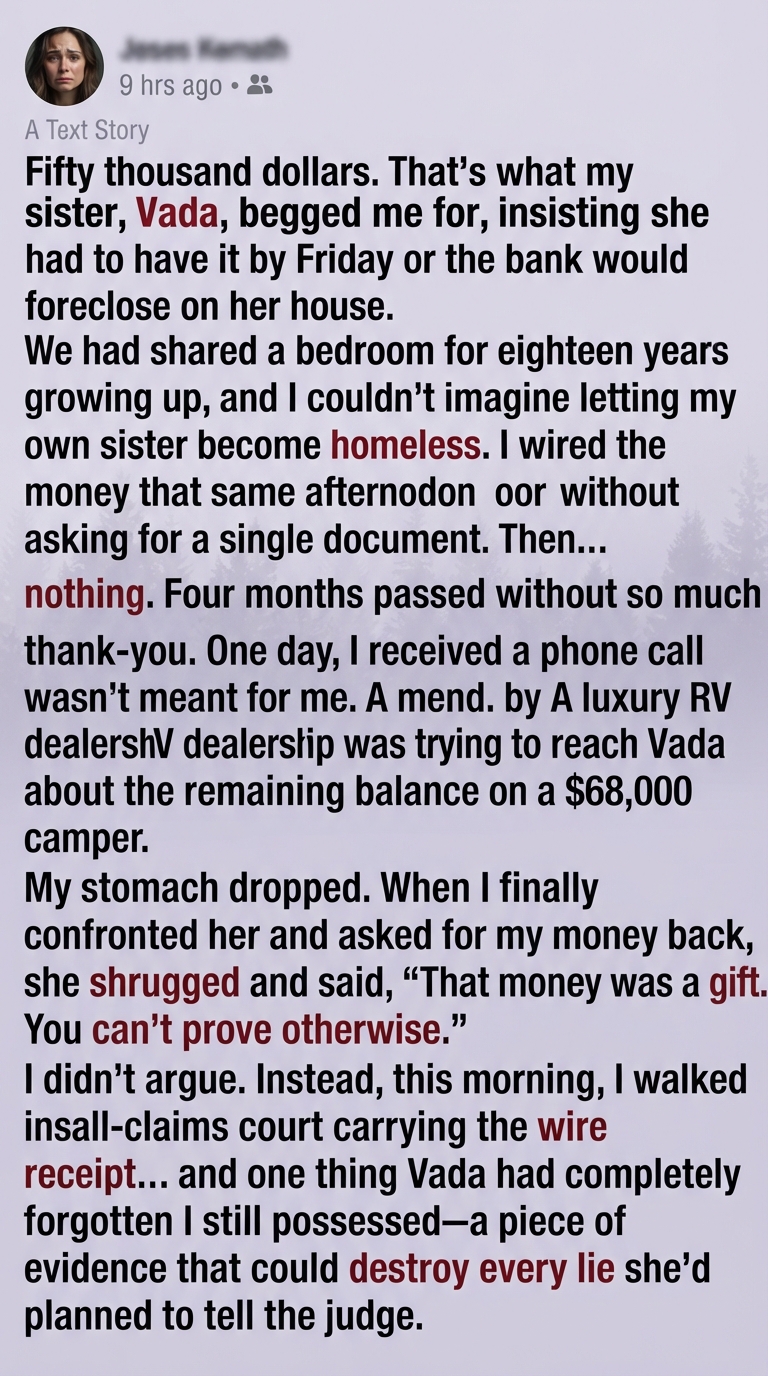
“I need fifty thousand dollars.”
The number stunned me.
“I know it’s crazy.”
“I hate asking.”
“But if I lose the house…”
“My kids lose everything.”
She sobbed again.
“I’ll pay you back.”
“I swear.”
I didn’t ask for documents.
I didn’t ask to see foreclosure papers.
She was my sister.
That was enough.
I transferred fifty thousand dollars that afternoon.
In the transfer notes I typed:
Temporary loan for mortgage. Love you.
She texted seconds later.
“You saved us.”
“I’ll never forget this.”
For a while, I believed everything was fine.
The first month passed.
Then the second.
Then the third.
Every time I asked gently about repayment, Vada had another explanation.
“The bank changed things.”
“We’re refinancing.”
“My accountant is handling it.”
“I’ll call you tomorrow.”
Tomorrow never came.
By the fourth month, she stopped answering most of my messages.
Then fate intervened.
I was eating lunch at work when my phone rang.
“Hello, Ms. Vada Collins?”
“No, this is her sister.”
The man apologized.
“I’m terribly sorry.”
“I was calling regarding the remaining balance on her Horizon Elite motorhome.”
I frowned.
“Motorhome?”
“Yes.”
“The sixty-eight-thousand-dollar RV.”
“I’ll try another number.”
He hung up before I could ask another question.
I sat frozen.
That evening I drove past Vada’s house.
There, beside the garage…
Parked proudly in the driveway…
Sat a gleaming new luxury camper.
My stomach turned.
I knocked.
She answered smiling.
“Hey!”
“We need to talk.”
The smile faded.
Inside, I asked one simple question.
“Did you use my money to buy that RV?”
She looked away.
Finally she sighed.
“I used some of it.”
“Some?”
“The down payment.”
I stared at her.
“You told me your home was being foreclosed.”
“It was complicated.”
“No.”
“It wasn’t.”
“You lied.”
She crossed her arms.
“I deserved something nice.”
“You deserved?”
“My children were stressed.”
“We wanted family trips.”
I could barely believe what I was hearing.
“I gave you my retirement savings.”
“You gave it willingly.”
“It was a loan.”
She laughed.
“Can you prove that?”
I reminded her about the transfer.
She shrugged.
“Money between family is usually considered gifts.”
“You’ll never win.”
I stood quietly.
“Is that really what you believe?”
“Absolutely.”
I nodded once.
Then I left.
Over the next week I gathered every document I had.
The wire receipt.
Bank records.
Our text messages.
Then I remembered something.
Three years earlier, after our mother died, Vada had insisted we both use a family-planning app to organize finances for Mom’s medical bills.
We stopped using it months later.
But neither of us deleted the shared account.
Curious, I logged in.
Everything was still there.
Including a private note Vada had written the same day she called me.
I almost couldn’t believe my eyes.
The note wasn’t meant for me.
It was her own budgeting reminder.
It read:
Borrow $50K from Emma by Friday. Pay back after selling RV next spring.
She had forgotten the note even existed.
I printed it immediately.
Small-claims court couldn’t hear a fifty-thousand-dollar dispute in our state, so my attorney filed in the appropriate civil court instead.
The hearing arrived six months later.
Vada appeared confident.
She smiled politely at the judge.
“My sister gave me money because she loves me.”
“There was never any repayment agreement.”
Her attorney emphasized that families often exchange gifts without contracts.
The judge nodded thoughtfully.
Then looked toward me.
“My evidence, Your Honor.”
I handed over the wire confirmation.
The transfer memo clearly read:
Temporary loan for mortgage.
Vada’s attorney immediately argued.
“A memo isn’t a contract.”
“I agree,” the judge replied.
“What else do you have?”
I slid forward one final document.
“The defendant created this herself.”
The courtroom grew quiet.
The judge adjusted his glasses.
Then slowly read aloud.
Borrow $50K from Emma by Friday. Pay back after selling RV next spring.
He looked toward Vada.
“Did you write this?”
Her face turned white.
She whispered,
“…yes.”
“Was this note altered?”
“No.”
“So when you accepted the money…”
“…you considered it a loan?”
Silence.
Finally…
“Yes.”
Her attorney closed his folder.
There wasn’t much left to argue.
The court entered judgment in my favor, ordering repayment plus interest and court costs.
Outside the courthouse, Vada caught up with me.
“You embarrassed me.”
I looked at her sadly.
“No.”
“You embarrassed yourself.”
“I would’ve waited years if you’d simply been honest.”
She started crying.
“I made a mistake.”
“No.”
“You made dozens.”
“The first was lying.”
“The second was believing I’d never discover the truth.”
Months later she began making monthly payments under the court order.
They weren’t large.
But they were consistent.
Nearly two years after the lawsuit, she invited me to coffee.
“I sold the RV.”
“I should’ve never bought it.”
“I know.”
She looked down at her cup.
“I think I was ashamed.”
“Everyone else looked successful.”
“I wanted to pretend I was too.”
For the first time in a long while…
I believed she was telling the truth.
Our relationship never returned to what it had been as children.
Some things don’t.
But it slowly became honest again.
And honesty, though quieter than trust, is the only place trust can ever begin to grow back.
People often assume the strongest evidence in court is a hidden recording or dramatic confession.
Sometimes it is.
But more often…
The truth wins because dishonest people forget one simple thing.
Lies require a perfect memory.
The truth only requires good records.