The first time I noticed it, I smiled.
Ruby had spilled a handful of crayons across my kitchen floor.
Before I could even stand up to help, she whispered,
“I’m sorry.”
I laughed softly.
“They’re just crayons, sweetheart.”
She nodded quickly.
“I know.”
Then she picked up every single one, lined them up by color, and apologized again.
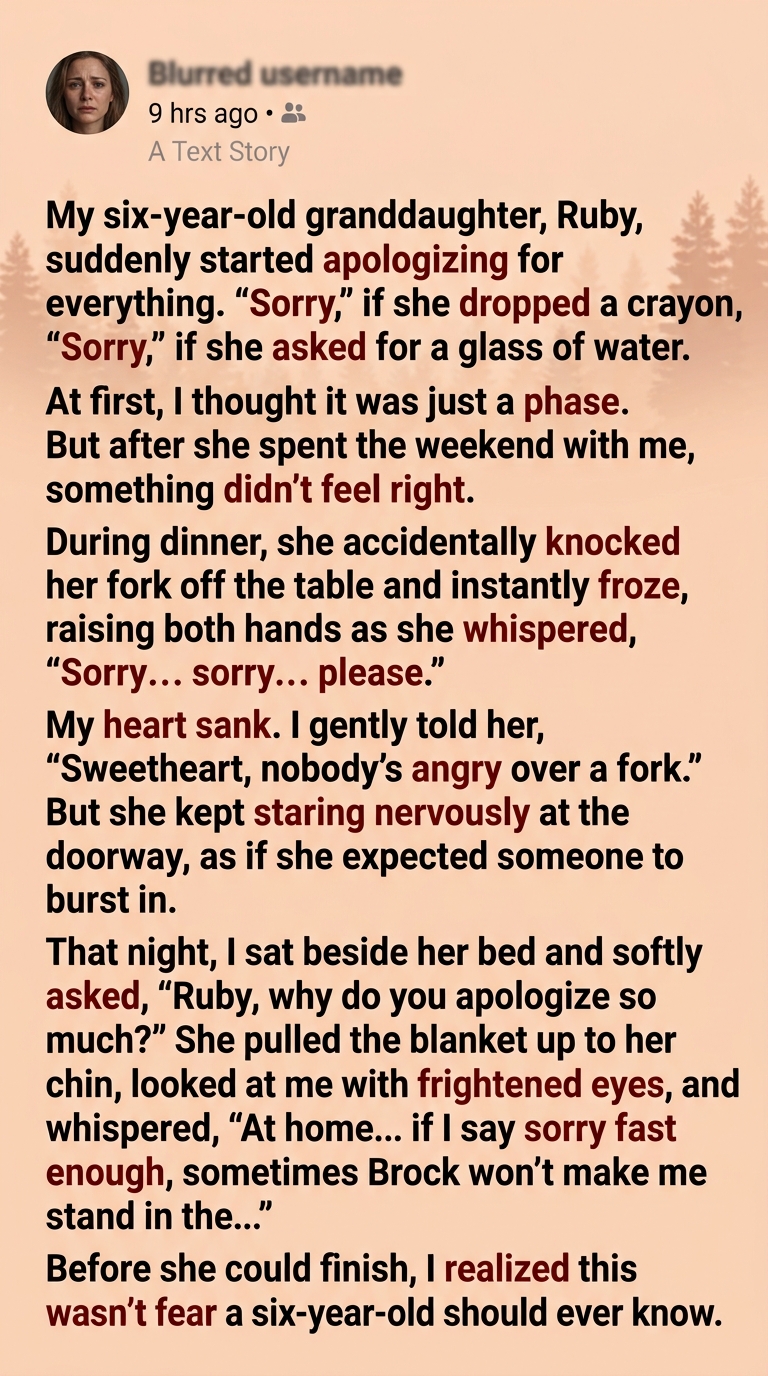
Over the weekend, I heard the word “sorry” at least fifty times.
“Sorry” for asking for juice.
“Sorry” for laughing too loudly.
“Sorry” for needing help tying her shoes.
She was only six years old.
Six-year-olds usually apologize because they know they’ve done something wrong.
Ruby apologized simply for existing.
I told myself perhaps she’d learned extra manners at school.
Children go through phases.
I tried not to overthink it.
Then Sunday evening changed everything.
We were eating spaghetti together.
She was telling me about a butterfly she’d seen in the park when her fork slipped from her little hand.
It clattered against the hardwood floor.
The sound echoed through the kitchen.
Ruby instantly froze.
Both hands shot into the air.
Her shoulders curled inward.
She stared toward the doorway with absolute terror.
“I’m sorry.”
“I’m sorry.”
“Please.”
The word please broke my heart.
There was no anger in my home.
No raised voice.
No one even standing in the doorway.
Yet she looked as though she expected someone to come running.
I slowly picked up the fork.
“Sweetheart…”
I knelt beside her.
“It’s only a fork.”
She didn’t move.
“No one’s upset.”
Her breathing gradually slowed.
That night, after we read two bedtime stories, I tucked the blankets around her.
Instead of turning off the light immediately, I sat beside her.
“Can I ask you something?”
She nodded.
“Why do you say you’re sorry so much?”
She pulled the blanket closer to her chin.
For several seconds she said nothing.
Then she whispered,
“At home…”
“…if I say sorry fast enough…”
“…sometimes Brock won’t make me stand in the…”
Her voice disappeared.
“The what?”
Tears filled her eyes.
“The closet.”
My entire body went cold.
“Who is Brock?”
“My mommy’s boyfriend.”
She immediately looked frightened.
“Please don’t tell.”
“He’ll be mad.”
I reached for her tiny hand.
“You are not in trouble.”
“Has Brock ever hurt you?”
She shook her head quickly.
“He doesn’t hit.”
“What does he do?”
“If I’m loud…”
“…or spill things…”
“…or cry…”
“…I have to stand in the dark closet.”
“For how long?”
“I don’t know.”
“Until he says.”
I felt sick.
She continued quietly.
“He says if I apologize before he gets angry…”
“…maybe I won’t have to.”
I hugged her carefully.
“Thank you for telling me.”
“You did exactly the right thing.”
That night, after Ruby fell asleep, I called my daughter, Melissa.
“Brock makes Ruby stand in a closet.”
There was silence.
Finally Melissa sighed.
“Oh.”
“You know?”
“It’s not like you’re thinking.”
“It’s just a timeout.”
“In a closet?”
“She exaggerates.”
I had never heard my daughter sound so uncertain.
“Melissa.”
“Does she cry?”
“…Sometimes.”
“Does Brock yell?”
Another pause.
“He gets frustrated.”
I ended the call with one sentence.
“We’re talking tomorrow.”
The next morning I contacted Ruby’s school counselor before anyone else.
I wanted guidance, not assumptions.
The counselor thanked me for speaking up and explained that when a child describes frightening discipline, it deserves careful attention.
She arranged for the appropriate child protection professionals to become involved.
Over the following week, trained social workers interviewed Ruby gently, without leading questions.
They spoke with Melissa.
They spoke with Brock.
They visited the home.
They also learned something Melissa had been too embarrassed to admit.
Brock believed harsh discipline built “character.”
The closet wasn’t just a brief timeout.
Ruby had been required to stand inside a narrow hallway closet in complete darkness, sometimes for long periods, without being allowed to ask questions or cry.
If she cried, the time started over.
The investigators concluded the discipline was emotionally harmful.
Melissa was devastated.
“I thought he was just stricter than me.”
“You knew Ruby was scared.”
“I told myself she’d adjust.”
The hardest part wasn’t that Melissa didn’t love her daughter.
She loved Ruby deeply.
The hardest part was realizing she’d ignored what fear looked like because she wanted so badly to believe her relationship was working.
Brock moved out that same week.
Melissa enrolled in parenting counseling.
She also agreed to family therapy for herself and Ruby.
No one pretended healing would happen overnight.
Fear rarely disappears that quickly.
The first months were difficult.
Whenever someone accidentally raised their voice watching football on television, Ruby flinched.
If she spilled milk, she’d immediately whisper,
“I’m sorry.”
But little by little, new routines replaced old fears.
Instead of punishment, mistakes became opportunities.
Spilled milk meant grabbing a towel together.
Broken crayons became art projects.
Forgotten homework became problem-solving instead of shame.
One afternoon, nearly eight months later, Ruby and I baked chocolate chip cookies.
She accidentally dropped an entire bowl of flour onto the kitchen floor.
A white cloud exploded everywhere.
For a second she stared at me.
I saw the old fear return.
Then I smiled.
“Well…”
“I guess the floor wanted dessert too.”
She blinked.
“You’re… not mad?”
“I’ve spilled bigger things than flour.”
She looked uncertain.
“So…”
“…I’m not in trouble?”
“No.”
“We clean it together.”
She stared at me for another second.
Then, for the very first time in nearly a year…
She laughed.
A real, joyful laugh that filled the whole kitchen.
Months later, during a school conference, her teacher smiled as she handed Melissa one of Ruby’s drawings.
At the bottom of the page, Ruby had written in careful six-year-old handwriting:
Everybody makes mistakes.
Mistakes are okay.
Melissa cried before we even reached the parking lot.
“I almost taught her the opposite.”
I squeezed her hand.
“You listened.”
“When it mattered most.”
Today Ruby is ten.
She still says “sorry” sometimes.
Most children do.
But now she also says something else.
“I can fix it.”
Those four words tell me more about her healing than any report ever could.
Children shouldn’t have to earn love by being perfect.
They shouldn’t believe that a dropped fork, a spilled drink, or a childish mistake makes them deserving of fear.
Sometimes the bravest thing a child can do is whisper the truth.
And sometimes the most important thing an adult can do is listen before that whisper disappears.