The hardest words I ever spoke weren’t cruel because I meant them.
They were cruel because I was afraid.
Afraid that my daughter would struggle the way I had.
Afraid that dreams wouldn’t pay the bills.
Afraid that love alone couldn’t protect her from disappointment.
Her name was Anna.
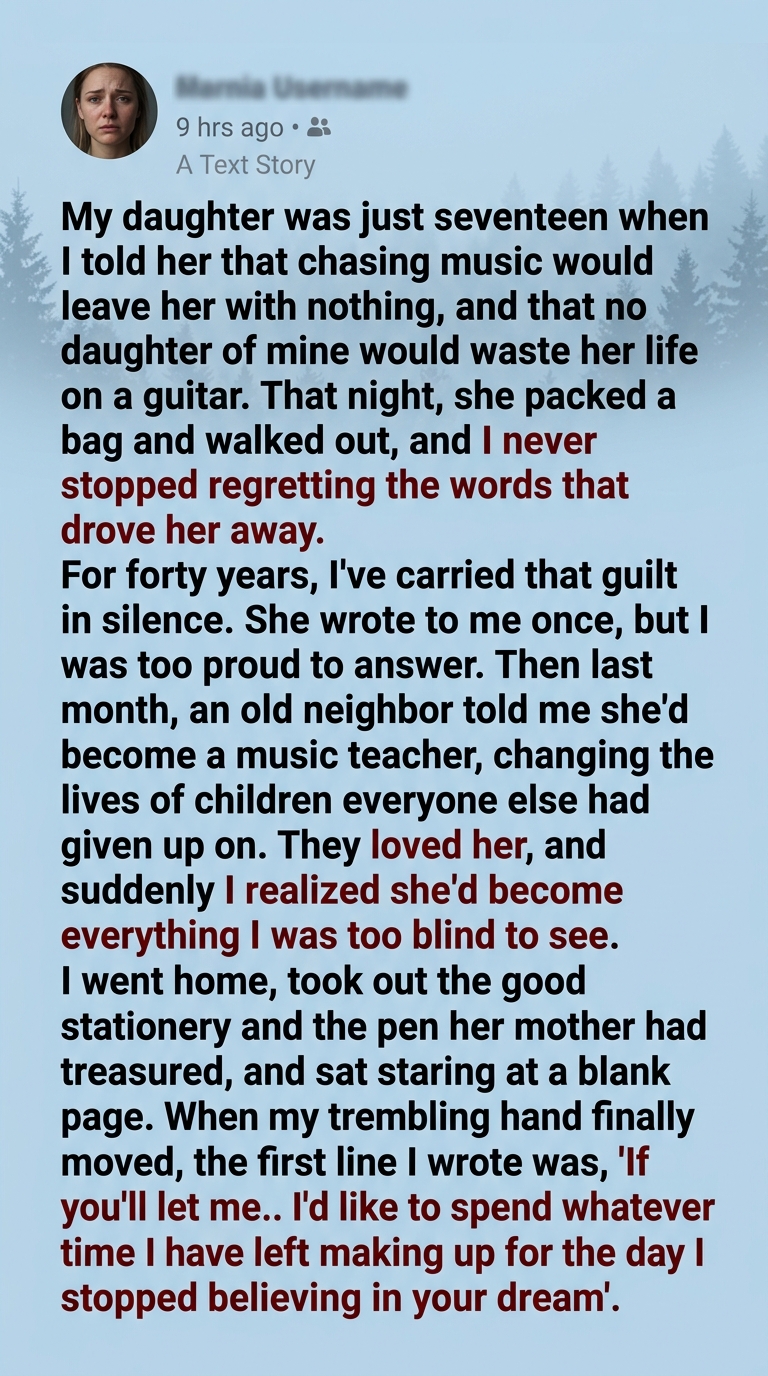
She was seventeen years old when she carried her guitar into the kitchen and announced she’d been accepted into a music conservatory.
“I got in, Dad.”
Her smile filled the room.
“They only accepted twelve students.”
She expected me to be proud.
Instead, I looked at the acceptance letter and thought about overdue bills, worn-out work boots, and the factory where I’d spent thirty years watching people with talent settle for survival.
I wanted safety for her.
What came out sounded like rejection.
“Music won’t feed you.”
She stared at me.
“Dad…”
“No daughter of mine is going to waste her life chasing a guitar.”
She looked toward her mother.
My wife, Helen, quietly whispered,
“Frank…”
But I wasn’t listening anymore.
I kept talking.
About responsibility.
About practical careers.
About reality.
Anna never raised her voice.
She simply nodded.
“I understand.”
Then she walked upstairs.
That evening, she packed one suitcase.
She carried her guitar over one shoulder.
At the front door she paused.
“I wish you believed in me the way Mom does.”
Then she left.
Helen cried after the door closed.
“You didn’t lose an argument.”
She looked at me through tears.
“You pushed away your daughter.”
I told myself Anna would come back in a few days.
She didn’t.
Weeks later, a letter arrived.
Dad,
I’m safe.
I’ve enrolled anyway.
I don’t want us to spend our lives angry.
When you’re ready to believe I can build my own future, you’ll know where to find me.
Love,
Anna
I read that letter a dozen times.
Then folded it.
Put it in a drawer.
And never answered.
Not because I didn’t love her.
Because every day that passed made answering harder.
Pride is a strange thing.
It convinces you that waiting one more day somehow makes the conversation easier.
Instead…
It quietly builds a wall brick by brick.
Years passed.
Helen kept writing to Anna.
They spoke on birthdays and holidays.
I always asked how she was.
I never picked up the phone myself.
Helen never pressured me.
She only said the same thing every Christmas.
“One day you’ll wish you’d made the call.”
She was right.
Helen died before I ever found the courage.
After the funeral, the house became painfully quiet.
I retired.
Neighbors moved away.
Friends passed on.
The drawer containing Anna’s letter remained unopened.
Until last month.
I was buying tomatoes at the farmers market when an old neighbor recognized me.
“Frank?”
It took me a moment to remember George Miller.
We stood talking about old times.
Then he asked,
“Do you still hear from Anna?”
I looked away.
“Not really.”
He smiled.
“I visited my grandson’s school last spring.”
“She teaches there.”
I blinked.
“She became a teacher?”
“The music teacher.”
George laughed.
“You should’ve seen those kids.”
Half of them had been labeled difficult.
Some had learning disabilities.
Others came from homes where nobody expected much from them.
“They absolutely adore her.”
He pulled out his phone.
“Look.”
There was Anna.
Older now.
Gray beginning to appear in her dark hair.
Standing in front of a group of smiling children holding violins and guitars.
“They call her the teacher who never gives up on anyone.”
The words hit me harder than anything I’d heard in years.
Never gives up on anyone.
Except…
The one person who had given up on her had been me.
I drove home in silence.
Opened the drawer I’d avoided for four decades.
Anna’s letter was still there.
The paper had yellowed around the edges.
Then I opened another drawer.
Helen’s fountain pen rested exactly where she’d left it.
She always called it her “good pen.”
The one reserved for important letters.
I carried it to the kitchen table.
Placed a sheet of stationery in front of me.
Then stared at the blank page.
For nearly an hour.
How do you apologize for forty years?
Finally…
My hand began to move.
Dear Anna,
If you’ll let me…
I’d like to spend whatever time I have left making up for the day I stopped believing in your dream.
I wasn’t angry with your music.
I was afraid of poverty.
Afraid of failure.
Afraid the world would hurt you.
Instead…
I became the one who hurt you.
I have replayed that day more times than I can count.
Not because I forgot what I said.
Because I never have.
Your mother always believed you’d find your way.
She was wiser than I was.
George told me about your students.
He said you change lives.
I realized something after he left.
Everything I feared music would take from you…
It actually gave you.
Purpose.
Joy.
The chance to help children feel seen.
I wish I’d celebrated your acceptance letter instead of treating it like a mistake.
You deserved applause.
I gave you doubt.
I’m deeply sorry.
If seeing me again would only reopen old wounds, I will understand.
If all you ever send back is one sentence saying you’ve built a happy life, that will be enough.
But if there is still room somewhere in your heart…
I’d love to hear you play.
Just once.
Love,
Dad
I mailed it before I could change my mind.
The waiting felt endless.
Three weeks later, a plain envelope appeared in my mailbox.
My hands shook so badly I almost couldn’t open it.
Inside was a single page.
Dad,
I kept hoping someday this letter would arrive.
I forgave you years ago.
I was only waiting for you to forgive yourself.
My students are performing next Saturday.
Front row.
Seat three.
If you’re still willing to listen…
I’d love to play for my father.
Love,
Anna
The school auditorium wasn’t large.
Children buzzed with excitement.
Parents filled the seats.
I found seat three in the front row.
A little girl beside me whispered,
“Are you Miss Anna’s dad?”
I nodded.
She grinned.
“She’s the nicest teacher ever.”
The lights dimmed.
Anna walked onto the stage carrying the same old guitar.
Older.
Wiser.
Beautiful in a way that had nothing to do with age.
Before the concert began, she looked into the audience.
Our eyes met.
She smiled.
The same smile she’d worn at seventeen when she’d shown me her acceptance letter.
This time…
I stood and applauded before she played a single note.
When the concert ended, she crossed the stage and hugged me.
Neither of us said anything for a long time.
Some apologies are too large for words.
Some forgiveness is too deep to need them.
On the drive home, I realized something.
Parents spend years believing they must teach their children how to live.
Sometimes…
If we’re humble enough…
Our children spend the rest of our lives teaching us how to love.
And no matter how many years have passed, one heartfelt letter can still become the first note in a brand-new song.