At sixty-four years old, I learned something I never expected.
People stop seeing your experience long before you stop having it.
My name is Margaret Ellis.
For twenty-eight years, I worked at Green Valley Cannery.
I started there at nineteen, standing on a concrete floor for ten hours a day, packing peaches and green beans into steel cans.
By the time I retired, I had worked nearly every position on the production line.
I trained supervisors.
I repaired equipment.
I could tell whether a can had sealed properly just by tapping it with my fingernail.
The younger workers used to joke that I had “magic hands.”
I’d laugh and tell them it wasn’t magic.
“It just takes twenty years of paying attention.”
When my husband, Walter, was alive, retirement felt comfortable.
His pension covered most of our monthly expenses.
My Social Security covered the rest.
Then Walter passed away after a sudden stroke.
Three months later, I learned something I hadn’t fully understood.
His pension ended with him.
Medical bills consumed what little savings we had left.
Each month became a choice between fixing something in the house or buying something we needed.
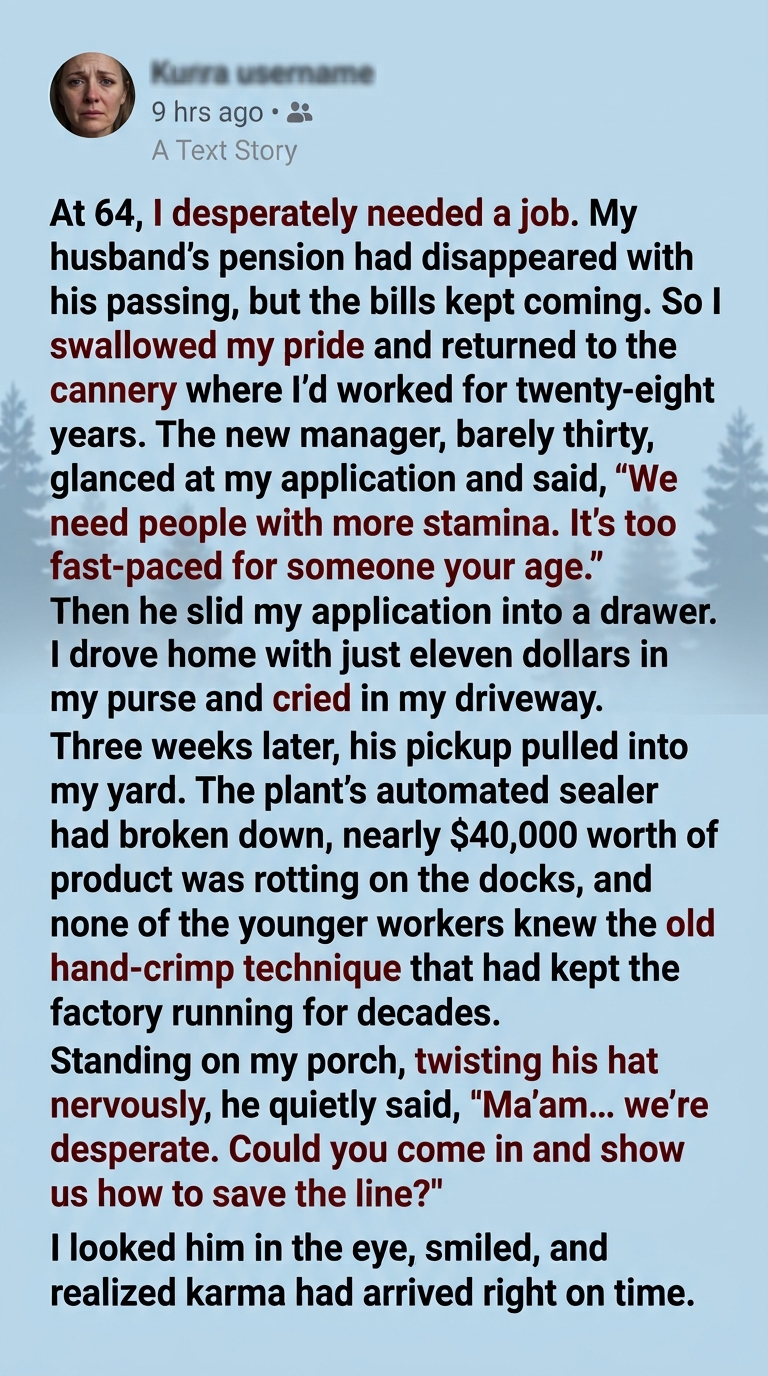
One rainy Tuesday, I opened my purse.
Eleven dollars.
One ten-dollar bill.
One single dollar.
That was all.
I sat at my kitchen table for nearly an hour before making a decision I’d hoped never to make.
I ironed my best blouse.
Printed a résumé.
And drove back to Green Valley Cannery.
The building looked newer than I remembered.
The machines were bigger.
The conveyor belts moved faster.
Digital screens had replaced handwritten production charts.
Only the smell remained the same.
Tomatoes.
Salt.
Steam.
Home.
The receptionist smiled politely.
“I’d like to apply.”
She seemed surprised.
“Certainly.”
Half an hour later, I sat across from the new operations manager.
His name was Kyle Reynolds.
He couldn’t have been older than thirty.
He skimmed through my application.
“Twenty-eight years here?”
“Yes.”
“That’s impressive.”
For one hopeful moment, I thought experience still mattered.
Then his eyes landed on my birthdate.
His smile became awkward.
“I’ll be honest.”
“This job is demanding.”
“It requires stamina.”
He gently slid my application into a drawer.
“I think we’d be doing you a disservice.”
I understood exactly what he meant.
He thought I was too old.
Not because he’d watched me work.
Because he’d looked at a number.
I thanked him anyway.
Walked to my car.
Drove home.
Parked in my driveway.
And cried.
Not because I hadn’t gotten the job.
Because after forty-five years of working without complaint…
Someone had dismissed everything I knew in less than three minutes.
Three weeks later, I heard tires crunching on my gravel driveway.
Kyle climbed out of a dusty pickup truck.
He looked exhausted.
His shirt was stained with grease.
He removed his cap before walking toward my porch.
“Mrs. Ellis?”
“Yes.”
“I owe you an apology.”
I folded my arms.
“What happened?”
“Our automatic double-sealer failed.”
“So?”
“The replacement motor is coming from another state.”
“It won’t arrive until Monday.”
I nodded.
“And?”
“We’ve got nearly forty thousand dollars’ worth of vegetables waiting.”
“If we don’t seal them today…”
“…we throw them away.”
I still wasn’t sure why he was standing on my porch.
Then he looked down at his boots.
“The older maintenance crew told me…”
“…you’re the only person who still knows how to run the manual hand-crimp station.”
I smiled slightly.
“They still have it?”
“In storage.”
“Covered with dust.”
“I was hoping you could…”
He hesitated.
“…teach us.”
For a long moment, neither of us spoke.
This was the same man who had looked at my age and decided I had nothing left to offer.
Now he was standing on my porch asking for the one thing experience had given me.
Knowledge.
I could have refused.
I thought about it.
Then I remembered something Walter used to say.
“Don’t let someone else’s mistake become your character.”
I reached for my jacket.
“Let’s go.”
The factory was in complete chaos.
Pallets of vegetables filled every available space.
Workers rushed from one machine to another.
Several looked relieved when I walked through the door.
An older mechanic named Luis smiled.
“I told them you’d know what to do.”
The manual hand-crimp machine sat exactly where Kyle had said it would.
Covered in years of dust.
Most of the younger workers had never seen it before.
One whispered,
“That thing still works?”
I brushed the dust from the steel handle.
“It works if you know how to listen.”
Kyle frowned.
“Listen?”
“Machines talk.”
He looked confused.
I smiled.
“You’ll understand.”
We cleaned the machine.
Oiled the gears.
Adjusted the pressure arm.
Then I demonstrated.
“You don’t force the handle.”
“You feel the resistance.”
“When it changes…”
“…stop.”
“That’s when the seal is finished.”
The first can came out perfectly.
Then another.
Then another.
Within an hour, five employees were learning.
By lunchtime, fifteen.
By evening, every salvageable can had been sealed.
Instead of losing forty thousand dollars’ worth of product…
The company lost less than two thousand.
Workers cheered.
Someone actually clapped.
Kyle walked over carrying two cups of coffee.
“I’ve never been happier to be wrong.”
I laughed.
“Most people aren’t.”
He looked embarrassed.
“I judged you without ever seeing you work.”
“Yes.”
“I’m sorry.”
I believed him.
The next morning, he called me into his office.
“I’d like to offer you a position.”
I smiled.
“As what?”
“Senior Production Trainer.”
“I don’t need someone to outrun the conveyor.”
“I need someone who can make sure this knowledge doesn’t disappear.”
I accepted.
Not because I needed revenge.
Because I needed groceries.
But I also accepted because I realized something important.
Knowledge hidden in one person’s memory helps no one.
Over the next eighteen months, I trained every new employee.
Not just how to operate machines.
How to notice small problems before they became expensive ones.
How to recognize the sound of a weak seal.
How humidity changed pressure.
How temperature affected storage.
The things no manual ever explained.
One afternoon, a young employee named Ava asked,
“How do you know all this?”
I smiled.
“By making every mistake you’re about to make.”
She laughed.
“So experience is basically surviving enough mistakes?”
“Exactly.”
A year later, the company unveiled a new training room.
On the wall hung a sign that read:
Experience is not old knowledge. It’s knowledge that survived reality.
Kyle insisted my name appear beneath it.
I told him that wasn’t necessary.
He smiled.
“It is.”
“You taught us more than hand-crimping.”
“What else?”
“Never mistake age for inability.”
Today I’m seventy.
I’m finally retired again.
This time because I chose to be.
Sometimes I stop by the cannery just to visit.
The younger workers wave.
Some still ask questions.
Kyle, now a little older himself, always jokes,
“I hope I never forget what you taught me.”
I tell him the same thing every time.
“Don’t remember me.”
“Remember the lesson.”
Because machines will always change.
Technology will always improve.
But no factory…
No company…
No family…
Ever becomes stronger by throwing away the people who remember how to keep everything running when the lights go out.