The first time Emma called me “Daddy,” she immediately covered her mouth.
She looked terrified.
“I’m sorry,” she whispered.
“I didn’t mean to.”
She was five years old.
Her mother, Sarah, and I had been married for only three months.
I smiled.
“You never have to apologize for that.”
She studied my face carefully.
“Really?”
“Really.”
She ran into my arms.
From that day on, she never called me anything else.
People often say blood makes a family.
I disagree.
Family is built in ordinary moments.
Packing lunches.
Helping with math homework.
Teaching someone to ride a bike.
Sitting through piano recitals where they only remember half the notes.
Holding a bucket when the stomach flu arrives at two in the morning.
Listening to middle-school heartbreak over friendships that feel like the end of the world.
That’s where family is built.
Emma’s biological father, Jason, was never completely absent.
He simply appeared whenever it suited him.
Sometimes he’d call every week.
Then disappear for three months.
He’d promise weekends.
Cancel Friday afternoon.
Promise birthday dinners.
Forget.
Each time Emma waited by the window anyway.
Sarah never spoke badly about him.
Neither did I.
When Emma asked why he missed another visit, we’d simply say,
“Sometimes adults make choices that are hard to understand.”
As Emma grew older, she started seeing the pattern herself.
Still…
Whenever Jason reached out, she wanted to believe.
Every child deserves the chance to hope.
By thirteen, Emma spent one weekend each month at Jason’s apartment.
Sometimes the visits went well.
Sometimes she came home unusually quiet.
One Friday evening, while Sarah and I watched television, my phone buzzed.
A text.
Dad… can you come get me?
No explanation.
Just the address.
I immediately stood.
Sarah looked at me.
“What happened?”
“I don’t know.”
“I’ll go.”
The drive took twenty-five minutes.
Jason opened the apartment door looking irritated.
“She’s being dramatic.”
“I’ll talk to her.”
Emma walked out carrying a backpack.
She never looked back.
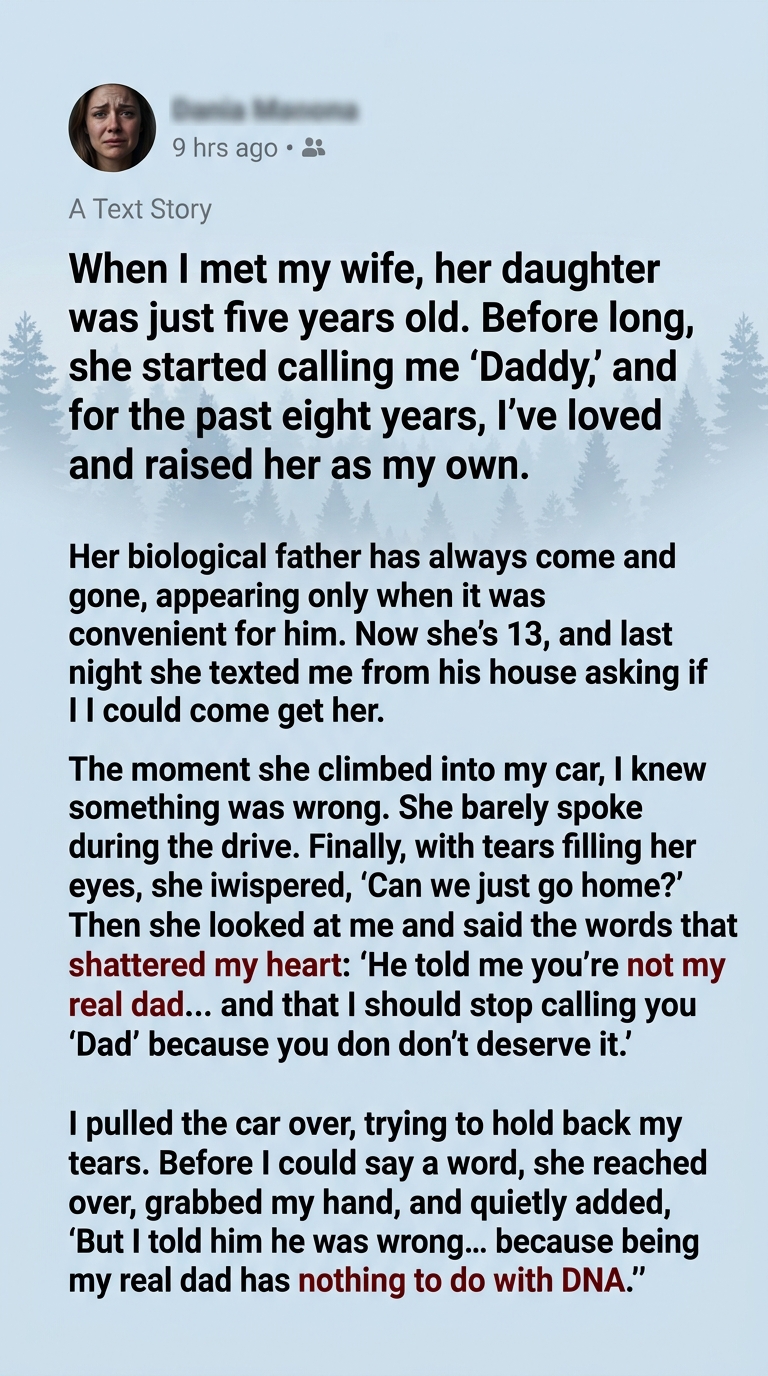
The moment she climbed into the passenger seat, I knew something was wrong.
Usually she’d tell me everything.
School gossip.
Soccer practice.
Funny videos.
Tonight…
Nothing.
We drove almost ten minutes in complete silence.
Finally she whispered,
“Can we just go home?”
“Of course.”
A few more miles passed.
Then tears slowly filled her eyes.
“He said…”
She stopped.
I waited.
“He told me you’re not my real dad.”
My hands tightened on the steering wheel.
“And…”
“…that I should stop calling you ‘Dad’…”
“…because you don’t deserve it.”
I pulled the car onto a quiet side street.
For several seconds I couldn’t speak.
Not because I didn’t know what to say.
Because I was trying very hard not to cry before she finished.
She looked at her hands.
“I didn’t know what to tell him.”
“You don’t have to defend me.”
She shook her head.
“I already did.”
She reached across the console.
Took my hand.
Then quietly said,
“But I told him he was wrong.”
I looked at her.
“Because being my real dad…”
“…has nothing to do with DNA.”
That was it.
The tears I’d been fighting finally came.
I turned away for a moment.
Embarrassed.
She squeezed my hand.
“Don’t cry.”
I laughed weakly.
“I’m trying not to.”
“You always tell me real strength isn’t pretending you don’t have feelings.”
She smiled through her own tears.
“So…”
“…you should probably listen to yourself.”
I laughed again.
She had me there.
When we got home, Sarah wrapped Emma in the longest hug I’d ever seen.
Neither of them spoke for nearly a minute.
Later that night, after Emma had gone to bed, Sarah quietly asked,
“What exactly happened?”
I told her.
She closed her eyes.
“I was afraid this day would come.”
The following afternoon Jason called.
“I need to talk to Emma.”
“I don’t think today is the right day.”
“She needs to understand who her father is.”
I answered carefully.
“She does.”
“And she gets to decide what that word means.”
He became angry.
“You’ve been replacing me.”
“No.”
“You left spaces.”
“I simply showed up.”
Silence.
Then he hung up.
A week later, Emma asked if we could talk.
Just the two of us.
We sat on the back porch watching rain fall across the yard.
“I have a question.”
“Anything.”
“If someone helps make a baby…”
“…does that automatically make them a dad?”
I thought carefully before answering.
“It makes them a biological parent.”
She nodded.
“What’s the difference?”
I took a long breath.
“There are some questions nobody else gets to answer for you.”
“What do you mean?”
“Biology explains how a life begins.”
“But relationships explain how that life grows.”
She looked thoughtful.
“So…”
“…can someone have two dads?”
“I think someone can have two very different relationships.”
She smiled.
“One helped make me.”
“And one helped raise me.”
“I think that’s a fair way to describe it.”
She leaned against my shoulder.
“I don’t want to hurt him.”
“You don’t have to.”
“But I also don’t want to stop calling you Dad.”
“You never have to choose based on making someone else comfortable.”
“You choose the words that honestly describe your heart.”
Several weeks later, Jason asked to meet.
Just him and me.
I almost declined.
Instead, we met at a quiet coffee shop.
He looked tired.
Older than I remembered.
“I handled things badly.”
“Yes.”
“I was jealous.”
I appreciated the honesty.
“I kept thinking…”
“…she loves you more.”
I shook my head.
“This isn’t a competition.”
“It felt like one.”
I stirred my coffee.
“You know what she remembers?”
“What?”
“The science fair where you promised to come.”
He looked down.
“I know.”
“You missed it.”
“I did.”
“The dance recital.”
“I know.”
“The emergency room when she broke her arm.”
He nodded silently.
“I wasn’t there.”
“No.”
“I was.”
I looked directly at him.
“She isn’t choosing between DNA and me.”
“She’s responding to years of who was present.”
His eyes filled with tears.
“I don’t know how to fix that.”
“You don’t fix it with speeches.”
“How?”
“You keep showing up.”
He looked skeptical.
“Will that be enough?”
“I don’t know.”
“But it’s the only place to start.”
Over the next year, something slowly changed.
Jason stopped making promises he couldn’t keep.
If he said he’d come…
He came.
If work interfered…
He called Emma himself instead of disappearing.
He started attending soccer games.
Parent-teacher conferences.
Birthday dinners.
Not perfectly.
But consistently.
One evening after a game, Emma walked between the two of us toward the parking lot.
She suddenly grabbed both our hands.
One in each of hers.
Neither of us expected it.
She smiled.
“You know…”
“…I think families are weird.”
Jason laughed.
“Probably.”
“So stop making them harder than they already are.”
We all laughed.
Even Jason.
Years later, at Emma’s high school graduation, she walked to the podium to give the student address.
Near the end she smiled toward the audience.
“I’ve learned that family isn’t one simple definition.”
She looked at both of us.
“Some people give you life.”
“Others teach you how to live it.”
“When you’re lucky…”
“…you can spend your life being grateful for everyone who truly shows up.”
After the ceremony she hugged Jason first.
Then me.
As she stepped back, she grinned.
“Ready, Dad?”
Jason instinctively answered,
“Which one?”
She laughed.
“The one who’s driving me home.”
Sometimes people think fatherhood is something proven by a birth certificate.
Sometimes they think it’s earned by a title.
Emma taught me something different.
Fatherhood is built in thousands of ordinary days when no one is keeping score.
DNA may explain where a child comes from.
But love, consistency, and presence are often what determine where they feel most at home.
And in the end, no test in the world can measure that.