When our son, Noah, was born, my wife, Emily, announced she wanted to leave her job.
“I want to stay home with him,” she said.
We spent weeks going over our budget.
One income would be tight.
There would be fewer vacations.
Older cars.
No eating out every weekend.
But if that’s what she wanted, we’d make it work.
“I know it’s a sacrifice,” I told her.
She smiled.
“It’ll be worth it.”
For the first few months, everything looked exactly like the picture people post online.
Every evening I’d come home to a clean house.
Dinner simmered on the stove.
Laundry folded.
The baby giggled whenever I walked through the door.
Emily always looked tired…
…but happy.
When coworkers complained about daycare costs, I’d smile.
“We’ve been lucky.”
Emily sent me pictures throughout the day.
Noah finger-painting.
Noah at the park.
Noah napping.
Noah smiling beside homemade sensory toys.
Her messages were always upbeat.
We baked banana muffins today!
Mommy-and-me music class was adorable!
He took a two-hour nap!
Whenever someone said staying home with a baby must be exhausting, Emily laughed.
“It’s honestly easier than people make it sound.”
I believed her.
Why wouldn’t I?
She never complained.
Never asked for help.
Never hinted she was overwhelmed.
Looking back…
That should have worried me.
One Tuesday afternoon, I left work early because a meeting had been canceled.
As I drove home, my phone rang.
The screen showed:
Richard – Emily’s Dad
I answered.
“Hi, Richard.”
There was a pause.
Then he sighed heavily.
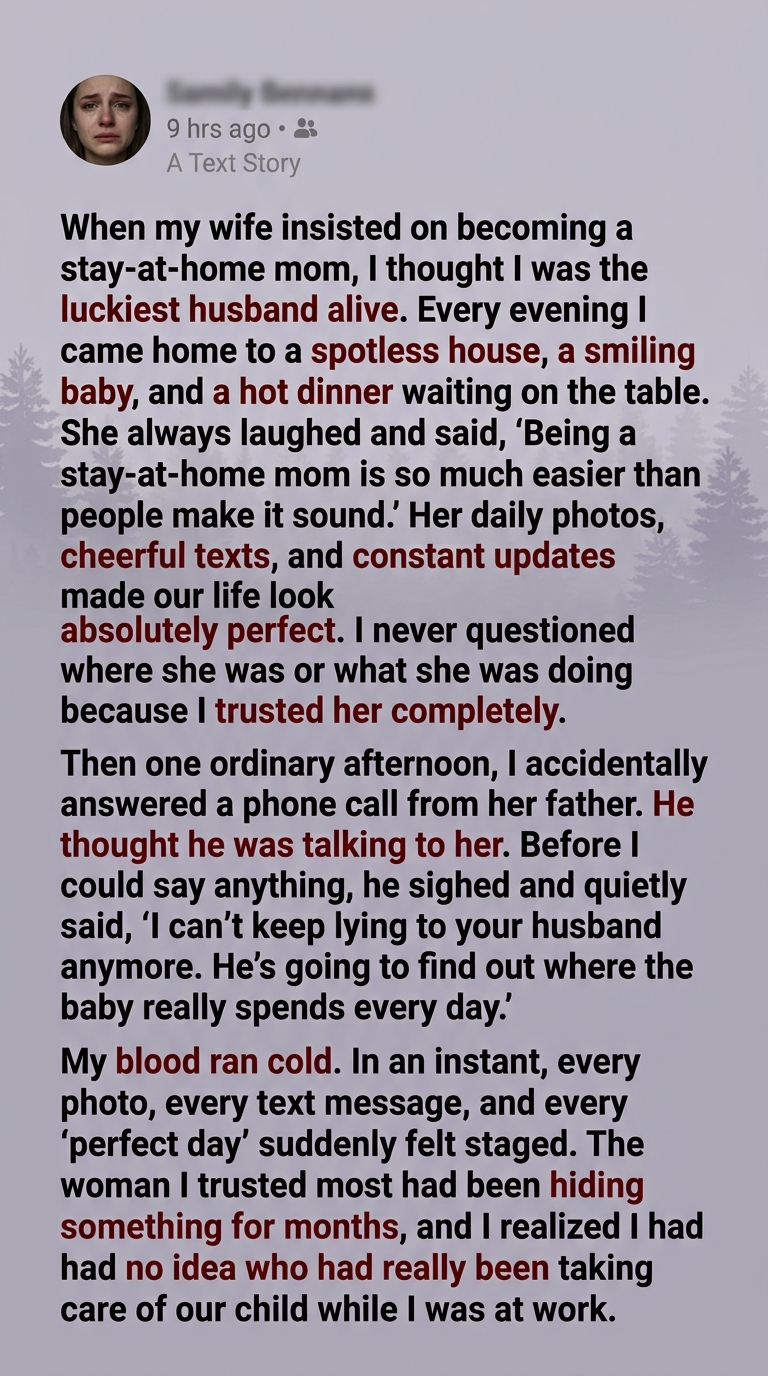
“I can’t keep lying to your husband anymore.”
My hands tightened on the steering wheel.
He thought he was talking to Emily.
Before I could say anything, he continued.
“He’s going to find out where the baby really spends every day.”
My heart stopped.
Every cheerful photo.
Every smiling text.
Every perfect update…
Suddenly felt staged.
I pulled into an empty parking lot.
“Richard…”
He froze.
“…this is Daniel.”
Silence.
A very long silence.
Finally he whispered,
“Oh…”
Then quietly,
“I suppose it’s time.”
I drove straight to his house.
He was waiting on the porch.
He looked like a man who hadn’t slept in days.
“I’m sorry.”
“Start talking.”
He nodded.
“But please…”
“…hear everything.”
We sat in his kitchen.
He folded his hands together.
“Emily isn’t having an affair.”
“I didn’t ask if she was.”
“I know.”
“But I figured that’s where your mind went.”
He wasn’t wrong.
“So where is Noah every day?”
He took a deep breath.
“Here.”
I stared.
“Here?”
He nodded.
“With me.”
I frowned.
“I don’t understand.”
“Emily drops him off every morning around eight.”
“And picks him up around four.”
The room spun.
“She’s not staying home with him?”
“Not all day.”
“Then where is she?”
Richard looked ashamed.
“Sleeping.”
I blinked.
“What?”
“She comes here after dropping Noah off.”
“She sleeps for several hours.”
“Then showers.”
“Cleans your house.”
“Makes dinner.”
“Picks Noah up.”
None of it made sense.
“Why would she do that?”
His eyes filled with tears.
“Because she thinks she’s failing.”
An hour later, Emily walked through the front door carrying Noah.
She froze when she saw my car.
Then she saw me sitting at her father’s table.
She immediately understood.
The color drained from her face.
“I’m sorry.”
She hadn’t even asked what he’d told me.
She already knew.
We drove home mostly in silence.
After Noah fell asleep, we sat together on the living room couch.
For almost ten minutes neither of us spoke.
Finally she whispered,
“I don’t know how to explain this.”
“Start at the beginning.”
She nodded.
“The beginning…”
“…was about three weeks after Noah was born.”
She described nights when Noah woke every ninety minutes.
Days when she forgot whether she’d brushed her teeth.
Afternoons when she’d stand in the kitchen crying because she couldn’t remember why she’d walked in there.
“I thought every mom handled it better than I did.”
“You never told me.”
“I tried.”
“When?”
She looked at me.
“The day I said maybe we should look at daycare.”
I searched my memory.
Then remembered.
I’d laughed gently.
“I thought you loved staying home.”
“I thought I was encouraging you.”
“You were.”
“But what I heard was…”
“…’You wanted this. Figure it out.'”
My stomach sank.
“I never meant that.”
“I know.”
“But that’s how it felt.”
She explained that one afternoon she’d nearly fallen asleep while holding Noah.
Terrified, she’d called her father.
He came immediately.
The next day he offered to watch Noah for a few hours so she could rest.
Those few hours became every weekday.
“I kept telling myself I’d only do it for one more week.”
“But every week I was still exhausted.”
“So why pretend?”
She wiped away tears.
“Because everyone kept saying I looked like I had motherhood figured out.”
“I didn’t.”
“I was barely surviving.”
“The photos?”
“I took several at once.”
“The park pictures?”
“Dad took Noah.”
“The music class?”
“That happened once.”
“I just kept posting pictures from that day.”
Every image wasn’t fake.
They just weren’t current.
They created a life that no longer existed.
“I felt trapped by my own pretending.”
I quietly asked,
“Was Noah safe?”
She looked shocked.
“Always.”
“Dad adores him.”
Richard had spent forty years as an elementary school principal before retiring.
Noah hadn’t been neglected.
He’d been loved.
Just not by the person I believed was caring for him every day.
“I should’ve told you.”
“Yes.”
“I know.”
“But I was so ashamed.”
“A stay-at-home mom who couldn’t handle staying home.”
I reached for her hand.
“You weren’t failing.”
“You were drowning.”
She started crying harder.
“The internet made it look easy.”
“I thought everyone else managed.”
“No one admits when they’re struggling.”
The following week, we met with a therapist together.
During our first session, the therapist asked Emily one simple question.
“When was the last time you slept through the night?”
Emily thought.
Then laughed sadly.
“I honestly don’t remember.”
The therapist nodded.
“Sleep deprivation can affect mood, memory, judgment, and emotional resilience.”
Emily wasn’t lazy.
She wasn’t avoiding motherhood.
She was profoundly exhausted and carrying the crushing belief that asking for help meant she had failed.
The therapist also looked at me.
“What messages did you hear about stay-at-home parenting?”
I answered honestly.
“That it’s hard.”
“But Emily kept telling me it wasn’t.”
The therapist smiled gently.
“And because you trusted her…”
“…you believed her.”
Exactly.
Neither of us had intended to hurt the other.
We’d simply stopped telling each other the truth.
Within two months, everything changed.
Emily stopped pretending.
We enrolled Noah in daycare three mornings each week.
Emily started working part-time from home doing freelance graphic design, something she’d always enjoyed.
Richard still babysat one afternoon each week—not because he had to, but because he loved spending time with his grandson.
Our evenings changed too.
Dinner wasn’t always homemade.
Sometimes it was frozen pizza.
Sometimes the laundry waited until Saturday.
Sometimes the house was messy.
Oddly enough…
We were happier.
One evening I came home to toys scattered across the living room.
Emily sat on the floor wearing sweatpants, laughing while Noah stacked blocks that kept falling over.
She looked up.
“I’m ordering takeout.”
I smiled.
“Sounds perfect.”
“No clean house.”
“I noticed.”
“No homemade dinner.”
“I’ll survive.”
She laughed.
“I only managed one load of laundry.”
I kissed her forehead.
“You know what I managed today?”
“What?”
“I stopped believing we have to look perfect to be a good family.”
Years later, we still joke about the “museum house” phase of our marriage.
The phase where everything looked flawless in pictures while both of us quietly carried burdens we were too afraid to name.
The biggest lesson wasn’t that Emily accepted help from her father.
It was that she believed she had to hide it.
Families aren’t strongest when one person silently carries everything.
They’re strongest when everyone is honest about what they can—and cannot—carry alone.
Because perfection is exhausting.
But honesty gives people the chance to help.
And help, when accepted without shame, is often what allows a family to truly thrive.