My grandmother had always believed the best about people.
Even when they didn’t deserve it.
At eighty-seven, arthritis had slowed her down, and she sometimes forgot where she’d put her reading glasses, but she never forgot birthdays, never missed sending handwritten cards, and never ended a phone call without saying, “Take care of each other.”
She’d been widowed for nearly twenty years.
After my grandfather died, our blended family slowly drifted into separate circles.
My step-siblings—children from my late stepfather’s first marriage—visited Grandma only a handful of times each year.
She never complained.
She was simply happy whenever anyone remembered her.
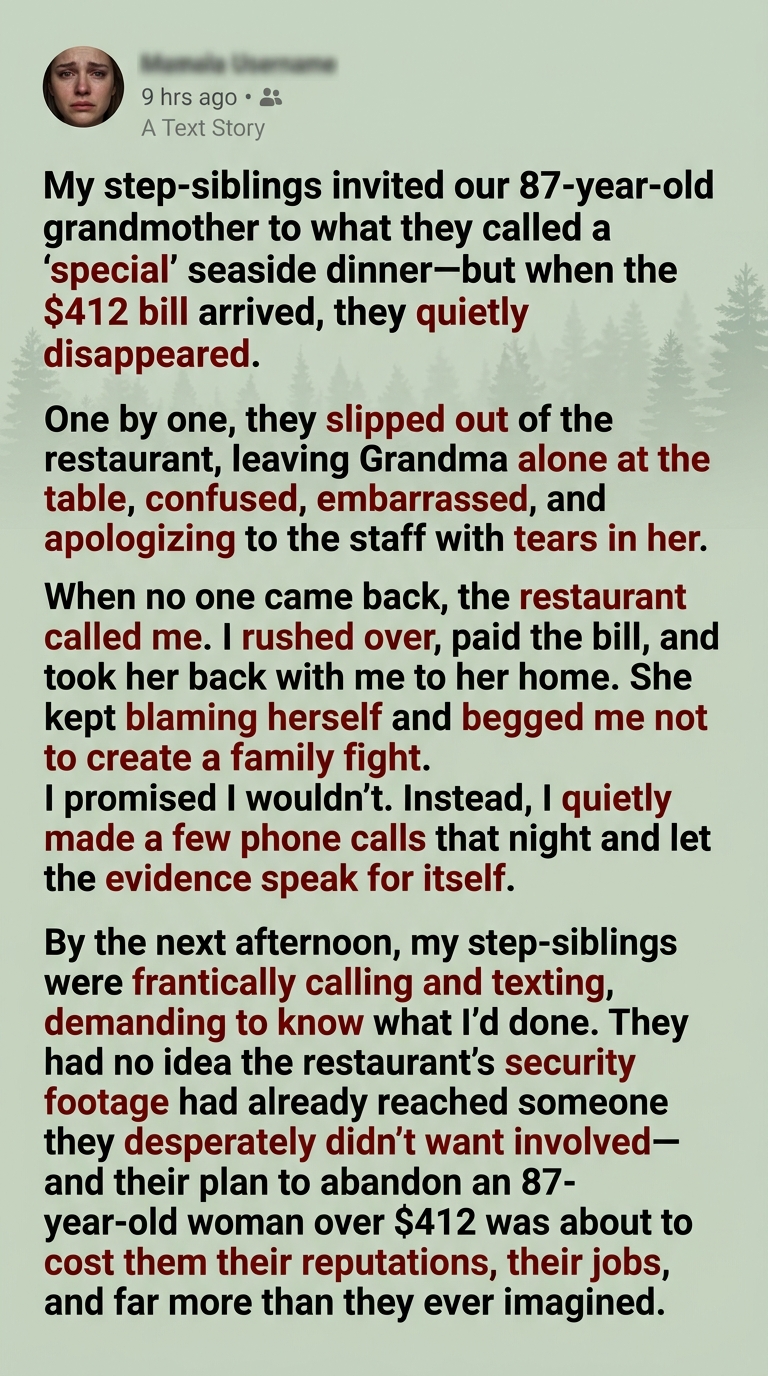
So when they called to invite her to what they described as a “special family dinner” at a seafood restaurant overlooking the water, she was thrilled.
She spent two days deciding what to wear.
She even asked me whether pearl earrings were “too fancy.”
“They’re perfect,” I told her.
She smiled like a teenager getting ready for her first date.
“I just want everyone to have a nice evening.”
Around nine o’clock that night, my phone rang.
The caller ID showed the restaurant.
At first I assumed Grandma had forgotten her purse.
Instead, the manager spoke gently.
“Are you related to Mrs. Evelyn Carter?”
“Yes.”
“Is she okay?”
There was a pause.
“I’m afraid she’s here alone.”
My stomach tightened.
“What do you mean?”
“Her family appears to have left.”
I didn’t understand.
“They went to the restroom one at a time.”
“No one came back.”
I was already grabbing my keys.
“I’ll be there in fifteen minutes.”
When I arrived, I found Grandma sitting exactly where they’d left her.
The restaurant had nearly emptied.
The untouched dessert menu still rested beside her plate.
She clutched her purse with both hands.
The moment she saw me, she tried to smile.
“I’m so sorry.”
The apology broke my heart.
“For what?”
“They must have forgotten.”
I looked around the room.
“They didn’t forget.”
She lowered her eyes.
“The waitress has been so patient.”
“I kept telling her they’d be back.”
The manager quietly handed me the bill.
$412.18
I paid it without another word.
As we walked toward the car, Grandma reached into her purse.
“I can give you part of it.”
“You don’t owe me anything.”
“I should’ve offered sooner.”
I stopped beside the passenger door.
“You didn’t do anything wrong.”
Tears filled her eyes.
“They’re family.”
“They wouldn’t…”
She couldn’t finish the sentence.
On the drive home she asked only one thing.
“Please don’t start a fight.”
“I don’t want everyone arguing because of me.”
I looked over at her.
“I promise I won’t.”
And I meant it.
I had no interest in screaming matches or dramatic social-media posts.
The truth didn’t need help.
After making sure Grandma was settled in for the night, I called the restaurant manager.
“I’d like copies of the receipt and any written incident report.”
“We can provide those.”
“I’d also like to know whether your cameras captured what happened.”
“They did.”
“I can’t release footage directly to you without authorization.”
“I understand.”
“Would you be willing to preserve it if someone formally requested it?”
“Absolutely.”
The next morning, I made three phone calls.
The first was to Grandma’s attorney.
The second was to the executor listed in her estate planning documents.
The third was to the family mediator who had helped organize legal paperwork after my stepfather passed away several years earlier.
I didn’t ask anyone to punish my step-siblings.
I simply documented exactly what had happened.
The restaurant manager agreed to provide statements if needed, and the footage was preserved in case any facts were later disputed.
By lunchtime, word had reached my stepfather’s older brother, Richard.
He had long been regarded as the unofficial peacemaker of that side of the family.
He asked only one question.
“Is there proof?”
“There is.”
He requested the restaurant’s written account through the proper channels.
That afternoon, he met with the manager in person.
The security video showed the evening exactly as the staff had described it.
My step-siblings left separately over the course of several minutes.
No one spoke to the staff.
No one returned.
Grandma remained seated, glancing toward the hallway each time the restaurant door opened.
She waited nearly forty minutes before the manager approached her.
Richard called me that evening.
“I’ve seen enough.”
“What are you going to do?”
“I’m going to tell the truth.”
He kept his word.
The following day, he invited the entire extended family to a scheduled family meeting that had originally been planned to discuss holiday arrangements.
Instead of rumors, he brought documentation.
The receipt.
The manager’s written statement.
The timeline.
He calmly explained what had happened.
Then he played the security footage.
No accusations.
No raised voices.
Just facts.
When the video ended, the room stayed silent.
One of my step-siblings finally spoke.
“It was supposed to be a joke.”
Richard looked at them steadily.
“Explain the joke.”
No one answered.
Another quietly admitted they assumed someone else would eventually pay.
Richard asked another question.
“Which one of you planned to tell an eighty-seven-year-old woman she had been left behind?”
Again…
Silence.
News of the incident spread quickly—not because anyone posted it online, but because several relatives who had previously trusted my step-siblings with volunteer leadership roles in family organizations stepped back and questioned their judgment.
One worked for a community nonprofit that emphasized care for older adults. After learning what had happened through the family’s internal discussions, the organization’s board reviewed whether the incident conflicted with its code of conduct. Following its own procedures, it placed that person on leave while it completed its review.
Another had been organizing fundraising events for a local senior center. The center decided to appoint a different volunteer while it evaluated the situation.
None of those decisions happened because I demanded punishment.
They happened because people who had responsibilities involving older adults wanted to understand whether the behavior reflected the standards expected in those roles.
A week later, every one of my step-siblings came to Grandma’s house.
They stood quietly on the porch.
Grandma invited them inside before I could say anything.
The oldest spoke first.
“We’re sorry.”
She looked at them for a long time.
“I believe you’re sorry.”
Then she surprised all of us.
“But I don’t think you’re sorry because of the bill.”
“I think you’re sorry because everyone else found out.”
No one argued.
Because she was right.
One of them finally admitted the truth.
The expensive dinner had been their idea.
They assumed Grandma—or another relative—would cover the bill, just as she had quietly paid for family meals many times over the years.
When she didn’t reach for her purse immediately, they panicked.
Instead of admitting they couldn’t afford the evening they had planned…
…they walked away.
Grandma listened without interrupting.
When they finished, she folded her hands in her lap.
“I could have forgiven a mistake.”
“I’ve made plenty myself.”
“What hurt wasn’t the money.”
She looked at each of them.
“It was sitting there believing the people I loved had simply forgotten me.”
Every eye in the room filled with tears.
She accepted their apology.
But she also made one request.
“If you ever make another mistake…”
“…face it.”
“Don’t leave someone else carrying it.”
Years later, our family still talks about that dinner.
Not because of the $412.
Not because of embarrassment.
But because one quiet evening reminded all of us that character isn’t measured by how generously someone spends when things are easy.
It’s measured by what they do when they’re afraid, ashamed, or tempted to let someone else pay the price for their choices.
And my grandmother, at eighty-seven years old, taught every one of us that dignity is something worth protecting—even when the person who needs protecting is too kind to ask for it herself.