When my daughter, Claire, was six years old, she handed me a penny she’d found on the sidewalk.
“Put it with my college money,” she said proudly.
I smiled and slipped it into an old coffee tin that already held a few dollars in loose bills and coins.
She had no idea that I’d started saving for her the day she was born.
Back then, I was a twenty-four-year-old widow working two jobs.
Her father had died in a highway accident before Claire turned one.
There was no life insurance worth mentioning.
No wealthy relatives.
No inheritance.
Just me.
Every extra dollar I could spare went into savings.
Sometimes it was five dollars.
Sometimes twenty.
One Christmas, it was only seventy-five cents.
I never skipped adding something.
Over thirty years, the coffee tin became a savings account.
The savings account became a certificate of deposit.
Those matured into new investments.
Whenever one reached maturity, I’d roll it over into another account.
I wasn’t trying to become wealthy.
I was trying to build security for the child I loved more than myself.
Claire grew up wanting for very little.
Not because we had money.
Because I quietly went without.
I wore the same winter coat for twelve years.
Drove a car until it had over three hundred thousand miles.
Skipped vacations.
Worked overtime.
Packed my lunch almost every day.
When friends asked why I never spent money on myself, I’d smile.
“I already am.”
I just didn’t explain what I meant.
As Claire got older, our relationship slowly changed.
College.
Career.
New friends.
A different lifestyle.
She began earning more in her twenties than I ever had.
I was proud of her.
But somewhere along the way…
She also became embarrassed by how simple my life remained.
She’d gently tease my old phone.
My thrift-store sweaters.
The little house I’d never remodeled.
“It wouldn’t hurt to enjoy life a little, Mom.”
I always smiled.
“I already do.”
She thought I meant gardening.
Or reading library books.
She never knew the greatest joy of my life was watching that account continue to grow.
When she got engaged, I was genuinely happy.
Her fiancé, Ethan, came from a wealthy family.
His parents paid for an elegant wedding at a country club.
More than two hundred guests attended.
Crystal chandeliers reflected across polished marble floors.
Fresh flowers covered nearly every table.
It was beautiful.
At the reception, people lined up to present gifts.
Designer luggage.
Expensive artwork.
Vacation packages.
Checks in embossed envelopes.
I waited until near the end.
From my purse, I carefully removed an old blue savings passbook.
I knew it looked ordinary.
Its corners were worn from decades of careful handling.
I placed it in Claire’s hands.
“For your future.”
She glanced at the cover.
Her smile barely lasted a second.
“A passbook?”
“It’s something I’ve been keeping for you.”
Before I could say another word, she laughed awkwardly.
“Oh, Mom…”
She turned toward Ethan.
“She’s always so sentimental.”
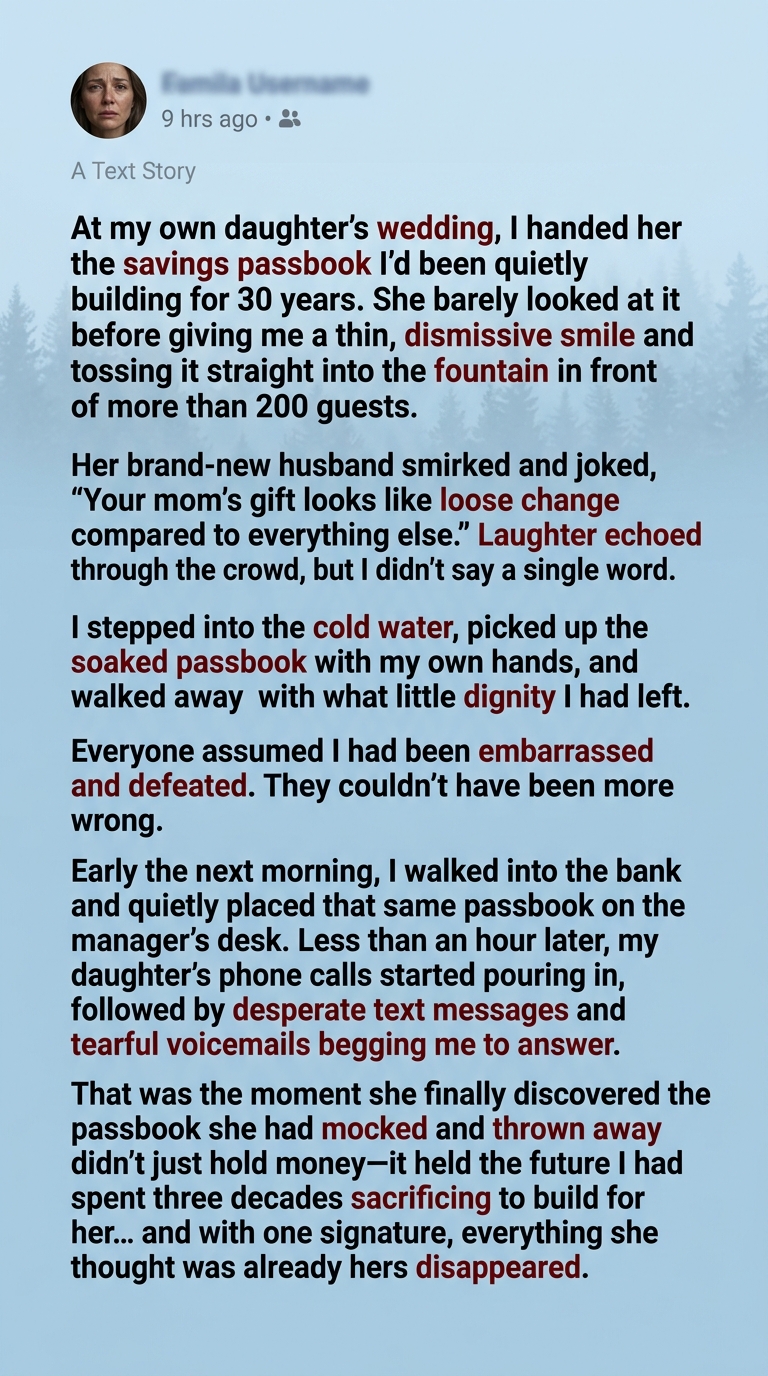
Then, with one careless motion, she tossed it toward the decorative fountain beside the dance floor.
It landed with a splash.
Several guests gasped.
Ethan chuckled.
“Your mom’s gift looks like loose change compared to everything else.”
A few nervous laughs echoed through the room.
No one meant cruelty.
But no one stopped it either.
I stood completely still.
Then quietly walked to the fountain.
The water was cold.
I stepped in anyway.
I picked up the soaked passbook.
Pressed it gently between both hands.
Looked once at my daughter.
She avoided my eyes.
Without saying a single word…
I left.
I cried all the way home.
Not because of the money.
Because somewhere along the journey from six years old to thirty-six…
My little girl had forgotten who had walked every mile beside her.
The next morning, I visited my bank.
The branch manager, Mr. Alvarez, had known me for years.
He smiled warmly.
“Big wedding yesterday?”
“It was.”
I placed the damp passbook on his desk.
“I’d like to close the account.”
He looked surprised.
“Are you certain?”
I nodded.
“I am.”
He reviewed the records carefully.
Thirty years of deposits.
Interest.
Renewals.
Everything was in order.
“This account is payable to you.”
“Yes.”
“I’d like the balance transferred into a charitable trust.”
He paused.
“For what purpose?”
“I’d like to establish a scholarship.”
He smiled softly.
“What should we call it?”
I thought for only a moment.
“The Second Chance Scholarship.”
“Who will it help?”
“Single parents returning to school.”
His eyes brightened.
“That’s a wonderful idea.”
The paperwork took nearly forty minutes.
When I signed the final page…
The account ceased to exist.
Not because it vanished.
Because it had become something new.
About thirty minutes later, my phone rang.
Claire.
I let it ring.
Then again.
And again.
Voicemails followed.
“Mom…”
“I didn’t know.”
Then texts.
Please call me.
I’m so sorry.
The bank called because I tried to ask about the account.
Please don’t do this.
Apparently, after the wedding, Ethan had finally opened the soaked passbook.
Inside were handwritten balance updates spanning decades.
He’d called the bank that morning expecting to learn how to access the funds after the marriage.
Instead, he was informed that the account belonged solely to me and that I had already given new instructions.
No confidential financial details were shared with him.
Only that the account was no longer available to anyone else.
Claire came to my house that evening.
She stood on the porch crying.
“I didn’t know.”
“I know.”
“I thought…”
“I know.”
She looked down.
“I thought it was symbolic.”
“It was.”
“But it was also thirty years of love.”
She broke completely.
“I’m ashamed.”
I invited her inside.
We sat at the kitchen table where she’d once done homework every afternoon.
She noticed the old coffee tin sitting on the shelf.
“The penny…”
I smiled sadly.
“You remember.”
“You kept it?”
“I kept everything.”
She cried harder.
“I’ve spent my whole life believing you never had much.”
“I didn’t.”
“I simply chose to spend what I had differently.”
She looked around the small kitchen.
“You gave up everything.”
“No.”
“I invested it.”
“In you.”
Silence filled the room.
Finally she asked the question she’d come to ask.
“Is there any way to undo what you did?”
I answered honestly.
“The scholarship has already been established.”
She nodded slowly.
“I understand.”
She stood to leave.
Then stopped.
“I don’t deserve any of it.”
I looked at her.
“Yesterday…”
“No.”
“But tomorrow is another chance.”
Over the following months, something changed.
Not overnight.
Trust rarely heals that quickly.
Claire began visiting every Sunday.
Not because she wanted money.
Because she wanted time.
She started asking about stories she’d never cared to hear before.
How I’d worked night shifts.
Why I’d never remarried.
What her father had been like.
One afternoon she quietly said,
“I used to think love was measured by expensive gifts.”
She smiled through tears.
“Now I know it’s measured by invisible sacrifices.”
Three years later, the scholarship held its first awards ceremony.
Five single parents received grants to finish nursing school, teaching degrees, and technical certifications.
Claire attended every ceremony.
She volunteered to help review applications.
At the first event, she asked if she could say a few words.
Standing before the audience, she held up the old blue passbook, now dried and preserved inside a clear display case.
“This isn’t here because of the money that was once inside it.”
She took a steadying breath.
“It’s here because I once judged a lifetime of sacrifice by its appearance.”
She looked toward me.
“My mother taught me the most expensive lesson of my life.”
“Some gifts stop belonging to us the moment we treat them like we’re entitled to them.”
Afterward, she hugged me longer than she had in years.
“I’m still sorry.”
“I know.”
“I probably always will be.”
“You don’t have to spend your life proving you’re sorry.”
“What should I do instead?”
I smiled.
“Spend your life becoming someone who would never make another person feel that small.”
She nodded.
“I can do that.”
The passbook never became part of Claire’s inheritance.
Instead, it became something much larger.
Every year another family found hope because one mother chose compassion over revenge.
I could have kept the money.
I could have used it to teach my daughter a lesson through loss alone.
Instead, I chose to let my disappointment become an opportunity for others.
Because money eventually runs out.
But a lesson learned with humility—and a kindness passed from one generation to the next—can keep changing lives long after the balance reaches zero.