If you’d asked anyone in Chicago who the successful daughter in our family was, they would have answered without hesitation.
My older sister, Victoria.
Chief of surgery at one of the city’s most prestigious hospitals.
Board member.
Magazine covers.
Television interviews.
Awards lining the walls of her office.
Then there was me.
Elena.
The daughter my parents described with polite smiles and vague answers.
“She keeps busy.”
“She’s… independent.”
“We’re very proud of both girls.”
They always said the last sentence with just enough hesitation that people understood it wasn’t entirely true.
For twenty-five years, I had quietly become the family’s disappointment.
Not because I had failed.
Because I had chosen a different life.
After graduate school, I left corporate law and began working in nonprofit healthcare development.
The salary was modest.
The work was exhausting.
Most people had never heard my name.
I liked it that way.
My parents didn’t.
“You had every opportunity,” my father often said.
“And you threw it away.”
Victoria agreed.
“You could have been somebody.”
I usually smiled.
“I already am.”
They mistook contentment for lack of ambition.
I stopped trying to correct them years ago.
One October evening, our family attended the annual Hope for Tomorrow Children’s Health Gala at Chicago’s historic Blackstone Hotel.
Crystal chandeliers sparkled above more than four hundred guests.
Surgeons.
Researchers.
Business leaders.
Philanthropists.
Journalists.
The evening’s guest of honor was Dr. Michael Harris, an internationally respected pediatric cardiac surgeon whose foundation had funded children’s hospitals across the country.
Television crews followed him everywhere.
My parents could hardly contain their excitement.
Victoria had spent weeks telling everyone she expected to join the foundation’s national advisory board.
“This could change everything,” she whispered proudly.
I was genuinely happy for her.
At least…
I wanted to be.
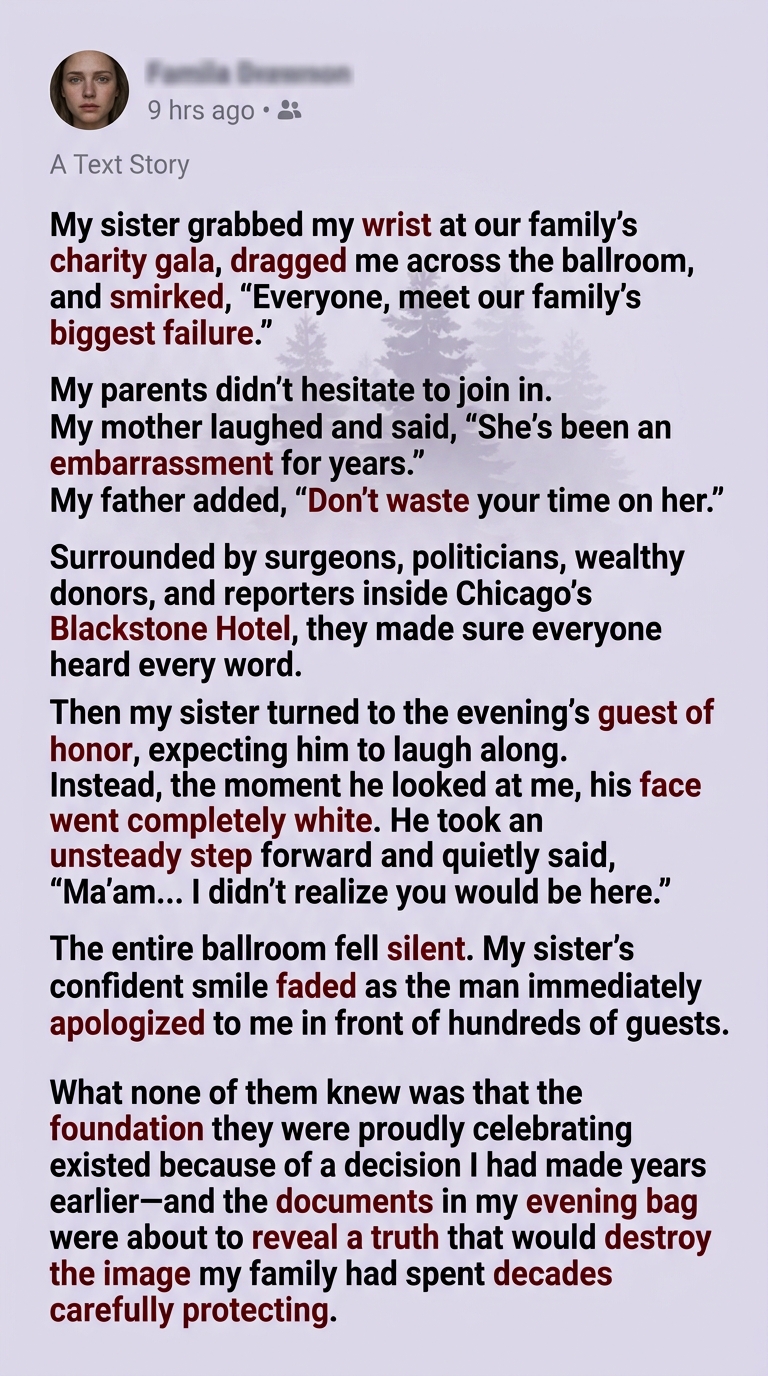
I had barely finished greeting an old colleague when I felt someone seize my wrist.
Victoria.
“There you are.”
Before I could respond, she pulled me across the ballroom.
“What are you doing?”
“Fixing something.”
She stopped beside one of the largest donor tables.
Nearly twenty people turned toward us.
Reporters raised cameras.
Victoria smiled broadly.
“Everyone…”
“I’d like you to meet our family’s biggest failure.”
Laughter rippled uncertainly through the table.
People assumed it was a joke.
It wasn’t.
My mother joined immediately.
“She’s been embarrassing us for years.”
Dad chuckled.
“Don’t waste your networking time on her.”
The room became painfully quiet.
Someone looked away.
Another guest suddenly became very interested in their wine glass.
No one wanted to participate.
But no one interrupted either.
Victoria folded her arms.
“So…”
“Tell everyone what you’ve accomplished.”
I answered honestly.
“I help nonprofit hospitals secure funding.”
She laughed.
“See?”
“I told you.”
“She gave up a real career.”
Then she noticed movement behind me.
Dr. Michael Harris had approached the table.
Victoria beamed.
“Doctor!”
She extended her hand enthusiastically.
“We’re honored to finally meet you.”
He nodded politely.
Then his eyes moved past her.
To me.
His expression changed instantly.
The color drained from his face.
He took one slow step forward.
Then another.
Finally he spoke so quietly the entire ballroom leaned in to hear.
“Ma’am…”
“I didn’t realize you would be here.”
Every conversation stopped.
Victoria frowned.
“I’m sorry…”
“Have you two met?”
He didn’t answer her.
Instead, he looked directly at me.
“I owe you an apology.”
“For what?”
“I should have confirmed whether you were attending before accepting tonight’s recognition.”
I smiled gently.
“There was no need.”
“There absolutely was.”
The ballroom had become completely silent.
Dr. Harris turned toward the audience.
“I think many people here are missing some important history.”
Victoria laughed nervously.
“I think there’s been some misunderstanding.”
“There has.”
“But not the one you think.”
He looked back at me.
“Would you allow me?”
I nodded.
“Please.”
He walked to the podium.
“Ladies and gentlemen…”
“I’ve accepted many awards.”
“But none of them would exist without someone who never wanted her name attached to any of them.”
People exchanged confused looks.
He continued.
“Twelve years ago…”
“Our pediatric heart program was nearly bankrupt.”
“We had exhausted every grant.”
“Construction had stopped.”
“We were weeks away from closing.”
I remembered those meetings.
The spreadsheets.
The impossible numbers.
The desperate phone calls.
He smiled.
“Then one person walked into my office.”
“She didn’t ask for recognition.”
“She didn’t ask for a board seat.”
“She simply asked one question.”
He looked toward me.
“‘How much would it take to keep treating children?'”
Several guests slowly turned in my direction.
“The answer was twenty-two million dollars.”
A collective gasp spread through the ballroom.
Victoria whispered,
“What?”
Dr. Harris continued.
“She told us she knew someone who might help.”
He paused.
“The next month…”
“…anonymous funding arrived.”
“The hospital survived.”
“The foundation everyone is celebrating tonight was built from that rescue.”
My father frowned.
“Anonymous?”
Dr. Harris nodded.
“For twelve years.”
“By contractual requirement.”
“Only three people knew the donor’s identity.”
He smiled sadly.
“Tonight…”
“…that confidentiality period expires.”
He looked directly at me.
“I’m sorry.”
“I know you never wanted public attention.”
I quietly stood.
“It isn’t about attention.”
“I know.”
“But people should know the truth.”
I opened my evening bag.
Inside was a thick folder.
Not dramatic evidence.
Not scandal.
Just documents.
The original donor agreement.
Board resolutions.
Letters.
Signed acknowledgments.
Every page confirmed the same thing.
Years earlier, after selling the healthcare software company I had quietly helped build with two partners, I established a charitable trust dedicated to children’s cardiac care.
The trust required complete anonymity.
No buildings.
No plaques.
No interviews.
Only measurable outcomes.
More than six thousand children had received treatment because of those funds.
Dr. Harris carefully held up one document.
“The donor listed here…”
“…is Ms. Elena Whitmore.”
Silence.
Absolute silence.
Victoria stared at me.
“No…”
Mom shook her head.
“That’s impossible.”
Dad whispered,
“You never had that kind of money.”
I smiled softly.
“You never asked.”
Years earlier, while my family celebrated Victoria’s promotions, I had quietly negotiated the sale of my company.
I had chosen privacy over publicity.
My parents assumed modest clothing meant modest success.
They never imagined someone could become financially secure without constantly talking about it.
One reporter cautiously raised a hand.
“May I ask why you remained anonymous?”
I answered honestly.
“Because children deserve medical care whether or not anyone applauds the person paying for it.”
The room erupted into applause.
Not for me.
For the thousands of children whose lives had been changed.
That mattered far more.
Victoria slowly approached.
“I…”
She stopped.
For perhaps the first time in her life…
She had no prepared speech.
“I’m sorry.”
I believed she meant it.
But I also knew apologies are beginnings.
Not endings.
Later that evening, my mother found me standing alone on the terrace overlooking Grant Park.
“We were wrong.”
“Yes.”
“We thought you had wasted your life.”
I looked out at the city lights.
“No.”
“You decided my life was a failure because it didn’t look like yours.”
She quietly cried.
“I don’t know how to fix this.”
I thought about that for a long moment.
“You don’t fix thirty years with one apology.”
“You rebuild them.”
“One honest conversation at a time.”
Over the following years, our family slowly changed.
Not perfectly.
People rarely do.
Victoria eventually joined the foundation’s advisory board.
Not because she was my sister.
Because she became one of its hardest-working volunteers.
My parents began attending scholarship ceremonies instead of society galas.
They met children whose surgeries had been funded by gifts they never knew existed.
One little girl, eight years old, handed my father a drawing of a heart with angel wings.
“Thank you for helping people like me.”
He cried harder than I had ever seen.
Driving home that night, he finally admitted something.
“I spent my whole life measuring success by applause.”
He looked out the window.
“You measured it by impact.”
I reached over and squeezed his hand.
“It took all of us a while to learn the difference.”
The next year’s gala was very different.
When the emcee invited me to the stage for a lifetime humanitarian award, I accepted only after making one request.
“Please don’t tell my story.”
“Tell theirs.”
The screen behind me filled with photographs.
Children running.
Parents laughing.
Families reunited after successful surgeries.
Thousands of ordinary moments that existed because someone, somewhere, had chosen compassion over recognition.
That was always the real legacy.
Not my name.
Not my wealth.
Not even the foundation itself.
The real legacy was every child who grew up healthy enough to live an ordinary life.
And I’ve always believed that’s the greatest success anyone could ever hope to achieve.