When my husband moved into the guest room after twelve years of marriage, I believed every word he said.
“I love you,” Jason told me, rubbing the dark circles beneath his eyes.
“But your snoring is getting worse.”
I felt terrible.
“I had no idea.”
“I didn’t want to hurt your feelings.”
“You didn’t.”
I immediately bought nasal strips.
Downloaded sleep-tracking apps.
Scheduled an appointment with a sleep specialist.
I even started sleeping on my side with a ridiculous-looking pillow I’d seen recommended online.
Nothing seemed to help.
Or at least, Jason always claimed it didn’t.
“I’m still exhausted,” he’d sigh every morning.
“I barely slept.”
So he stayed in the guest room.
At first, I thought it was temporary.
Then weeks passed.
The guest room slowly stopped looking like a guest room.
His laptop stayed in there.
Then his tablet.
A second phone charger.
A printer.
Stacks of folders.
Eventually, he even started showering in the small bathroom connected to the room instead of using ours.
One evening I joked,
“You know you’re basically renting a room from me now.”
He laughed.
“Just until we figure out your snoring.”
But something felt wrong.
He locked the door every night.
Not occasionally.
Every night.
If I knocked, he’d always answer after several long seconds.
As though he needed time to hide something.
He also became strangely protective of his backpack.
He carried it everywhere.
Even to the grocery store.
One Saturday afternoon I offered to wash his laundry.
“I’ll do it.”
“I’ve already started.”
“No.”
“I’ll handle mine.”
He took the basket from my hands a little too quickly.
That was when my instincts began whispering.
Not screaming.
Just whispering.
One Tuesday I visited my sleep specialist.
After an overnight sleep study, the doctor smiled.
“The good news?”
“What?”
“You barely snore.”
I blinked.
“What?”
“A little congestion occasionally.”
“But nothing remotely severe.”
I laughed awkwardly.
“That’s impossible.”
“My husband says—”
The doctor interrupted gently.
“Whatever is keeping him awake…”
“…it’s probably not your breathing.”
I drove home with a knot in my stomach.
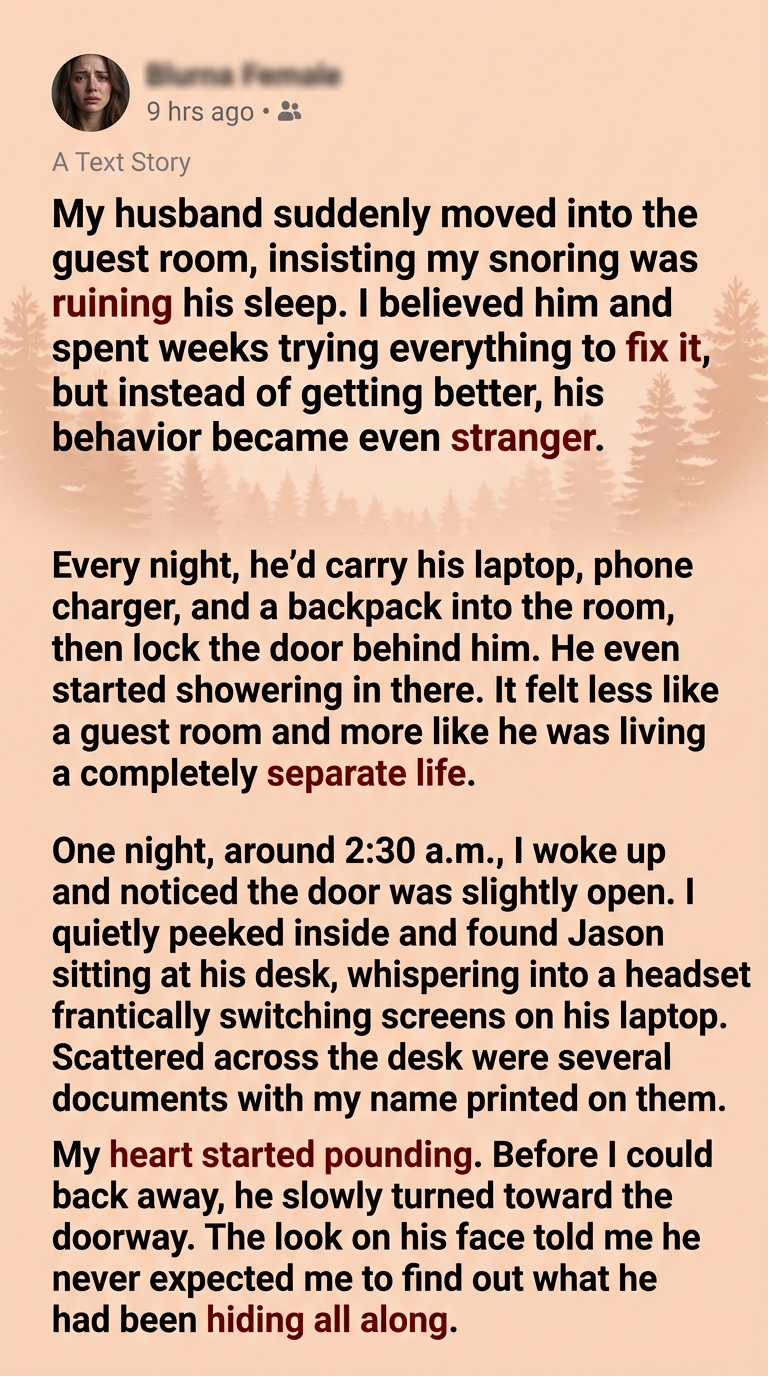
That night Jason carried his laptop, backpack, and coffee into the guest room exactly as usual.
At 10:30 p.m., I heard the lock click.
Again.
I lay awake for hours.
Around 2:30 in the morning, I woke to use the bathroom.
As I walked down the hallway, I noticed something unusual.
The guest-room door wasn’t completely closed.
A narrow strip of light spilled into the hallway.
I took one cautious step closer.
Jason sat at the desk wearing a headset.
His voice was barely above a whisper.
“No…”
“…she doesn’t know yet.”
He clicked rapidly between several windows on his laptop.
Papers covered the desk.
One page slid partly onto the floor.
My name was printed across the top.
Another document showed my name.
Then another.
My pulse exploded.
Was he stealing my identity?
Planning a divorce?
Moving money?
Before I could step backward…
Jason slowly turned.
Our eyes met.
He froze.
For several seconds neither of us moved.
Finally he removed the headset.
“I can explain.”
I looked at the papers.
“I think you’d better.”
He closed the laptop.
The headset disconnected with a soft beep.
“I didn’t want you to find out like this.”
I folded my arms.
“Find out what?”
Instead of answering, he quietly picked up one of the folders and handed it to me.
The first page read:
Accessibility Modification Assessment
The next:
Architectural Plans
Then:
Medical Equipment Options
I frowned.
“What is this?”
He took a deep breath.
“Three months ago…”
“…your neurologist called me.”
My stomach tightened.
“What?”
“You’d signed paperwork allowing them to discuss certain things with me if necessary.”
I remembered.
When I’d undergone additional testing for the numbness in my legs, I’d completed a stack of medical forms without thinking much about them.
Jason continued quietly.
“They told me they were concerned.”
“Concerned about what?”
“They couldn’t make a diagnosis yet.”
“But they believed there was a real possibility you’d eventually need mobility accommodations.”
I stared at him.
“No.”
“They never told me that.”
“They didn’t know yet.”
“They only told me they wanted me prepared in case future testing confirmed their concerns.”
He opened another folder.
Inside were estimates.
Widening doorways.
Installing ramps.
Bathroom renovations.
A stair lift.
Everything was for our house.
Everything had my name on it.
I looked up slowly.
“You’ve been planning this?”
He nodded.
“I’ve been researching every night.”
“Talking to specialists.”
“Meeting with contractors after work.”
“Learning about insurance.”
I sat down hard on the hallway floor.
“So…”
“…the guest room?”
He gave a tired smile.
“I converted it into an office because I didn’t want you seeing everything.”
“The shower?”
“I was meeting contractors by video before work.”
“The backpack?”
“It held all the paperwork.”
“The locked door?”
“I didn’t want you reading half-finished reports and panicking before the doctors even knew anything.”
Tears welled in my eyes.
“You lied.”
“I know.”
“I hated every minute of it.”
“So why not tell me?”
He sat beside me.
“Because every time I imagined saying the words…”
“…I pictured watching hope disappear from your face.”
I whispered,
“You decided that for me.”
He nodded.
“I did.”
“And I was wrong.”
The next morning, instead of pretending nothing had happened, we called my neurologist together.
She invited both of us to come in that afternoon.
After reviewing all of my tests, she smiled reassuringly.
“The additional imaging gives us much better news than we feared.”
Jason squeezed my hand so tightly it almost hurt.
“The condition we were worried about has been ruled out.”
I closed my eyes in relief.
“What caused the symptoms?”
“A treatable autoimmune inflammation.”
“It will require medication and physical therapy.”
“But we expect an excellent recovery.”
Jason cried before I did.
On the drive home, neither of us spoke for nearly fifteen minutes.
Finally I broke the silence.
“You thought you were preparing to watch me lose my ability to walk.”
He nodded.
“I was terrified.”
“I kept thinking if I could just get the house ready…”
“…maybe you’d never have to see how scared I was.”
I reached for his hand.
“You don’t have to protect me from the truth.”
“I know.”
“I just wanted to carry it for a little while.”
“And it almost cost us.”
He smiled sadly.
“It did.”
We spent the next weekend turning the guest room back into what it had always been meant to be.
The folders were filed away.
The extra desk disappeared.
The lock came off the door.
A month later, after my treatment had begun, I teased him while making the bed.
“So…”
“My snoring?”
He laughed.
“I deserve that.”
“You really do.”
“I couldn’t exactly say, ‘Honey, I’m secretly researching wheelchair ramps at two in the morning.'”
“No.”
“But you also couldn’t blame my innocent nose forever.”
He wrapped his arms around me.
“Fair.”
Years later, whenever friends talked about the importance of communication in marriage, we’d exchange the same look.
Love isn’t only about protecting someone from pain.
Sometimes love means trusting them enough to carry frightening news beside you instead of carrying it alone.
Because secrets—even well-intentioned ones—grow heavier every day they’re hidden.
The burden becomes lighter only when two people are willing to lift it together.