When my mother was diagnosed with breast cancer at sixty-eight, the first thing she worried about wasn’t dying.
It was being a burden.
“I’ll manage at home,” she insisted after her second chemotherapy appointment.
“You don’t need to rearrange your lives for me.”
I took both of her hands.
“Mom.”
“You spent my entire childhood rearranging yours for me.”
“It’s my turn.”
I was forty-one.
Married to Daniel for twelve years.
We had no children, and our guest room sat empty most of the year.
To me, the decision wasn’t difficult.
She was coming home with us.
Daniel smiled when I asked him.
“Of course.”
“But chemo is hard.”
“I know.”
“We’ll get through it together.”
I kissed him that night, believing I’d married the kindest man I’d ever known.
I couldn’t have been more wrong.
The first few weeks were difficult.
Chemotherapy drained Mom’s energy.
Some mornings she barely had the strength to sit up.
Other days she insisted on folding towels or peeling potatoes.
“I need to earn my keep,” she’d whisper.
I always laughed.
“You’ve already earned it.”
She never believed me.
That was her generation.
Love meant giving.
Even when there was almost nothing left to give.
Daniel remained polite.
But something had changed.
At dinner, he spoke less.
He complained quietly that the television was always on daytime shows Mom liked.
He sighed when doctor’s appointments interrupted weekend plans.
Nothing dramatic.
Nothing obvious.
Just tiny moments that made me uncomfortable.
Whenever I asked if everything was okay, he’d smile.
“I’m fine.”
I wanted to believe him.
Six weeks into treatment, my company sent me on a three-day business trip.
I almost canceled.
Mom refused.
“I’ll be fine.”
“Daniel’s here.”
He nodded.
“I’ve got everything covered.”
Before I left, Mom hugged me tightly.
“Don’t worry about us.”
“I’ll be home Thursday evening.”
As it turned out…
I came home Wednesday afternoon.
The conference ended early.
I thought I’d surprise them with takeout from Mom’s favorite restaurant.
When I unlocked the front door, the house was strangely quiet.
No television.
No music.
No voices.
“Mom?”
No answer.
“Daniel?”
Nothing.
I walked toward the guest room.
The door was slightly open.
I pushed it gently.
My breath caught.
The bed was perfectly made.
Unused.
On the floor beside it…
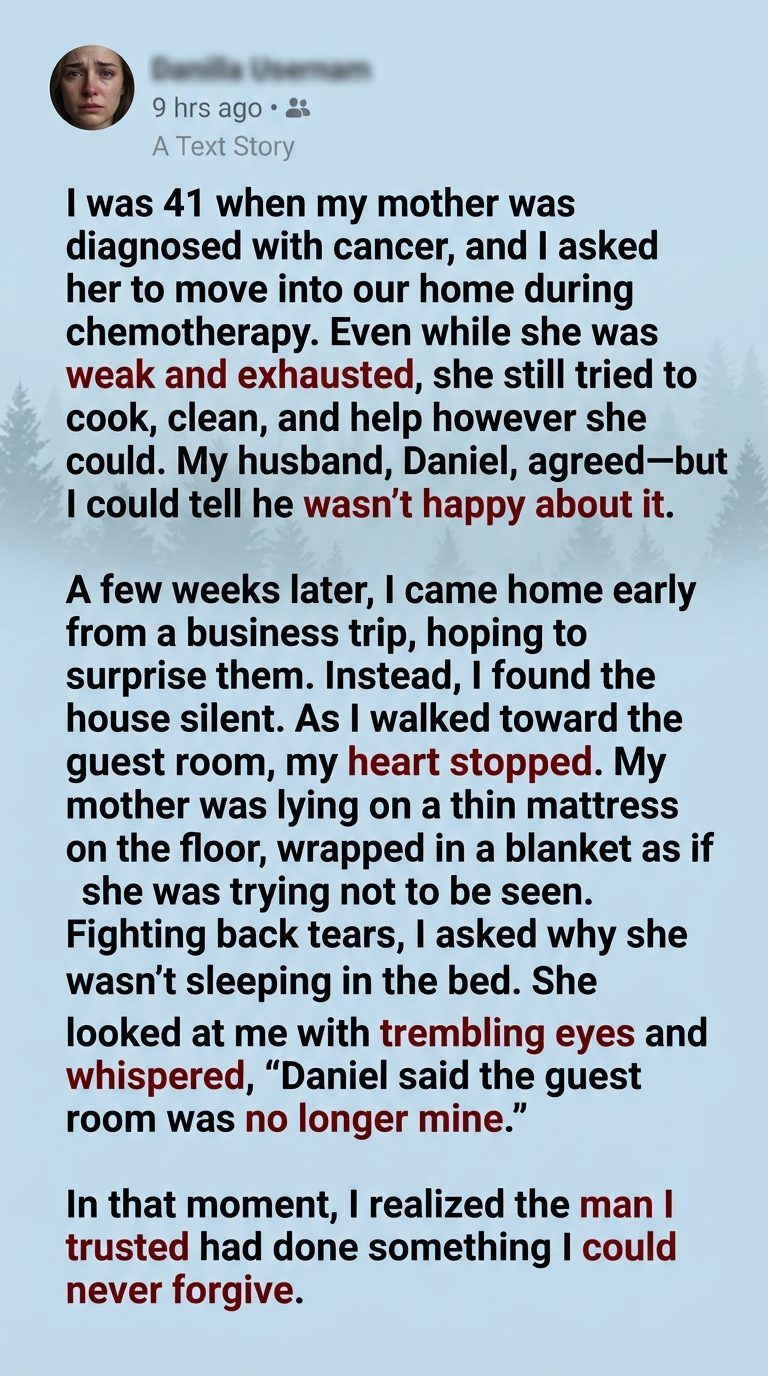
My mother lay curled on a thin camping mattress.
A faded blanket covered her shoulders.
A small pillow rested beneath her head.
Her chemotherapy blanket—the one volunteers had made at the cancer center—was folded beneath her because the floor was too hard.
For a second…
My brain refused to understand what I was seeing.
“Mom?”
She startled awake.
“Oh…”
“…you’re home early.”
I knelt beside her.
“Why are you on the floor?”
She immediately tried to smile.
“It’s only temporary.”
I looked at the untouched bed.
“No.”
“Why?”
Her eyes filled with tears.
She hesitated so long I almost stopped asking.
Finally she whispered,
“Daniel said…”
She swallowed hard.
“…the guest room was no longer mine.”
My heart stopped.
“What?”
“He said I moved too slowly.”
“That I left medicine bottles everywhere.”
“That I coughed during the night.”
She quickly added,
“He wasn’t yelling.”
“He just said the mattress would be easier.”
I looked around the room.
The bed held neatly folded golf equipment.
Daniel’s clubs.
Fishing gear.
Storage boxes.
My mother’s clothes had been stacked in plastic bins against the wall.
The closet she’d been using was empty.
I couldn’t speak.
My own husband had quietly removed my mother from the bed while I was away.
Not because there wasn’t space.
Because he wanted the room back.
I helped Mom sit up.
“How long?”
She stared at the floor.
“About a week.”
“A week?”
“I didn’t want to upset you during your trip.”
My hands shook.
“You’ve been sleeping on the floor after chemotherapy?”
She smiled weakly.
“I’ve slept in worse places.”
That sentence broke something inside me.
Because she had.
Growing up, she’d worked double shifts.
Skipped meals.
Gone without new shoes so I could have school supplies.
And now…
The woman who had sacrificed everything for me believed she should quietly sleep on the floor rather than inconvenience my husband.
The front door opened.
Daniel walked in carrying grocery bags.
He froze when he saw me.
“I thought you were coming back tomorrow.”
“So did Mom.”
His eyes shifted toward the mattress.
“I can explain.”
“I’d love to hear it.”
He set the bags down.
“It wasn’t like that.”
“Really?”
“The guest room became crowded.”
I pointed at the golf clubs.
“Crowded?”
“I needed somewhere to keep them.”
I waited.
Surely there had to be more.
That couldn’t possibly be the reason.
“It was only temporary.”
“For a woman recovering from chemotherapy?”
He sighed.
“Emily…”
“…she kept insisting she wanted to help.”
“She wouldn’t stop cleaning.”
“I thought if she was on the mattress she’d rest more.”
My mother quietly interrupted.
“Please don’t argue because of me.”
I turned toward her.
“No.”
“We’re arguing because of him.”
Daniel looked frustrated.
“I didn’t think it was a big deal.”
I stared at him.
“That’s exactly the problem.”
The next morning, while Mom rested, Daniel and I met with a marriage counselor we’d seen years earlier after a different family crisis.
I wanted someone else to hear the conversation—not to choose sides, but to help us understand what had happened.
The counselor asked a simple question.
“Daniel, what did you hope to accomplish by moving Emily’s mother out of the bed?”
He was quiet for a long time.
Finally he admitted,
“I felt like I was disappearing in my own house.”
“Everything revolved around the illness.”
“I didn’t know how to say I was overwhelmed.”
The counselor nodded.
“Feeling overwhelmed is understandable.”
She paused.
“But making a vulnerable person sleep on the floor without discussing it with your spouse isn’t.”
Daniel lowered his head.
“I know.”
“I kept telling myself it was temporary.”
“I never stopped to think about what it looked like through her eyes.”
Or mine.
When we returned home, Daniel carried every box out of the guest room himself.
He returned the bed exactly as it had been.
Then he knocked softly before entering.
“I’m sorry.”
Mom smiled gently.
“You don’t owe me comfort.”
He shook his head.
“I do.”
“I treated you like an inconvenience instead of family.”
She looked at him kindly.
“Then don’t do it again.”
The apology mattered.
But it wasn’t enough.
For months afterward, trust had to be rebuilt through actions.
Daniel attended counseling on his own to work through his resentment and learn healthier ways to communicate when he felt overwhelmed.
He began driving Mom to appointments without being asked.
He learned how to cook the soups she could tolerate after treatment.
He apologized more than once—not because repeating the words erased the hurt, but because consistency mattered.
Mom finished chemotherapy the following spring.
Her scans brought hopeful news, and her doctors said there was no evidence of active disease.
The day she moved back into her own apartment, Daniel carried every box.
Before she left, she hugged him.
“I forgive you.”
He quietly replied,
“Thank you.”
“I’ll spend the rest of my life trying to deserve that.”
Years later, people sometimes asked why my marriage became stronger after such a painful season.
The answer surprised them.
It wasn’t because we ignored what happened.
It was because we faced it honestly.
If Daniel had refused responsibility, our marriage would have ended.
Instead, he confronted parts of himself he had been avoiding.
And I learned something equally important.
Love doesn’t require pretending someone never hurt you.
It requires deciding whether they are willing to do the difficult work of becoming someone who won’t hurt you the same way again.
When I think back to that afternoon, I don’t remember the mattress first.
I remember my mother’s instinct to protect the man who had hurt her.
That was who she had always been.
And it reminded me that kindness without boundaries can become self-neglect.
She had spent her whole life putting others first.
That day, I finally learned how to put her first instead.
Because the people who once carried us deserve more than gratitude.
They deserve a bed.
A safe home.
And the certainty that, when they are at their weakest, someone will stand beside them without hesitation.