For fifteen years, Maria was the first person my daughters saw every morning.
She packed their lunches.
Walked them to school.
Read bedtime stories when business dinners kept my husband and me away.
She remembered every birthday, every allergy, every nightmare, and every favorite stuffed animal.
To the girls, she wasn’t “the nanny.”
She was simply Maria.
To me…
She had become part of the family.
Or at least I thought so.
Then one evening my husband, Victor, came home from work unusually irritated.
“We need to let Maria go.”
I looked up from the dinner table.
“What?”
“It’s time.”
“Why?”
He shrugged.
“The girls are older.”
“They don’t need a nanny anymore.”
“They’re ten and twelve.”
“They’re fine.”
I frowned.
“They still spend hours alone after school when we’re working.”
“We’ll hire someone part-time.”
He hesitated before adding,
“Someone younger.”
“More modern.”
I stared at him.
“What does that even mean?”
“Someone with fresh ideas.”
I argued for nearly an hour.
Victor wouldn’t budge.
In the end, he reminded me that we had always agreed major household staffing decisions would be made together.
For the first time in our marriage…
I gave in against my own instincts.
The next morning, I sat with Maria in the kitchen.
She didn’t cry.
She didn’t beg to stay.
She simply smiled sadly.
“I understand.”
“No, you don’t.”
“I’m so sorry.”
She reached across the table and squeezed my hand.
“You’ve always been kind to me.”
“It isn’t your fault.”
She packed one small suitcase.
Before leaving, she hugged both girls.
“I’ll always love you.”
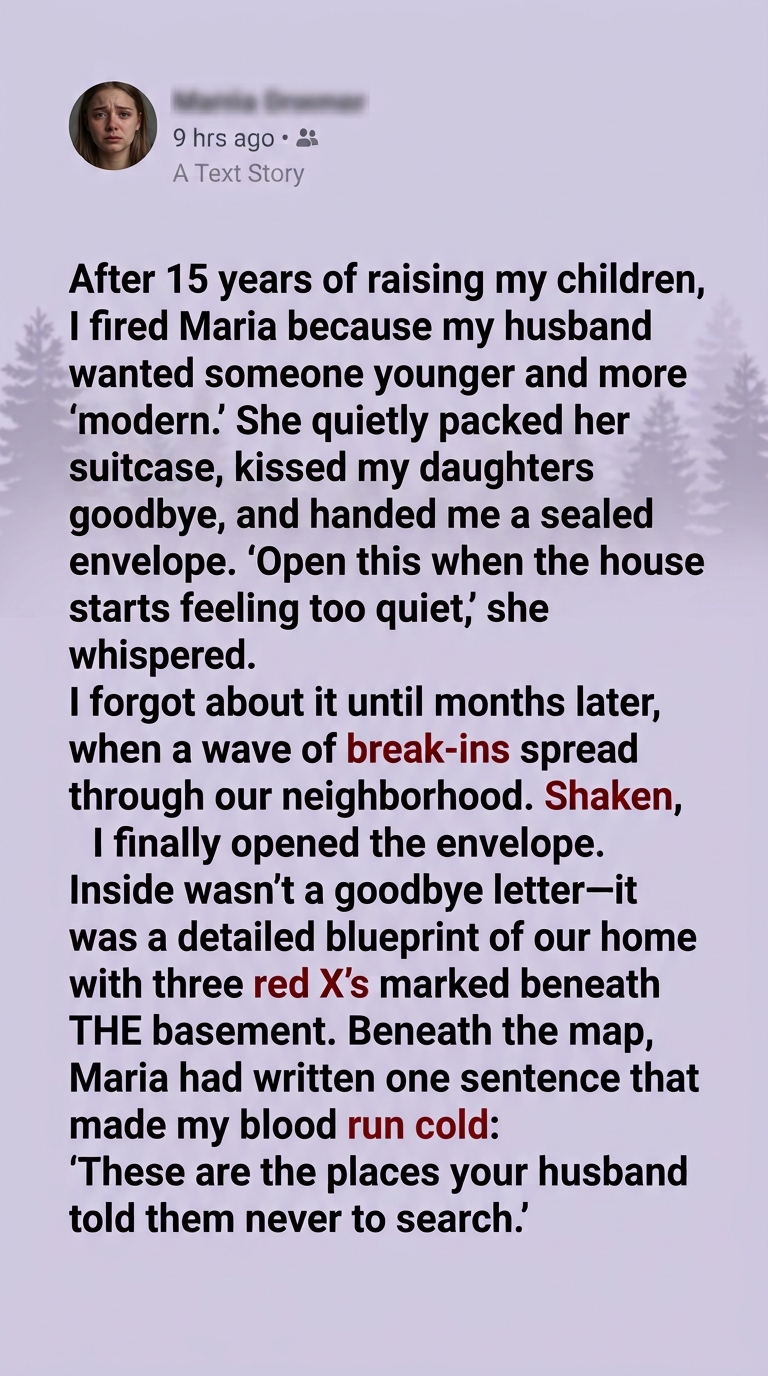
Then she handed me a sealed envelope.
“Don’t open it today.”
“When should I?”
She looked toward Victor, who was standing in the hallway.
Then back at me.
“When this house starts feeling too quiet.”
I laughed nervously.
“What does that mean?”
“You’ll know.”
She walked out the front door.
Neither of us realized it would be the last time we would see her for months.
Life changed quickly.
Without Maria, the house felt strangely empty.
The girls became more withdrawn.
Victor hired a rotating service that sent different caregivers every week.
None stayed long.
No one knew where anything belonged.
No one noticed when Emma forgot her asthma inhaler.
No one remembered Sophie hated thunderstorms.
The warmth Maria had quietly created disappeared.
Still…
Life moved on.
Then the break-ins started.
First the Hendersons across the street.
Then the family two blocks over.
Always the same pattern.
The thieves ignored obvious valuables and went straight to hidden safes, jewelry boxes behind paintings, and cash stored in unusual places.
Police believed someone had detailed knowledge of the homes.
Fear spread through the neighborhood.
Every night I checked every window twice.
One evening, while organizing a desk drawer, I found Maria’s unopened envelope.
My heart skipped.
I remembered her words.
When this house starts feeling too quiet.
The silence in our home suddenly felt deafening.
I opened it.
Inside wasn’t a farewell letter.
It was a carefully hand-drawn floor plan of our house.
Every room.
Every doorway.
Every storage space.
Three red X’s were marked beneath the basement.
At the bottom she’d written:
These are the places your husband told them never to search.
My hands began shaking.
Never to search?
Who was “them”?
For a moment, I couldn’t breathe.
Victor came into the room.
“What are you looking at?”
I instinctively folded the paper closed.
“Nothing.”
That night, after he fell asleep, I studied the map again.
The three X’s pointed beneath a section of unfinished basement flooring.
The next morning, while Victor was at work and the girls were at school, I called my attorney.
Not because I believed the note proved anything.
It didn’t.
But it raised serious questions, and I wanted to proceed carefully and lawfully.
She advised me not to confront Victor immediately.
“If you’re concerned,” she said, “document what you’ve found. And if you believe there’s evidence of criminal activity, contact the appropriate authorities rather than investigating alone.”
That afternoon I also called the detective assigned to the neighborhood burglary cases.
He listened carefully.
“I can’t say whether this is connected,” he told me, “but if you’d like us present while you inspect the area, we can arrange that.”
The next day, officers met me at the house while Victor was away.
With my permission as the homeowner, they carefully lifted several loose floor panels in the unfinished basement.
Beneath the first X…
Nothing.
Beneath the second…
An old metal box.
Inside were envelopes filled with receipts, property deeds, and decades-old financial records belonging to Victor’s late father.
Perfectly legal.
The detective looked disappointed.
“So far, nothing suspicious.”
Then they opened the third location.
Another metal container.
This one held several notebooks.
The detective carefully examined them.
“They’re inventories,” he said.
Lists.
Serial numbers.
Descriptions of antiques.
Family heirlooms.
Insurance information.
I looked confused.
“What does any of this mean?”
Then I noticed one final envelope tucked beneath the notebooks.
It was addressed to me.
In Maria’s handwriting.
If you’re reading this, you probably misunderstood the first note.
I’m sorry.
I had to keep it short in case someone else opened it.
Your husband didn’t tell criminals where not to search.
He told me.
Years ago, after several attempted burglaries in the neighborhood, he asked me to help him protect the family’s most important documents.
He hid them beneath the basement and made me promise never to tell anyone unless something happened to both of you.
When he insisted on replacing me, I became afraid no one else knew where these records were.
If a fire, flood, or burglary ever happened, your daughters might lose documents they would someday need.
That’s why I drew the map.
Please don’t be angry with him.
He trusted me because he trusted my character.
I read the letter twice.
Then a third time.
The detective smiled faintly.
“Looks like your husband was protecting family records, not hiding a crime.”
I felt both relieved…
…and embarrassed.
That evening I showed Victor everything.
He looked stunned.
“I completely forgot those were there.”
“You never told me.”
“I should have.”
He sighed.
“I asked Maria to keep the location confidential because the girls were little and liked exploring the basement.”
He smiled sadly.
“I never imagined she’d remember fifteen years later.”
I looked at the map.
“She remembered everything.”
He nodded.
“She always did.”
The next weekend, we drove to visit Maria.
She had retired to a small cottage near her sister.
When she opened the door and saw the girls, all three burst into tears.
Emma hugged her tightly.
“We missed you.”
“So did I.”
I apologized for letting her go the way we had.
She accepted my apology with grace.
Victor apologized as well.
“I should have spoken honestly.”
“I made it sound like you were replaceable.”
She smiled gently.
“No one is replaceable.”
“Not really.”
She was right.
We asked if she would consider coming back—not as an employee, but as an honorary grandmother who was always welcome in our home.
She laughed.
“I think I’d like that.”
Looking back, people assume the mysterious map exposed a terrible secret buried beneath our house.
It did.
Just not the one anyone expected.
The real secret wasn’t hidden under the basement floor.
It was hidden in plain sight for fifteen years.
We had mistaken loyalty for ordinary work.
We had confused consistency with routine.
We had forgotten that the people who quietly protect our families every day often become so dependable that we stop noticing just how extraordinary they are.
Maria never gave us treasure.
She reminded us of something far more valuable.
Trust isn’t measured by how long someone works in your home.
It’s measured by how faithfully they guard your family—even after they’ve walked out the front door.