The first time I held my son, everyone in the delivery room cried except me.
It wasn’t because I didn’t love him.
It was because I couldn’t quiet a thought that had already taken root.
He didn’t look like me.
People told me newborns changed.
“Give it time.”
“He’ll grow into your features.”
I nodded.
I smiled for photographs.
I learned to change diapers.
I woke for midnight feedings.
But every time someone said,
“He has his mother’s eyes…”
“…I silently finished the sentence.”
“And someone else’s father.”
I hated myself for thinking it.
But I kept thinking it anyway.
My wife, Emma, never gave me a reason to doubt her.
We had been married for six years.
She worked as an elementary school teacher.
She came home every afternoon exhausted but somehow still found the energy to read stories to our son, Noah.
She never hid her phone.
Never disappeared for unexplained hours.
Never behaved in any way that suggested infidelity.
My suspicion wasn’t built on evidence.
It was built on fear.
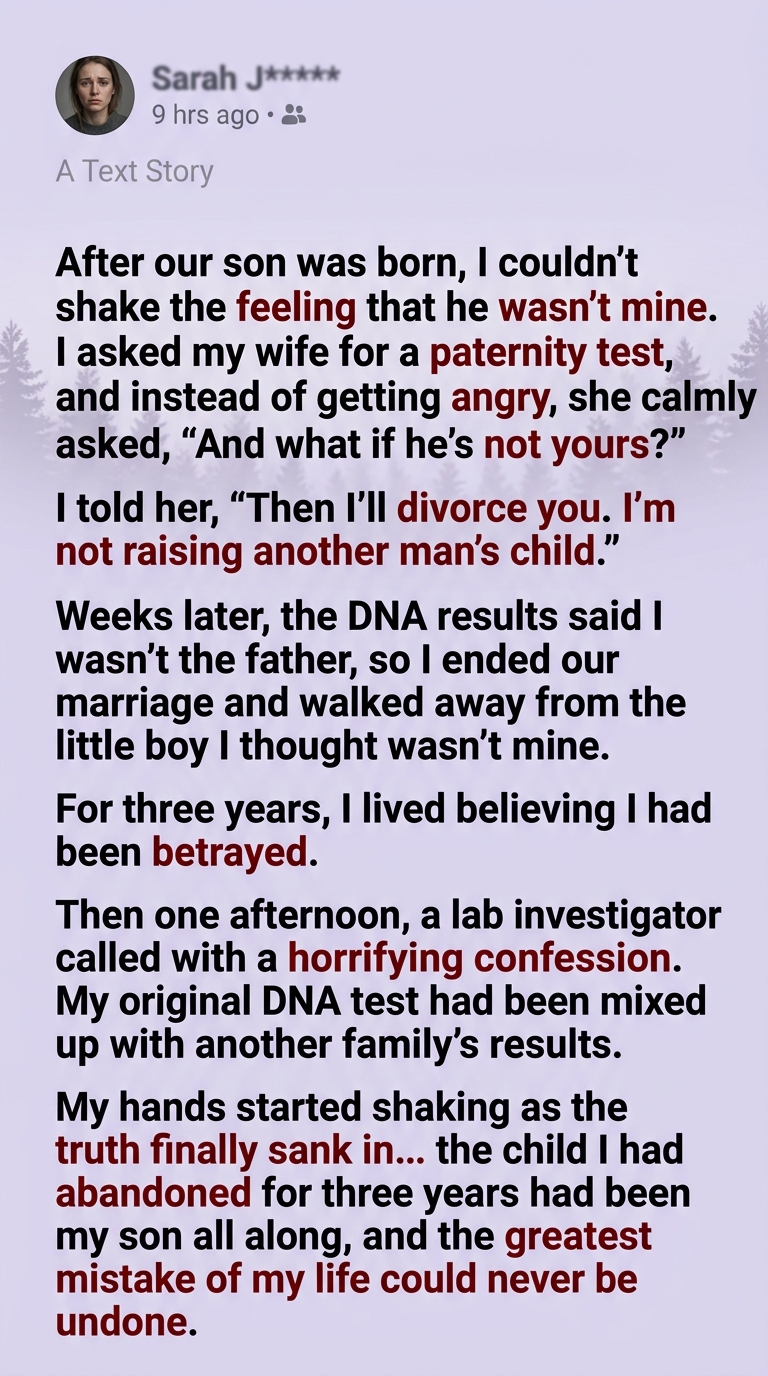
When Noah turned six months old, I finally said the words I’d rehearsed for weeks.
“I want a paternity test.”
Emma didn’t scream.
She didn’t throw anything.
She simply stared at me.
Then asked quietly,
“And what if he’s not yours?”
I answered without hesitation.
“Then I’ll divorce you.”
“I’m not raising another man’s child.”
She looked at Noah sleeping peacefully in his crib.
Then back at me.
“I’ll agree to the test.”
“But understand something.”
“What?”
“If you’re wrong…”
“…you’re not just testing DNA.”
“You’re testing whether you trust me.”
I wish I’d understood what she meant.
I didn’t.
The samples were collected through an accredited laboratory.
We followed every instruction.
Signed every form.
Verified our identities.
Then we waited.
Those were the longest two weeks of my life.
Emma barely spoke to me.
Not because she was angry.
Because she was hurt.
I mistook her silence for guilt.
Looking back…
It was heartbreak.
The report arrived on a Tuesday afternoon.
Probability of paternity:
0%.
I read it three times.
Then handed it to Emma.
She looked at the page.
Then at me.
“No.”
“This is wrong.”
I laughed bitterly.
“The test doesn’t have feelings.”
“It has science.”
She shook her head.
“I have never been unfaithful to you.”
“You have to believe me.”
“I believed the report.”
Instead.
The divorce was quiet.
Painfully quiet.
Emma never admitted to an affair because there wasn’t one.
She never begged me to stay.
She simply repeated the same sentence every time we met.
“The results are wrong.”
I interpreted that as denial.
The court recognized that I was not the legal father based on the laboratory report and the applicable legal process at the time. I was no longer obligated to provide child support, though the emotional consequences for everyone involved were far more significant than any legal ruling.
The day I moved out, Noah toddled toward me carrying one of his toy trucks.
“Dada?”
I stepped backward.
Emma picked him up.
“He doesn’t understand.”
“I know.”
I walked away anyway.
For years…
That single word echoed inside me.
Three years passed.
I changed jobs.
Moved to another city.
Dated occasionally.
Never seriously.
Every Father’s Day felt strangely empty.
Whenever I saw little boys Noah’s age, something inside me hurt.
I convinced myself I missed the idea of fatherhood.
Not him.
That lie became harder to believe every year.
Then one Thursday afternoon my phone rang.
Unknown number.
“This is Michael Reeves from Genomic Diagnostics.”
I almost hung up.
“I’m calling regarding your paternity test from three years ago.”
My stomach tightened.
“What about it?”
There was a long pause.
Then he said words that split my life into before and after.
“We discovered an internal sample identification error during a quality audit.”
I felt cold all over.
“What does that mean?”
“It means your original DNA result was incorrect.”
I couldn’t speak.
“The samples from two unrelated families were accidentally switched before analysis. The error was identified during a later review of archived records, and we’ve been contacting everyone affected.”
My voice barely worked.
“So…”
He swallowed audibly.
“…the child you tested…”
“…is biologically yours.”
Silence.
Complete silence.
My knees gave out.
I sat on the floor.
“No.”
“I’m afraid so.”
“The corrected testing confirms a probability of paternity greater than 99.99 percent.”
My hands shook so violently I dropped the phone.
For three years…
I had believed my son wasn’t mine.
For three years…
My son had believed his father chose to leave.
I drove five hours that same night.
Every mile felt heavier than the last.
Emma opened the door.
She looked exactly the same.
Just more tired.
When she saw my face, she knew.
“The lab called.”
I nodded.
“I’m sorry.”
She closed her eyes.
“I know.”
“I was wrong.”
“I know.”
“I believed a piece of paper instead of you.”
She looked at me for a long time.
Then quietly asked,
“Do you know what Noah asked me on his fifth birthday?”
I couldn’t answer.
“He asked whether he had done something bad.”
The words hit harder than anything else.
“He thought you left because of him.”
I broke.
Completely.
“I never stopped telling him you loved him.”
She wiped away a tear.
“I just couldn’t explain why you disappeared.”
Noah was in the backyard building a cardboard rocket ship.
He looked up when he saw me.
“Hi.”
“Hi.”
He studied my face.
“Mom says you’re my dad.”
“I am.”
He thought about that for several seconds.
“Were you lost?”
Children ask the questions adults can’t.
I knelt in the grass.
“No.”
“I made a terrible mistake.”
He looked down at the cardboard rocket.
“Are you going to leave again?”
I answered immediately.
“Not if you’ll let me stay.”
He quietly handed me a marker.
“I’m drawing planets.”
It wasn’t forgiveness.
Not yet.
It was something smaller.
An invitation.
Sometimes that’s how healing begins.
The laboratory later accepted responsibility for the error and reached a legal settlement with both families affected. No amount of compensation could restore the years that had been lost, but it helped cover counseling and other costs associated with rebuilding our lives.
Emma and I never remarried.
Some wounds heal into scars rather than disappearing.
We learned we could be respectful co-parents.
Eventually, genuine friendship returned.
Trust did not.
At least not the way it once existed.
That was the price of choices made too quickly.
As for Noah…
He didn’t care about legal settlements.
He cared about soccer games.
Homework.
Birthday cakes.
Fishing trips.
He cared about whether I showed up.
So I did.
Every single time.
Not because I thought consistency erased the past.
Because children deserve parents who keep choosing them, especially after they’ve experienced loss.
Years later, when Noah graduated from high school, he asked me to help him adjust his tie before the ceremony.
As I fixed it, he smiled.
“You know…”
“What?”
“You’ve been here for almost every important moment since I was five.”
“I tried.”
He nodded.
“I know.”
Then he added something I’ll never forget.
“You can’t change where you were.”
“But you changed where you are now.”
That sentence didn’t erase my guilt.
Nothing ever will.
But it reminded me that while the past cannot be rewritten, the future is still being written every day.
People often hear my story and focus on the laboratory’s mistake.
It was a terrible mistake.
But it wasn’t the only one.
The report was wrong.
My decision to stop listening to my wife was my own.
I had every right to ask difficult questions.
I did not have the right to stop asking them once the answers stopped making sense.
The greatest tragedy wasn’t simply that a DNA report was mixed up.
It was that one document became more powerful than years of love, trust, and shared life.
Science can identify a parent.
It cannot replace communication.
A laboratory can correct a report.
It cannot give a little boy back the first three years he spent wondering why his father disappeared.
And that’s the lesson I carry with me every day.
Some mistakes begin with bad information.
The ones that change lives forever happen when we stop believing the people we love before we’ve exhausted every path to the truth.