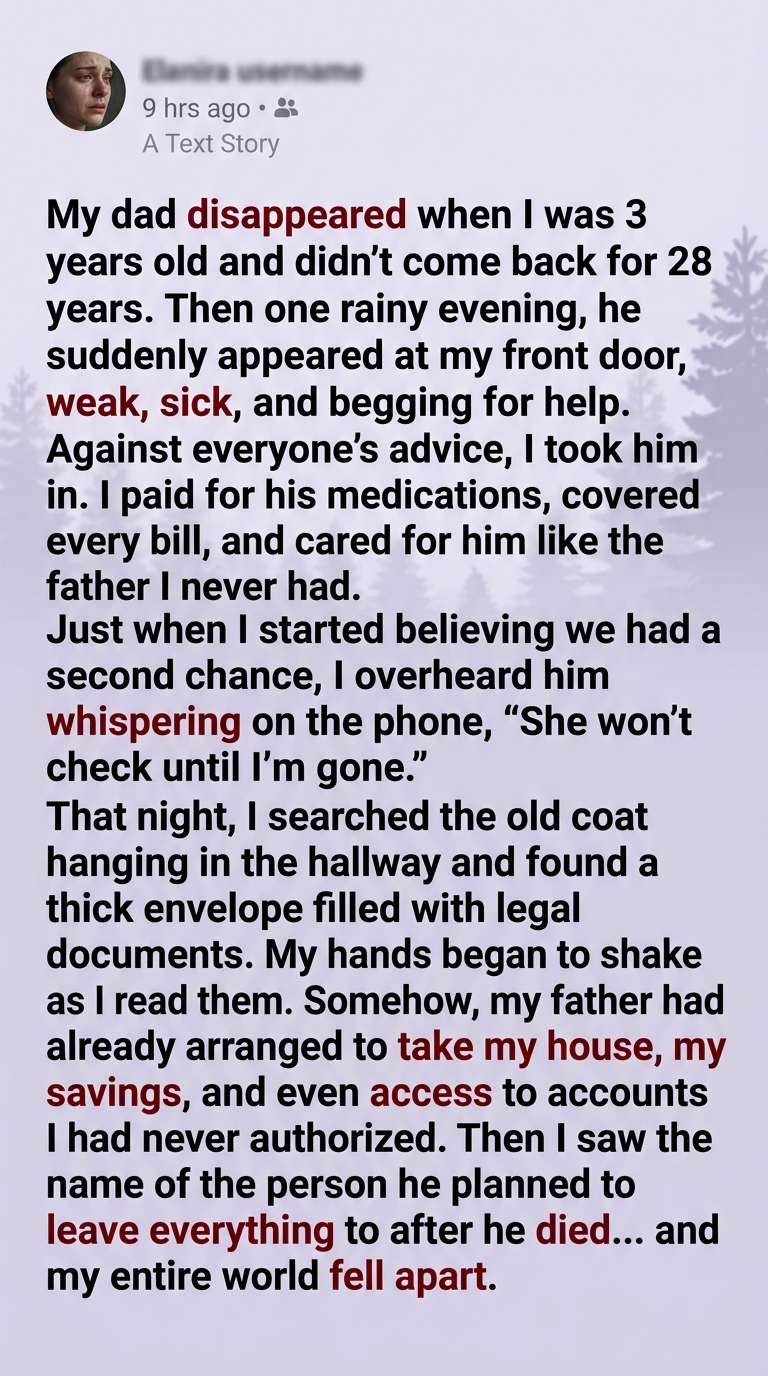
I was three years old the last time I saw my father.
At least, that’s what my mother always told me.
She said he kissed my forehead one morning, promised to be back before dinner, and walked out carrying a brown duffel bag.
He never came back.
No birthday cards.
No phone calls.
No child support.
Nothing.
When I was old enough to ask why, Mom always gave the same answer.
“I honestly don’t know.”
She never called him names.
Never poisoned me against him.
She simply stopped expecting him.
Eventually…
So did I.
Mom worked two jobs.
She packed school lunches before sunrise, cleaned offices after dark, and somehow still managed to attend every school play and parent conference.
By the time I was twenty-five, she was gone too.
Cancer.
Fast.
Cruel.
Before she died, she squeezed my hand and whispered,
“If your father ever comes back…”
I expected her to say,
“…slam the door.”
Instead she said,
“…don’t let guilt make your decisions.”
At the time, I didn’t understand.
Twenty-eight years after my father disappeared…
I finally did.
It was raining the night he knocked.
A slow, uneven knock.
When I opened the door, I barely recognized him.
Thin.
Gray-haired.
Leaning on a cane.
His clothes were soaked.
His face looked older than his sixty-three years.
He stared at me with tired eyes.
“Claire?”
“Yes.”
“I’m…”
He didn’t finish.
He didn’t have to.
Somehow I knew.
“Dad?”
He nodded once.
Then quietly began to cry.
“I know I don’t deserve this.”
“But I don’t have anyone else.”
Every warning I’d ever heard echoed in my head.
Don’t trust him.
He abandoned you.
He’s only here because he needs something.
Maybe all of those things were true.
But he was still standing on my porch.
Cold.
Shaking.
Alone.
I stepped aside.
“Come in.”
Everyone thought I had lost my mind.
My aunt was furious.
“You owe him nothing.”
My best friend refused to stay quiet.
“People don’t disappear for twenty-eight years and suddenly become fathers again.”
Even my attorney—who handled my late mother’s estate—gently reminded me to keep my finances separate.
I promised everyone the same thing.
“I’m just helping him get back on his feet.”
At first, it seemed worth it.
I paid for his medications.
Covered specialist appointments.
Bought him warm clothes.
Converted my home office into a bedroom.
Sometimes we’d stay up late talking.
He admitted he’d struggled with addiction when he was younger.
He said shame kept him away long after he’d gotten sober.
“I thought you’d hate me.”
“I did.”
He nodded.
“I would’ve deserved that.”
Little by little…
I let myself believe people could change.
For the first time in my life…
I had a father.
Or so I thought.
Three months later, I came home early from work.
The house was quiet.
Dad didn’t hear me come in.
His bedroom door was slightly open.
I wasn’t trying to listen.
Then I heard him whisper.
“No…”
“She won’t check until I’m gone.”
A pause.
“I’ve got everything ready.”
Another pause.
“Just wait.”
Every hair on my arms stood up.
I backed away before he could hear me.
My heart pounded so loudly I thought he’d notice.
For the rest of dinner, I could barely speak.
He acted completely normal.
Asked about my day.
Complimented the soup.
Watched television.
Laughed at an old comedy.
I smiled back.
Inside…
Something had changed.
That night, after he fell asleep, I remembered the heavy winter coat he’d hung in the hallway closet.
He never let anyone move it.
He always kept the inside pocket zipped.
I told myself I was invading his privacy.
Then I remembered the phone call.
My hands trembled as I reached inside the pocket.
There it was.
A thick manila envelope.
Inside were legal papers.
Power-of-attorney forms.
Bank information.
Copies of my property records.
Insurance documents.
Draft estate planning paperwork.
Some pages listed my name.
Others listed accounts I recognized.
Several required signatures.
I stared in disbelief.
My signature appeared on one page.
It wasn’t mine.
Someone had attempted to imitate it.
Poorly.
My stomach dropped.
Then I reached the last page.
It identified the primary beneficiary of the proposed estate plan.
Not me.
Not a charity.
Not another relative.
It was…
My cousin, Mark.
My mother’s nephew.
The boy I’d grown up calling my brother.
I couldn’t breathe.
Mark?
The same Mark who had urged me to let Dad stay.
The same Mark who insisted,
“Family deserves second chances.”
I suddenly remembered something else.
Mark had introduced us again.
He claimed he’d “accidentally” found Dad through social media.
What if it hadn’t been accidental at all?
I didn’t confront anyone.
Instead, the next morning I called my attorney.
She reviewed every document.
Her expression remained calm, but serious.
“Claire, several of these forms appear incomplete.”
“Incomplete?”
“They’re drafts.”
“And these signatures?”
“They don’t authorize anything.”
She pointed to the pages.
“Some require notarization.”
“Others were never filed.”
She looked directly at me.
“But if someone intended to deceive you into signing updated versions later—or gain access to your records—these drafts could have been part of that plan.”
She advised me to change my online passwords, notify my banks, place additional security measures on my financial accounts, and report the suspected forged signature to the appropriate authorities.
I followed every recommendation that day.
Then I agreed to let law enforcement review the documents.
That evening, I asked Dad to sit with me.
The envelope rested on the coffee table between us.
His face turned white the moment he saw it.
“You searched my coat.”
“I did.”
Silence.
Finally I asked,
“Who is Mark to you?”
He buried his face in his hands.
“I met him two years ago.”
“He found me.”
“He said he wanted to help us reconnect.”
“And these documents?”
His shoulders slumped.
“He kept bringing paperwork.”
“He said if I moved in with you, we’d eventually combine finances for ‘practical reasons.'”
I stared at him.
“You expected me to sign them?”
He shook his head violently.
“No.”
“I kept putting him off.”
“That’s why he called every week.”
“I told him…”
His voice cracked.
“…I told him you wouldn’t check until I was gone.”
I remembered the phone call.
The sentence I’d heard.
It sounded completely different now.
Not a conspiracy against me.
A delay.
He had been telling Mark to stop pressuring him.
Dad reached into his shirt pocket and pulled out a folded piece of paper.
“I was going to burn those documents.”
He handed me the note.
It was addressed to Mark.
In shaky handwriting it read:
I abandoned one daughter already. I won’t steal from her too. Don’t contact me again.
“I should’ve thrown everything away sooner,” Dad whispered.
“I kept thinking if I ignored him, he’d give up.”
“He didn’t.”
The investigation that followed found no evidence that any property had actually been transferred. The forged signature and related documents became part of a criminal inquiry into attempted fraud. Mark was later charged based on the evidence gathered during the investigation.
Dad cooperated fully.
He admitted every mistake he’d ever made.
The old ones.
And the new one.
“I was ashamed that I’d even listened to him,” he told detectives.
“I should’ve warned my daughter the first day.”
He was right.
Secrets had nearly destroyed us again.
Dad’s health declined rapidly over the following year.
The illness he had hidden from me left him with little time.
One evening, while we sat on the porch watching rain fall across the yard, he quietly said,
“You know…”
“What?”
“I thought disappearing was the worst thing I’d ever done.”
He looked at me with tears in his eyes.
“But almost letting someone hurt you…”
“…that would’ve been worse.”
I reached over and took his hand.
“You don’t get to erase the past.”
“I know.”
“But you helped protect my future.”
He nodded.
“It isn’t enough.”
“No.”
“It isn’t.”
We sat in silence for a while.
Then I added,
“But it’s where you finally started acting like my father.”
He smiled through tears.
When he died a few months later, his estate was almost nonexistent.
A few personal belongings.
Some photographs.
A weathered wallet.
And one letter addressed to me.
Inside he had written:
The greatest gift a parent can leave isn’t money.
It’s leaving their child safer than they found them.
I failed that job once.
Thank you for giving me one last chance to try.
People sometimes ask whether I regret opening my door that rainy night.
I don’t.
But I also don’t regret opening the envelope.
Compassion and caution are not enemies.
You can welcome someone into your home without surrendering your judgment.
You can forgive someone without handing them blind trust.
And sometimes the strongest act of love isn’t pretending danger doesn’t exist.
It’s having the courage to face the truth together before it’s too late.