I had worked at Maple Street Café for almost four years.
It wasn’t glamorous.
The chairs wobbled.
The espresso machine had a personality of its own.
And the kitchen somehow managed to run twenty degrees hotter than the rest of the building.
But it was home.
Most of us had worked there long enough to know each other’s coffee orders, birthdays, and worst habits.
My closest friend there was Sophie.
She was twenty-two, putting herself through nursing school by working evening shifts.
She never complained.
She picked up extra tables.
Covered holidays.
Stayed late whenever someone called in sick.
She deserved every good thing life had to offer.
Unfortunately, our manager, Rick, believed one terrible rule.
If customers walked out without paying…
The server was expected to cover the bill.
Several of us argued it wasn’t fair.
Rick always answered the same way.
“Someone has to be responsible.”
None of us could afford to quit.
So we stayed.
And hoped it would never happen to us.
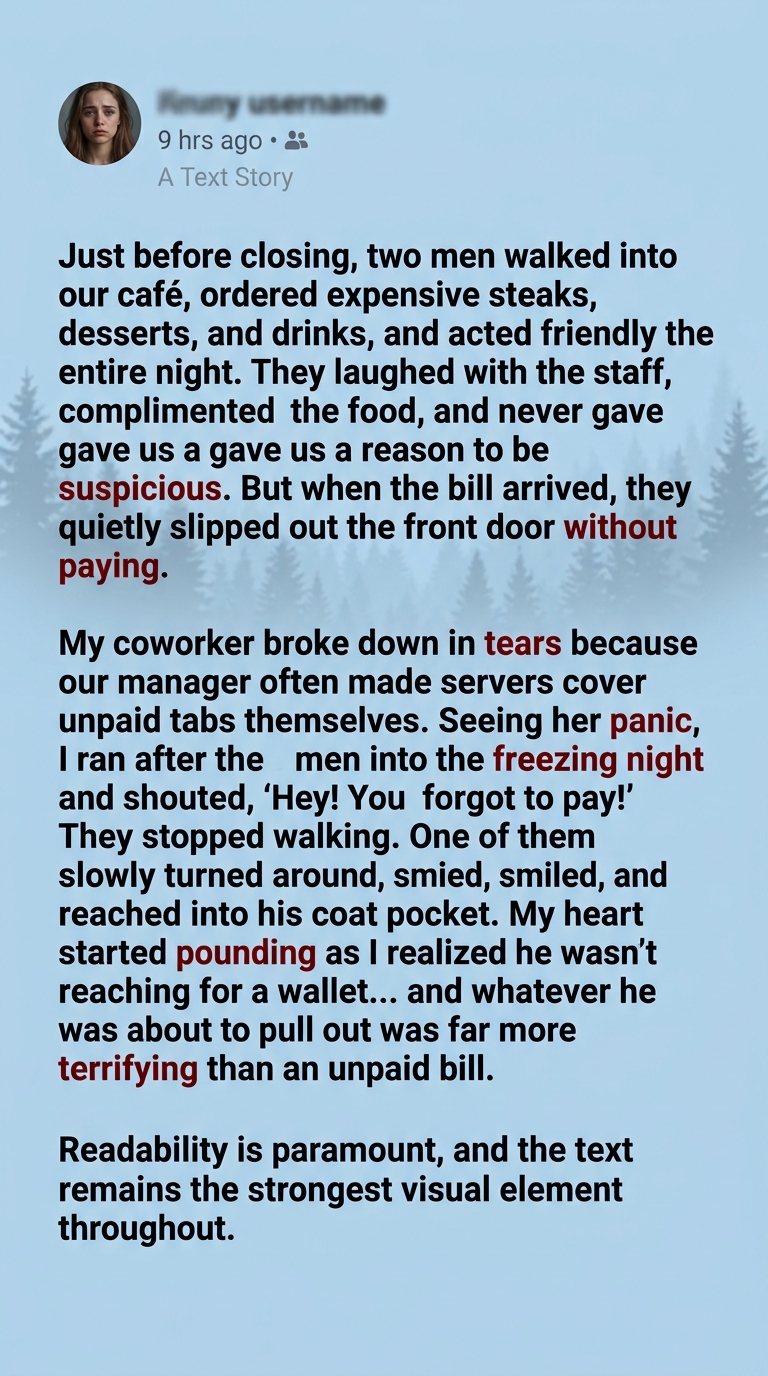
On a bitterly cold Thursday night, just twenty minutes before closing, two well-dressed men walked through the front door.
They looked like businessmen.
Expensive coats.
Polished shoes.
Easy smiles.
One had silver hair.
The other looked about forty.
They ordered without even glancing at the prices.
Two ribeye steaks.
Appetizers.
Imported wine.
Desserts.
After-dinner coffee.
Throughout the evening they were charming.
They complimented the chef.
Joked with the dishwasher.
Asked Sophie about nursing school after noticing her textbook beside the register.
“You’ll make a wonderful nurse,” the older man said.
She blushed.
“Thank you.”
Nothing about them seemed unusual.
When they finally asked for the check, Sophie smiled.
“I’ll be right back.”
She placed the leather bill folder on their table.
Then another customer asked for a refill.
She turned away for less than thirty seconds.
When she looked back…
The table was empty.
The front door was slowly swinging shut.
The bill folder still lay unopened.
The total was nearly three hundred dollars.
Sophie’s face went white.
“No…”
She ran outside.
The sidewalk was empty.
They were already halfway down the block.
She came back inside shaking.
“Rick’s going to make me pay.”
She sat behind the counter and burst into tears.
“I don’t even have that much.”
Without thinking, I grabbed my coat.
“I’m going.”
Sophie looked horrified.
“Don’t.”
“They’re gone.”
“I’m at least asking them to come back.”
I hurried into the freezing night.
The wind cut through my jacket.
I spotted them turning a corner.
“Hey!”
They kept walking.
“Hey!”
Still nothing.
Finally I shouted,
“You forgot to pay!”
Both men stopped.
Slowly…
The older one turned around.
He smiled.
Then reached inside his coat.
My heart slammed against my ribs.
The street suddenly felt very empty.
Every warning I’d ever heard rushed through my mind.
Don’t chase people.
Don’t corner strangers.
Don’t assume they’ll react reasonably.
His hand disappeared into the inside pocket.
I took an instinctive step backward.
He noticed.
“It’s okay,” he said calmly.
But he kept reaching.
For one terrifying second, I imagined every possible worst-case scenario.
Then…
He slowly pulled out…
A leather credential holder.
He opened it.
Inside was a badge.
Not a police badge.
An investigator’s identification from the regional restaurant insurance and fraud task force, working alongside local law enforcement on an ongoing investigation into organized dine-and-dash schemes.
I stared at him.
“What…?”
“I’m sorry we frightened you.”
The younger man sighed.
“We hoped no one would follow us.”
“I don’t understand.”
The older investigator pointed discreetly toward a parked vehicle farther down the street.
Inside sat two uniformed police officers.
“They’re waiting for our signal.”
I blinked.
“You didn’t actually steal dinner?”
He smiled faintly.
“Oh, we’ll be paying.”
“But we’re also documenting something.”
I was completely confused.
He explained quietly.
For several months, a group had been targeting restaurants across the city.
The same pattern every time.
Expensive meals.
Walking out.
Then threatening or intimidating young servers who confronted them—or taking advantage of restaurants that unlawfully pressured employees to cover unpaid tabs.
Investigators had been working with participating businesses to identify patterns and gather evidence about the broader scheme.
“But Maple Street wasn’t told,” I said.
“No.”
“We needed staff to behave naturally.”
He looked at me kindly.
“You did exactly what many caring coworkers do.”
“You tried to help.”
He handed me a business card.
“Now, please head back inside.”
“We’ll explain everything to your manager in a few minutes.”
Ten minutes later, the investigators entered the café with the officers.
The older investigator immediately paid the full bill, including a generous tip.
Then he asked to speak privately with Rick.
The rest of us tried not to stare.
After several minutes, raised voices drifted from the office.
“You make your servers pay?”
Rick’s voice became defensive.
“It’s company policy.”
The investigator replied evenly,
“You may want to review your policies with legal counsel. In many places, deducting customer losses from employees’ wages or requiring them to personally cover walkouts is restricted or prohibited. Regardless of the law where you operate, it’s a practice that creates serious problems.”
Rick didn’t say another word.
Over the following weeks, ownership reviewed the restaurant’s procedures with an employment attorney.
The policy was eliminated.
Staff received training on what to do during suspected thefts.
The first rule was written in bold letters:
Employees should never chase or physically confront customers over unpaid bills. Personal safety comes first.
Reading that sentence, I felt a knot in my stomach.
Because I had done exactly what the policy now warned against.
Later, the older investigator stopped by the café for lunch.
“You know,” he said, “you were brave.”
I shook my head.
“I was lucky.”
He smiled.
“That’s an even better lesson.”
I asked him the question that had bothered me since that night.
“When you reached into your coat…”
“…did you realize how scared I was?”
He nodded.
“The moment you stepped back.”
“I’m sorry.”
“It’s all right.”
“I should’ve identified myself sooner.”
We both laughed.
Months later, Sophie graduated from nursing school.
The entire café attended her pinning ceremony.
Rick came too.
He quietly apologized for the old policy.
“I was wrong.”
Sophie accepted the apology.
Then she hugged me.
“You know what I remember most about that night?”
“What?”
“You didn’t run after them because of the money.”
“You ran because you couldn’t stand seeing me cry.”
She was right.
It had never really been about the unpaid bill.
It was about protecting someone who thought she had to face the consequences alone.
Looking back, people often ask whether I’d chase someone again.
The answer is no.
Not because I care less.
Because I learned something more important.
No restaurant bill is worth risking a life.
Real courage isn’t running toward danger without thinking.
Sometimes it’s stopping, calling for help, and making sure everyone gets home safely.
That night began with what looked like a simple dine-and-dash.
It ended by changing the way our café protected the people who worked there.
And in the end, that was worth far more than the price of two steaks.