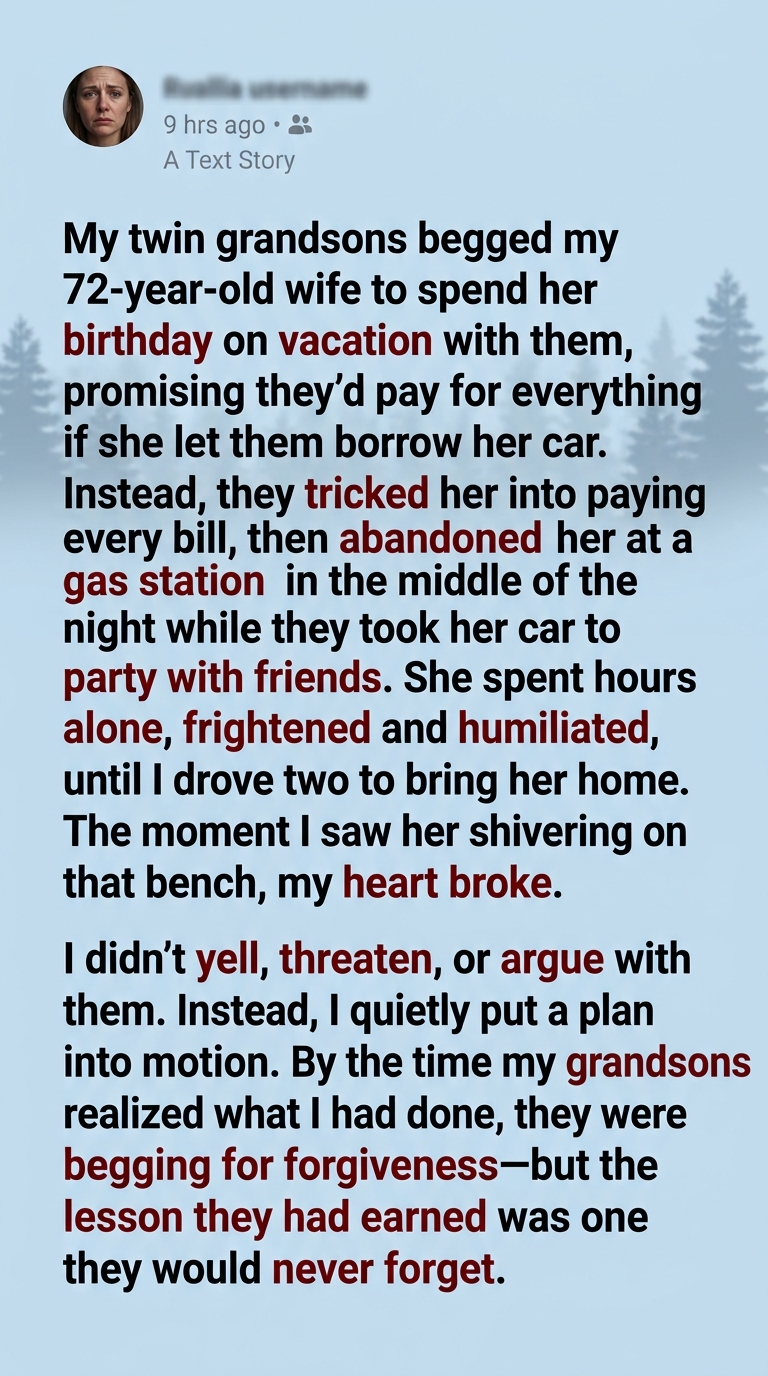
When my wife, Eleanor, turned seventy-two, she didn’t ask for presents.
She didn’t want a fancy dinner.
She just wanted everyone together.
After fifty years of marriage, she always said the same thing.
“Time with family is the only gift I need.”
Our twin grandsons, Mason and Tyler, were twenty-one.
Bright.
Funny.
Full of energy.
But like many young adults, they still believed that older people would always forgive them.
Sometimes…
That belief made them careless.
A week before Eleanor’s birthday, the twins arrived at our house carrying balloons and cupcakes.
“Grandma,” Mason said with a grin, “we have a surprise.”
Tyler pulled out a brochure.
“A weekend trip to Lake Evergreen.”
“You’ve always wanted to go.”
Eleanor’s eyes lit up.
“Oh, boys…”
“You shouldn’t spend that kind of money.”
“We’re paying for everything,” Tyler insisted.
“You’ve done enough for us.”
“There is one tiny favor.”
She laughed.
“I knew it.”
“What is it?”
“Can we borrow your SUV while we’re there?”
“Our car’s in the shop.”
“It’s bigger anyway.”
Without hesitation, she handed Tyler the spare key.
“Of course.”
I remember looking at the boys.
Something about their excitement felt… different.
But Eleanor was smiling so brightly that I ignored the feeling.
I wish I hadn’t.
The trip started well.
At least according to the photos they texted me.
Lakeside cabins.
Ice cream.
Boat rides.
Family selfies.
Every picture showed Eleanor smiling.
Then the messages stopped.
Late Saturday night, my phone rang.
It was an unfamiliar number.
“Hello?”
A trembling voice answered.
“George…”
It was Eleanor.
“Where are you?”
“I’m at a gas station.”
“What happened?”
She tried to sound calm.
“The boys said they were meeting friends for an hour.”
“They told me to wait inside.”
“They never came back.”
My heart stopped.
“Where are they now?”
“I don’t know.”
“They took my car.”
“How long have you been there?”
A long silence.
“Almost four hours.”
I looked at the clock.
1:18 a.m.
“Stay exactly where you are.”
“I’m coming.”
“It’s a two-hour drive.”
“I know.”
“I’ll be there.”
The drive felt endless.
Every terrible possibility raced through my mind.
When I finally reached the gas station, I spotted her immediately.
She sat alone on a metal bench near the entrance.
Still wearing the light sweater she’d packed for a summer evening.
The temperature had dropped sharply after sunset.
She looked so small.
So tired.
When she saw my truck, she stood slowly.
“I’m sorry,” she whispered.
I wrapped my coat around her shoulders.
“For what?”
“I ruined my birthday.”
“No.”
I looked into her tear-filled eyes.
“They did.”
On the way home, she explained everything.
The boys had gradually convinced her to pay for nearly everything.
The cabin.
Meals.
Boat rentals.
Gas.
They kept saying,
“We’ll pay you back.”
Then that evening they wanted to attend a party with friends.
“It’ll only be an hour.”
She waited.
And waited.
Eventually her phone battery died.
She borrowed the gas station phone to call me.
The twins finally stumbled through our front door the following afternoon.
They looked surprised to see both of us sitting quietly at the kitchen table.
Tyler smiled nervously.
“Grandpa…”
“We can explain.”
I held up my hand.
“No.”
“You’ll listen.”
They exchanged worried glances.
I wasn’t yelling.
That made them even more uncomfortable.
“You left your seventy-two-year-old grandmother alone in the middle of the night.”
“It wasn’t supposed to happen like that,” Mason muttered.
“We lost track of time.”
“You ignored thirty-two missed calls.”
Silence.
“You spent money she couldn’t afford to lose.”
“We were going to pay her back.”
“With what?”
Neither answered.
I stood.
“I’m not interested in excuses.”
Then I walked away.
That was all.
No punishment.
No shouting.
Nothing.
The twins looked confused.
They expected a fight.
Instead…
I made a few phone calls.
Three days later, I invited them over again.
On the dining room table sat several folders.
Inside each one was a detailed spreadsheet.
Every expense from the trip.
Cabin.
Meals.
Fuel.
Unexpected towing fee after they parked illegally.
Hotel cancellation insurance.
Replacement phone charger Eleanor had needed after hers was left in the SUV.
Everything.
The total came to just over $2,800.
Tyler stared.
“We don’t have that.”
“I know.”
Mason looked relieved.
“So…”
I slid another folder toward them.
Inside was a simple agreement.
For years, Eleanor and I had quietly contributed to college savings and investment accounts for both boys. They didn’t know about them.
The accounts were still legally ours to manage.
We had planned to transfer them when they turned twenty-five.
I looked at them calmly.
“We’re using part of those funds to reimburse your grandmother.”
Both boys looked stunned.
“You can’t be serious.”
“I am.”
“That money was for our future!”
I nodded.
“And your grandmother’s retirement was for hers.”
“You treated it like your personal spending account.”
Tyler’s face went pale.
“You’d take our savings?”
“I’m using money we set aside.”
“To repay money you took.”
“There is a difference.”
Mason slammed the folder shut.
“That’s not fair.”
I looked directly at him.
“Neither is leaving an elderly woman alone at one o’clock in the morning.”
Silence filled the room.
Then I added one more condition.
“The accounts won’t be closed.”
“The remaining balance stays invested.”
“But before you receive a single dollar from them, you will repay every cent that was withdrawn.”
“From your own earnings.”
“If you don’t…”
“The money stays in our names and eventually goes to charity.”
Neither spoke.
For months, they worked.
Extra shifts.
Weekend jobs.
Selling things they no longer needed.
Not because they were forced to suffer.
Because they were required to repair the harm they had caused.
Every month they handed Eleanor another payment.
She always thanked them.
She never shamed them.
One Saturday, nearly a year later, Mason quietly asked,
“Grandma…”
“Were you scared?”
She looked at him honestly.
“Yes.”
“I thought maybe you’d forgotten me.”
He started crying.
“I never meant…”
“I know.”
She reached across the table.
“But intentions don’t erase consequences.”
That sentence stayed with both boys.
Eventually they finished repaying every dollar.
True to my word, I restored the full value of their investment accounts from the repayments they had made and transferred management to them when they had demonstrated consistent responsibility. The point had never been to take away their future—it had been to teach them that a future built without accountability isn’t much of a future at all.
Years later, when Eleanor celebrated her eightieth birthday, the twins planned the entire weekend.
They rented a wheelchair-accessible van even though she still insisted she didn’t need one.
They booked hotel rooms in her name.
Paid every expense before she could reach for her purse.
And every time she thanked them, they smiled and answered the same way.
“You paid enough for us years ago.”
At the end of the weekend, Tyler quietly hugged me.
“You know…”
“What?”
“When you used our savings…”
“I hated you.”
“I know.”
“But if you’d just yelled…”
“…we would’ve blamed you.”
He looked toward Eleanor laughing with the rest of the family.
“Instead…”
“…you made us face ourselves.”
I nodded.
“That’s a much harder lesson.”
People sometimes assume the greatest punishment is the harshest one.
I’ve learned the opposite.
Real accountability isn’t about revenge.
It’s about restoring what was broken and making sure the person who caused the harm understands why it mattered.
My grandsons eventually became responsible men.
Not because we humiliated them.
But because we refused to let love become an excuse for avoiding consequences.
And every birthday since then, before anyone orders dessert or plans a trip, Mason and Tyler ask their grandmother the same question.
“Grandma…”
“What would make you happiest?”
Because the lesson they remembered wasn’t about money.
It was about never treating the people who spent a lifetime loving you as though they were there simply to be used.