I’ve never been able to ignore someone who’s hungry.
Maybe it’s because I grew up in a house where my mother stretched one pot of soup into three meals.
Maybe it’s because I still remember pretending I wasn’t hungry at school so my younger brother could finish my lunch.
Whatever the reason…
If someone tells me they don’t have food, I help.
No questions.
No conditions.
So when my friend Chloe called me one Tuesday evening sobbing, I didn’t hesitate.
“I don’t know what I’m going to do,” she cried.
“I’ve got almost nothing left.”
“I haven’t eaten properly in days.”
My chest tightened.
“Have you really not eaten?”
“I’ve been living on crackers.”
“I feel so embarrassed.”
“Don’t be.”
“I’ll bring you groceries.”
“No, no…”
“I hate asking.”
“You didn’t ask.”
“I’m offering.”
She cried harder.
“Thank you.”
“We’ll get through this.”
I hung up and immediately opened my refrigerator.
There was a large container of chicken soup I’d made the night before.
Fresh pasta.
Rice.
Roasted vegetables.
Chicken breasts I could grill quickly.
I spent nearly two hours cooking.
By the time I finished, my kitchen looked like I’d been preparing meals for a family reunion.
I packed everything carefully.
Breakfast burritos.
Soup.
Sandwiches.
Fruit.
Yogurt.
Granola bars.
Frozen meals she could reheat later.
I even tucked a handwritten note into one of the bags.
Everyone needs help sometimes. Better days are coming.
Looking at the bags stacked by my front door made me smile.
Helping someone always felt good.
I grabbed my car keys.
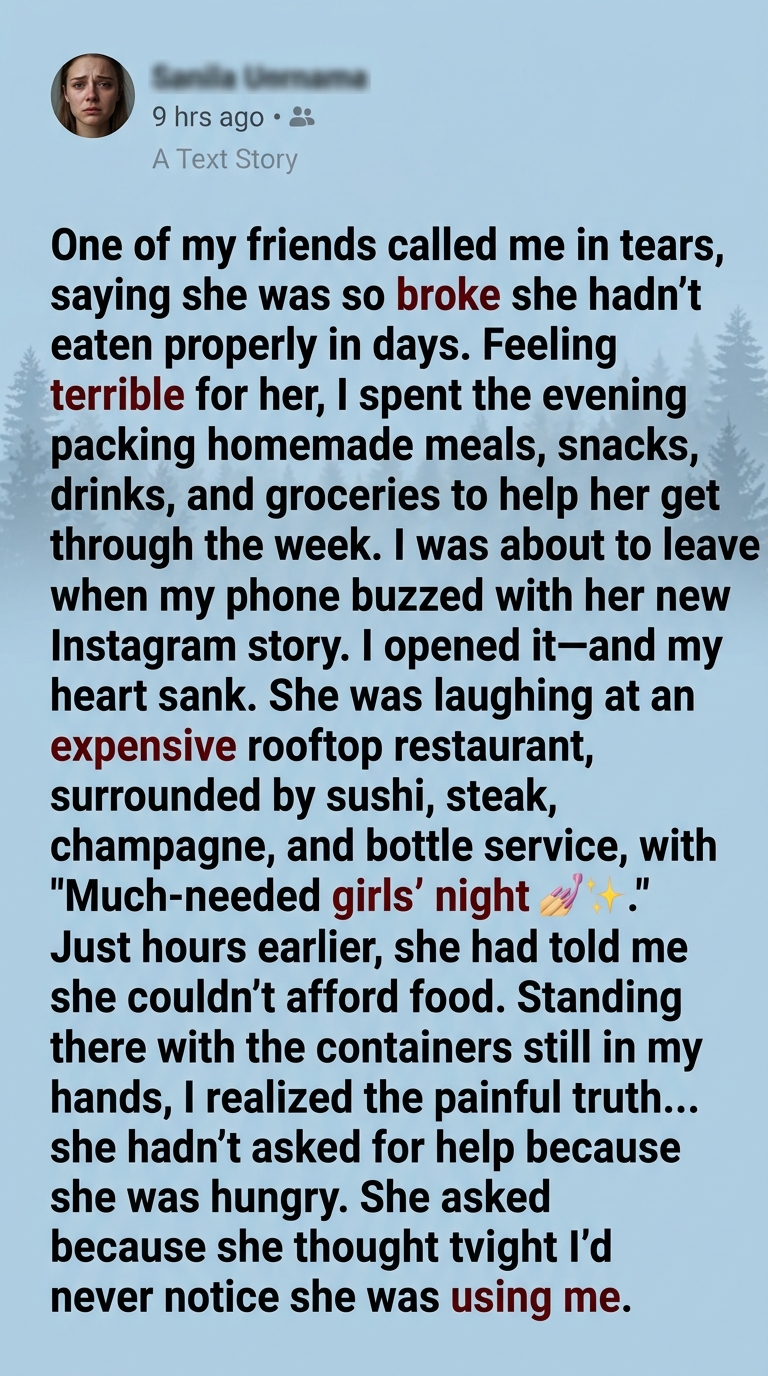
Just as I reached for the grocery bags, my phone buzzed.
Chloe added to her Instagram story.
Without thinking, I opened it.
The first clip showed sparkling city lights.
The second showed a rooftop restaurant.
The third…
Made my stomach drop.
Chloe sat at a beautifully decorated table surrounded by four friends.
There were platters of sushi.
Large steaks.
Seafood towers.
Champagne bottles with sparklers.
Someone yelled,
“To surviving another week!”
Everyone laughed.
Then Chloe held up a champagne glass toward the camera.
Across the screen she’d written:
Much-needed girls’ night 💅✨
I stared at the screen.
Maybe it was an old video.
I checked the timestamp.
Posted 4 minutes ago.
I replayed it.
She looked genuinely happy.
Not someone who hadn’t eaten in days.
I looked down at the containers still in my hands.
Then back at the video.
Less than three hours earlier she’d told me she couldn’t afford food.
Now she was celebrating in one of the most expensive restaurants downtown.
I wasn’t angry because she was enjoying herself.
I was angry because she’d used hunger to manipulate my compassion.
For several minutes, I simply stood in my kitchen.
The soup was getting cold.
Eventually I put the containers back into the refrigerator.
Then I sent her one message.
I hope you’re enjoying dinner.
Nothing else.
Five minutes later…
She replied.
What do you mean?
I sent a screenshot of her own story.
Silence.
Ten minutes.
Twenty.
Finally…
It’s not what it looks like.
I called her.
She answered immediately.
“I can explain.”
“I’d like to hear it.”
“My friend paid.”
“I didn’t spend anything.”
I nodded slowly, though she couldn’t see me.
“So why tell me you hadn’t eaten properly in days?”
“I…”
“I was embarrassed.”
“Were you hungry today?”
Long pause.
“No.”
“Were you hungry yesterday?”
Another pause.
“No.”
“So why did you say that?”
She started crying again.
Not the desperate crying from earlier.
Different.
Cornered.
“Because I knew you’d help.”
Those six words hurt more than any lie.
“You knew I’d help.”
“Yes.”
“I didn’t think it would matter.”
“It matters.”
“I wasn’t asking for money.”
“No.”
“You asked for trust.”
Silence.
“I just…”
“…everyone else says no.”
I took a deep breath.
“I would have helped you if you’d simply said you were struggling.”
“You didn’t need to invent hunger.”
She whispered,
“I know.”
Over the next few days, I thought about our friendship.
This wasn’t really about groceries.
It wasn’t even about one lie.
It was about a pattern I had ignored.
The forgotten wallet at restaurants.
The repeated promises to “pay me back next week.”
The emergencies that somehow always appeared just before payday.
The emotional phone calls that always ended with me solving a problem.
I realized something uncomfortable.
Chloe hadn’t suddenly become manipulative.
I’d slowly taught her that I rarely questioned the stories she told.
Not because I was foolish.
Because I wanted to believe people.
There’s kindness in that.
But there’s also risk.
A week later Chloe asked if we could meet.
We sat in a quiet coffee shop.
She looked exhausted.
“I’ve been thinking.”
“So have I.”
She pushed an envelope across the table.
Inside was cash.
“What’s this?”
“The groceries you made.”
“You never took them.”
“I know.”
“But you bought the ingredients.”
I looked at her.
“I don’t want reimbursement.”
“I want honesty.”
She nodded.
“My parents always solved problems by making people feel sorry for them.”
“I think I learned to do the same.”
“I’m trying to stop.”
I believed she meant it.
But belief wasn’t enough anymore.
Trust, once broken, doesn’t return because someone apologizes.
It returns through consistent actions over time.
Over the next year, Chloe changed in small but noticeable ways.
When she wanted company, she said,
“I’m lonely.”
Not,
“I’m having a crisis.”
When money was tight, she admitted,
“I made poor choices this month.”
Instead of inventing emergencies.
And when she borrowed something, she repaid it without reminders.
Slowly…
The friendship became healthier.
Not because I became less generous.
Because I became more honest too.
One evening she laughed and said,
“You know what changed everything?”
“What?”
“You didn’t embarrass me online.”
“You didn’t tell everyone.”
“You simply refused to keep pretending.”
I smiled.
“I figured that was enough.”
She nodded.
“It was.”
Looking back, people sometimes assume this story is about expensive dinners and fake emergencies.
It isn’t.
It’s about something much deeper.
Real friendship doesn’t require dramatic rescues built on deception.
It requires enough trust to tell the truth—even when the truth is less flattering.
Sometimes the truth is,
“I’m embarrassed.”
Sometimes it’s,
“I made bad financial decisions.”
Sometimes it’s simply,
“I don’t need groceries.”
“I just need someone to listen.”
I would have shown up for any of those conversations.
What hurt wasn’t that my friend enjoyed a fancy dinner.
It was discovering she believed my kindness was something to manage instead of something to respect.
That night, I didn’t stop being generous.
I simply stopped confusing generosity with the obligation to ignore dishonesty.
Because helping someone in need is an act of love.
Helping someone maintain a lie isn’t.
And knowing the difference may be one of the kindest lessons we can learn—for them and for ourselves.