When my husband left after thirty-seven years of marriage, I thought the hardest part would be the silence.
I was wrong.
The hardest part was the last thing he said before closing the front door.
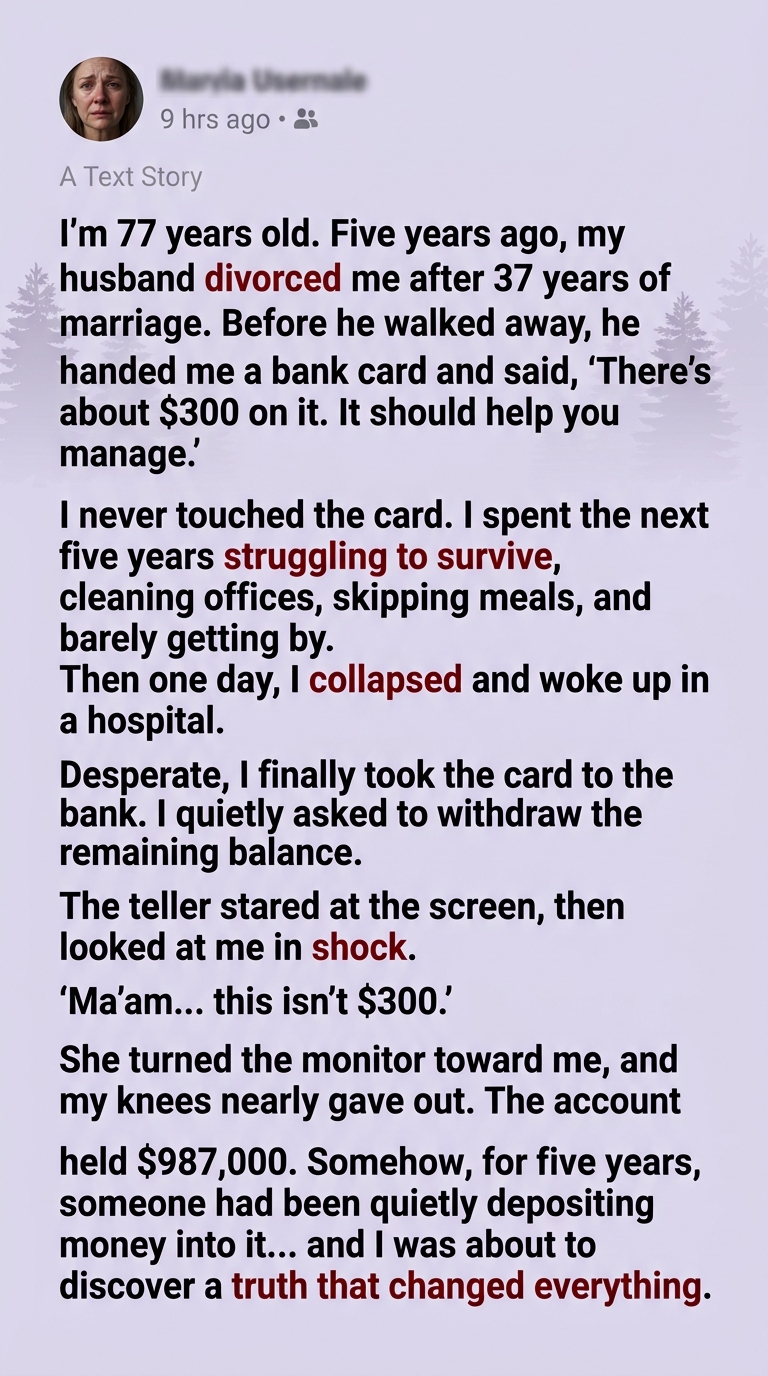
He handed me a plain debit card.
“There should be about three hundred dollars on it.”
“It should help you manage.”
Then he picked up his suitcase.
“I hope someday you understand.”
Those were the last words I heard from him.
No hug.
No goodbye.
No explanation that made any sense.
Just a bank card.
Three hundred dollars.
And thirty-seven years reduced to a piece of plastic.
I stood in the doorway long after his car disappeared.
Then I placed the card inside my jewelry box.
I never used it.
Not once.
I didn’t want anything from a man who had decided I was worth three hundred dollars.
My name is Evelyn.
I was seventy-two when my marriage ended.
Too old to start over.
Too young to stop living.
At least that’s what people kept telling me.
The problem was…
Starting over costs money.
I rented a tiny apartment.
Cleaned office buildings at night.
Folded laundry for a neighborhood motel on weekends.
Some weeks I skipped dinner so I could afford my blood pressure medication.
When friends asked how I was doing, I always smiled.
“I’m managing.”
It wasn’t true.
I was surviving.
Barely.
Pride is a strange thing.
It can keep you standing.
It can also keep you from asking for help.
Five years passed that way.
Five birthdays.
Five Christmases.
Five winters spent layering sweaters because I kept the thermostat low.
I never once touched the card.
Every time I saw it in the jewelry box, I remembered his voice.
“It should help you manage.”
I’d close the lid and walk away.
Then one Tuesday morning, while mopping the lobby of an office building, the room began to spin.
The bucket slipped from my hands.
The next thing I remember was opening my eyes in a hospital.
A nurse smiled gently.
“You gave us quite a scare.”
The doctor explained that I was severely dehydrated and malnourished.
“You’ve been pushing yourself too hard.”
He wasn’t wrong.
When the billing office asked how I planned to pay for follow-up care, I finally admitted something I’d spent years refusing to admit.
“I don’t know.”
That evening, lying alone in the hospital bed, I thought about the debit card.
For the first time in five years…
I opened the jewelry box my neighbor had brought from my apartment.
The card was exactly where I’d left it.
Maybe there really was three hundred dollars.
Maybe there was less.
Either way, I couldn’t keep pretending pride was going to pay medical bills.
The next morning, after I was discharged, I walked into the bank.
I waited patiently until a teller called me forward.
“I’d like to withdraw whatever is left.”
She smiled.
“Of course.”
She inserted the card.
Typed a few keys.
Then stopped.
Her expression changed.
She looked at the screen.
Then at me.
Then back again.
“Ma’am…”
“Yes?”
“Could you please wait one moment?”
My stomach tightened.
Had the account been closed?
Was the card invalid?
A manager approached.
He spoke kindly.
“Would you mind coming into my office?”
I followed him, convinced something had gone wrong.
He turned his monitor toward me.
“I just want to confirm you’re the account holder.”
I nodded.
He pointed to the balance.
My vision blurred.
$987,214.63
I honestly thought I had read it incorrectly.
“There must be a mistake.”
He shook his head.
“No, ma’am.”
“The account has been active for years.”
“I…”
“My ex-husband told me there was about three hundred dollars.”
The manager frowned.
“According to the transaction history, there was approximately three hundred dollars in the account five years ago.”
“I knew it.”
“But…”
He clicked another screen.
“…beginning the following month, someone started making automatic monthly deposits.”
Every month.
Without fail.
For five years.
The balance had quietly grown through regular deposits and investment earnings within the account.
My hands shook.
“Who?”
“I’m sorry,” he said gently, “I can’t disclose information beyond what appears on the account records without the proper authorization. But I can tell you the deposits all came from the same verified source.”
I left the bank more confused than when I’d entered.
The manager did give me one piece of advice.
“You may wish to speak with an attorney before making any assumptions.”
I did exactly that.
My attorney reviewed the account documents.
Then she looked at me.
“Evelyn…”
“…there’s something here you should see.”
She handed me a sealed envelope that had been stored with the account records.
It was marked:
To be released only if Evelyn personally requests account information.
My heart pounded.
The handwriting was unmistakable.
It belonged to my ex-husband.
I opened it.
Dear Evelyn,
If you’re reading this, then one of two things has happened.
Either you’ve finally decided to use the card…
Or something has gone terribly wrong.
I suspect it’s the second.
Because I know you.
You’d rather struggle than accept what you believe is charity.
The account really did have about three hundred dollars when I handed you the card.
That wasn’t a lie.
I wanted you to know exactly where we were starting.
What I couldn’t find the courage to explain was everything that came afterward.
I frowned.
I kept reading.
The divorce wasn’t because I stopped caring about you.
It was because my neurologist had just diagnosed me with a progressive illness that I wasn’t ready to tell anyone about.
The treatments were uncertain.
The future was even less certain.
I convinced myself that if I became completely dependent, I’d take away your retirement caring for me.
Instead of asking you what you wanted…
I made the decision for both of us.
It was the biggest mistake of my life.
I sold the business after we separated.
I arranged for part of the proceeds to be deposited into this account every month.
I couldn’t make myself stay.
But I also couldn’t stop trying to provide for you.
If you never touched the money, I hoped it would quietly become enough to keep you comfortable someday.
If you did need it, it would be there sooner.
Either way…
It was always yours.
Tears rolled down my face.
The final page read:
If I’ve already passed away, please don’t waste another day being angry with me.
Be angry with my pride instead.
It convinced me that protecting you meant making choices without your consent.
Love should never work that way.
If I’m still alive…
And if you’ll let me…
I’d like one chance to apologize in person.
Always,
Henry
I lowered the letter.
My attorney quietly asked,
“Did you know he was ill?”
I shook my head.
“No.”
She slid another document toward me.
Henry had appointed his sister as the account’s administrative contact. After receiving my permission, the attorney contacted her.
The next day, Henry’s sister called.
“He isn’t gone,” she said softly.
“He’s in a long-term care facility.”
“The illness progressed, but much more slowly than doctors first expected.”
“He never remarried.”
“He always asked whether you’d ever used the account.”
A week later, I walked into his room.
He looked older.
Frailer.
But when he saw me, he smiled exactly the way he had when we were twenty-three.
“I’m sorry,” he whispered before I could say a word.
“I know.”
“No.”
He shook his head.
“You don’t.”
“I stole five years from us.”
“You stole five years from yourself too.”
He closed his eyes.
“I thought I was protecting you.”
“You were protecting yourself from hearing that I might have chosen to stay.”
Neither of us spoke for a long time.
Some wounds aren’t healed by dramatic speeches.
They’re healed by finally telling the truth.
Henry and I never remarried.
Too much life had passed.
Too many chapters had closed.
But we did become companions again.
I visited every Wednesday afternoon.
We played cards.
Argued about crossword puzzles.
Shared hospital cafeteria pie that was never as good as homemade.
And when he passed away two years later, I was holding his hand.
Not because the money erased the pain.
It didn’t.
The money paid my medical bills.
It repaired my apartment.
It let me retire with dignity.
But the greatest gift wasn’t the account.
It was the chance to replace five years of unanswered questions with honest conversations.
Looking back, people often imagine this story is about an elderly woman who unexpectedly became wealthy.
It isn’t.
It’s about what happens when love and pride become tangled together.
Henry believed sacrifice meant making decisions alone.
I believed strength meant refusing help.
Both of us were wrong.
Real love doesn’t hide the truth.
Real strength isn’t measured by how much suffering you can endure in silence.
Sometimes the bravest thing two people can do is trust each other enough to face an uncertain future together.
We learned that lesson far too late.
But not so late that we never got the chance to say goodbye.