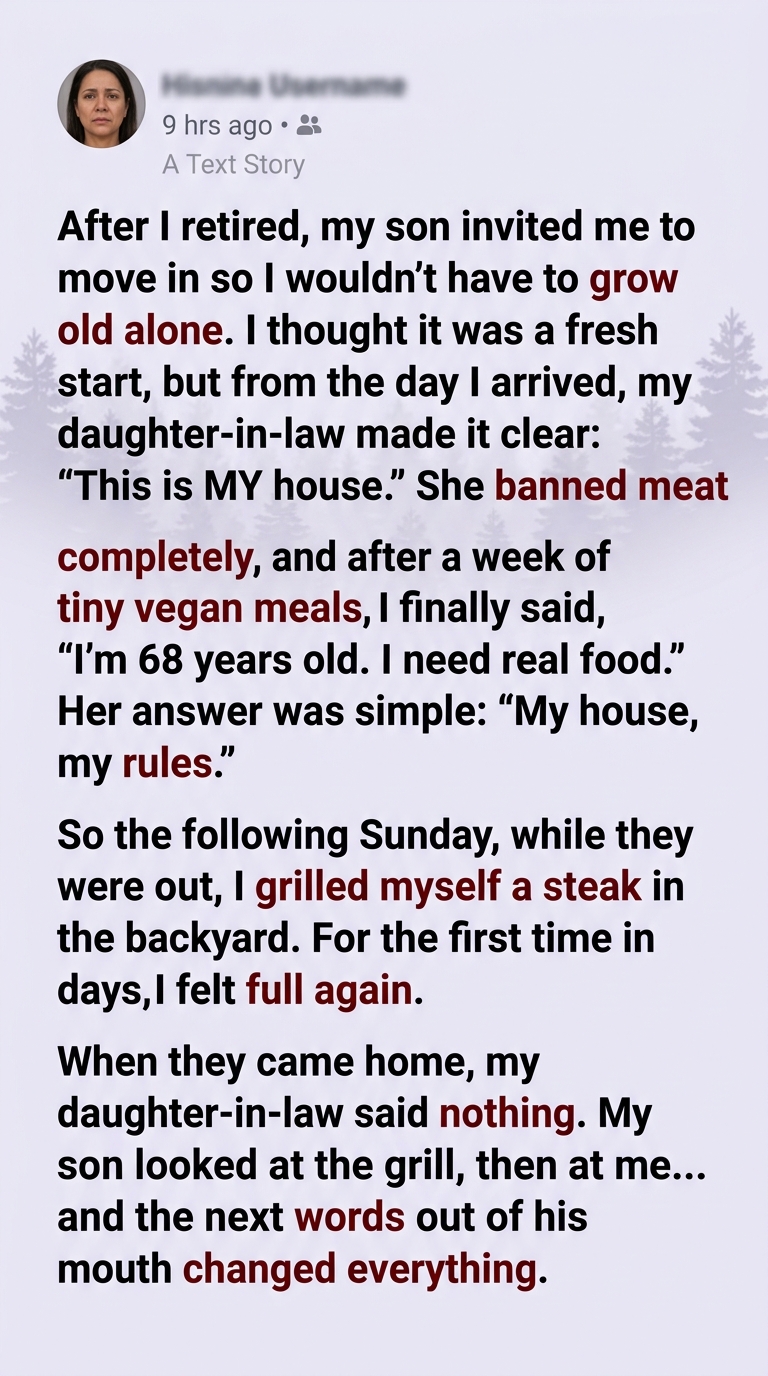
When I retired at sixty-eight, I imagined my life becoming quieter.
I pictured mornings with coffee on the porch.
Afternoons tending a small garden.
Weekends spoiling future grandchildren.
Instead, three months after leaving my job, I found myself packing forty years of memories into cardboard boxes.
My son, Daniel, insisted it was the right decision.
“Dad, you’ve lived alone since Mom passed.”
“You don’t have to do this anymore.”
“We’ve got plenty of room.”
“It’ll be good for all of us.”
His wife, Rachel, smiled politely.
“We’ll make the guest suite comfortable.”
I was grateful.
Selling my old house wasn’t easy, but maintaining it by myself had become harder every year.
I told myself this wasn’t giving up independence.
It was choosing family.
For the first few days, everything seemed fine.
Rachel proudly showed me the kitchen.
“The one thing we’re really passionate about is food.”
“I’ve noticed,” I joked, looking at shelves filled with grains, beans, spices, and vegetables.
“We’re completely plant-based.”
“I don’t mind vegetables,” I said.
“I’ve eaten them my whole life.”
She smiled.
“Great.”
Then her expression became more serious.
“We don’t allow meat in the house.”
I blinked.
“At all?”
“No.”
“It’s important to us.”
I hesitated.
“I usually eat a little chicken or fish.”
She folded her arms.
“This is my home.”
“My kitchen.”
“My rules.”
Daniel shifted uncomfortably beside her.
“It’s really important to Rachel.”
I nodded slowly.
“I understand.”
And I meant it.
It was their home.
I had moved into their space.
Respect mattered.
So I tried.
Breakfast became oatmeal.
Lunch was salads.
Dinner was lentils, tofu, beans, roasted vegetables, and more beans.
Rachel was a good cook.
That wasn’t the problem.
The problem was that my body wasn’t adjusting well.
I’d spent decades eating a varied diet.
Within a week I felt constantly hungry.
Not emotionally.
Physically.
I found myself waking up at night with my stomach growling.
One evening I quietly said,
“Rachel…”
“Yes?”
“I appreciate everything you’ve cooked.”
“But I don’t think this diet agrees with me.”
She frowned.
“It’s healthy.”
“I’m sure it is.”
“But I’d really like some meat once in a while.”
She shook her head immediately.
“No.”
“I won’t have animal products in this house.”
“I wasn’t asking you to cook them.”
“I could make something myself.”
“No.”
“My house.”
“My rules.”
Daniel stared at his plate.
Said nothing.
That silence hurt more than Rachel’s words.
I let the conversation end.
The following Sunday, Daniel and Rachel left early for a friend’s baby shower.
“I’ll be back around four,” Daniel said.
I smiled.
“Have a good time.”
The moment their car disappeared down the street, I walked to my truck.
Inside a cooler I’d packed the night before sat one small ribeye steak.
Nothing extravagant.
Just enough for one meal.
I carried my old portable charcoal grill into the backyard.
Set it near the fence.
Far away from the house.
I cleaned it thoroughly before using it.
When the coals turned gray, I placed the steak on the grate.
The smell instantly reminded me of camping trips with Daniel when he was little.
He used to insist that burnt marshmallows tasted better than perfect ones.
For ten peaceful minutes…
I wasn’t thinking about conflict.
I was simply enjoying lunch.
I ate slowly.
Cleaned the grill.
Disposed of the charcoal.
Washed every utensil.
You could barely tell I’d cooked anything.
Except…
The faint aroma still lingered in the air.
At exactly four-thirty, Daniel and Rachel came home.
Rachel stepped into the backyard.
Stopped.
Looked at the grill.
Then looked at me.
Her face tightened.
“You cooked meat.”
“I did.”
“I told you that wasn’t allowed.”
“I cooked it outside.”
“It never entered your kitchen.”
“It doesn’t matter.”
“My house.”
“My rules.”
Before I could answer, Daniel looked at the clean grill.
Then at the empty plate beside me.
Finally…
He looked at me.
His expression wasn’t angry.
It was thoughtful.
Quiet.
He took a slow breath.
Then he said something I never expected.
“Dad…”
“…I’m sorry.”
Rachel stared at him.
“For what?”
He looked at her gently.
“For putting my father in a position where he feels he has to hide lunch.”
She frowned.
“Daniel—”
“No.”
He held up a hand.
“Listen.”
“He respected our kitchen.”
“He cooked outside.”
“He cleaned everything.”
“He didn’t mock us.”
“He didn’t demand you cook meat.”
“He just wanted one meal that works for him.”
Rachel crossed her arms.
“This is still my home.”
Daniel nodded.
“It is.”
“And it’s also the place I invited my father to live.”
Silence filled the backyard.
Then he quietly added,
“If our rules make someone who helped raise me feel unwelcome…”
“…then maybe the rules deserve another look.”
Rachel looked stunned.
“I thought you’d support me.”
“I am supporting you.”
“But supporting your values doesn’t require ignoring his dignity.”
No one spoke for a long moment.
Finally I said,
“I never wanted to become a source of conflict.”
Daniel turned to me.
“You aren’t.”
“The conflict started when we stopped making room for each other.”
That evening the three of us sat at the dining table.
For the first time since I moved in…
We didn’t argue about food.
We talked about respect.
Rachel explained why she had become vegan after volunteering at an animal sanctuary years earlier.
Her convictions were sincere.
I respected them.
Then I explained something she hadn’t considered.
“My doctor hasn’t told me I need meat every day.”
“But he has encouraged me to eat enough protein and calories because I’ve lost weight since retiring.”
“I’m not asking you to change your beliefs.”
“I’m asking you to let me make different choices for my own body.”
Rachel listened quietly.
“I didn’t realize you’d been losing weight.”
“I didn’t want to make it your problem.”
She sighed.
“I think I was so focused on protecting what mattered to me that I forgot you were adjusting to an entirely new life.”
The conversation lasted nearly two hours.
By the end, we reached a compromise.
No meat would be cooked inside the house.
A small outdoor grill would stay in a corner of the yard.
I’d prepare my own meals there, clean everything afterward, and keep separate utensils and storage containers in a small outdoor cabinet and refrigerator.
Rachel never had to handle or cook meat.
I never had to pretend I wasn’t hungry.
Most importantly…
No one had to feel disrespected.
Months later, something unexpected happened.
Rachel began experimenting with hearty vegetarian recipes that provided far more protein and variety than when I first arrived.
Some became my favorites.
And every now and then, when I grilled a steak outside, she’d joke,
“At least warn me first so I don’t start craving grilled mushrooms.”
We all laughed.
The grill became less of a symbol of disagreement and more of a reminder that families don’t have to erase their differences to live together.
A year later, when friends asked Rachel how multi-generational living was going, she smiled.
“It taught me something.”
“What’s that?”
“That saying ‘my house, my rules’ is easy.”
“The harder question is…”
“‘How do we make everyone who lives here feel at home?'”
I couldn’t have said it better myself.
Looking back, people assume the turning point in our family was the steak.
It wasn’t.
It was my son’s decision to stop treating disagreement as disloyalty.
He didn’t choose between his wife and his father.
He chose fairness.
He reminded us that a home isn’t defined by whose name is on the deed.
It’s defined by whether the people inside it feel respected.
Because sharing a roof is simple.
Sharing a life takes something much more difficult.
Listening.
And being willing to leave room at the table—even when the plates don’t all look the same.