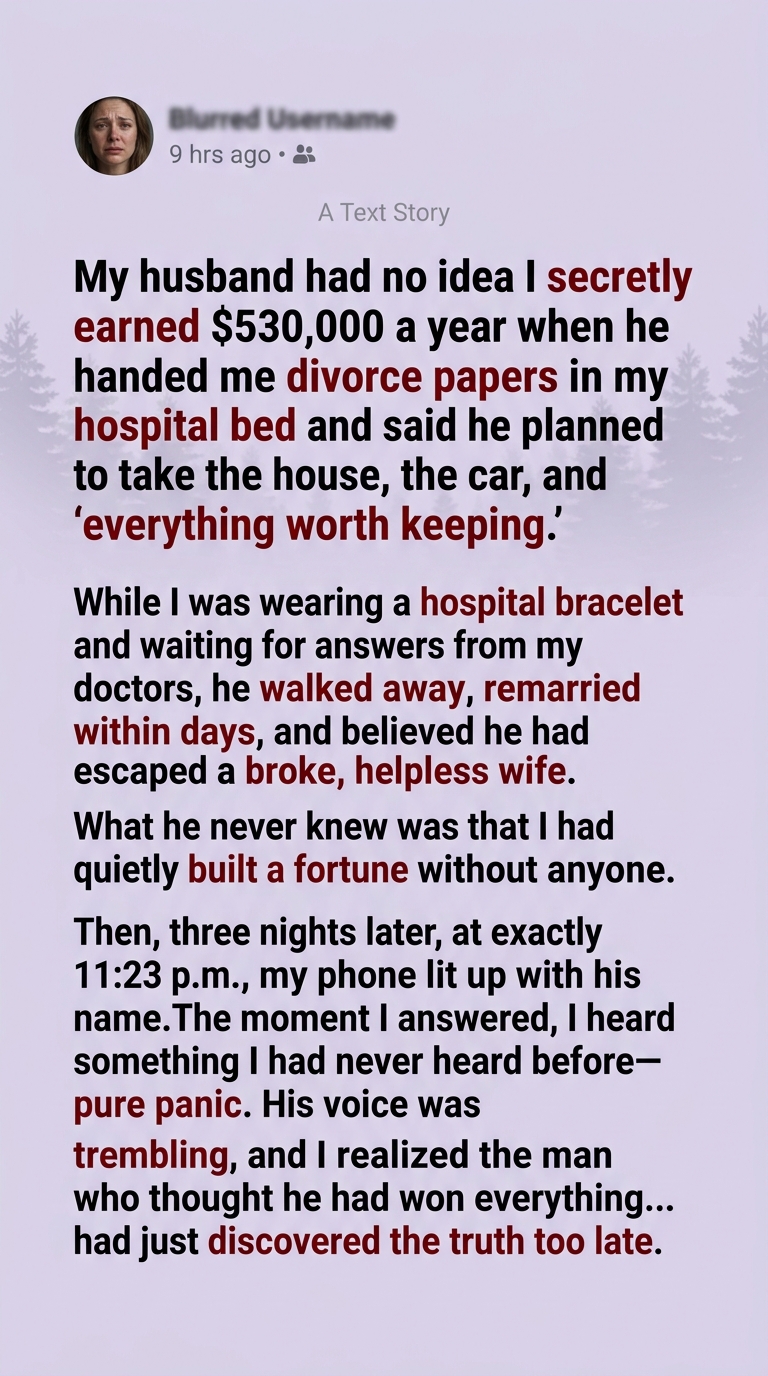
When my husband handed me divorce papers, I was lying in a hospital bed wearing a wristband with my name printed in faded black letters.
A nurse had just finished drawing blood.
My doctor was waiting for the results of several tests after weeks of unexplained exhaustion.
I felt scared.
Vulnerable.
And very much alone.
Richard chose that moment to end our twenty-two-year marriage.
He didn’t ask how I was feeling.
He didn’t ask what the doctors suspected.
He simply laid a folder across the hospital tray.
“I’ve already signed.”
I stared at him.
“What is this?”
“The divorce petition.”
I thought he was joking.
He wasn’t.
“I’ve met someone else.”
The words barely registered.
He continued talking as though he were discussing the weather.
“The lawyers have already prepared everything.”
He pointed to one page.
“I’ll keep the house.”
“The SUV.”
“The lake cabin.”
“And everything that’s actually worth keeping.”
I looked at him in disbelief.
“What about me?”
He shrugged.
“You’ll manage.”
Then he glanced around the small hospital room.
“You’ve never really earned much anyway.”
He picked up his jacket.
“I hope you don’t make this difficult.”
The door closed behind him.
I sat there staring at the unsigned papers until the nurse quietly removed them from my shaking hands.
She didn’t ask questions.
She simply squeezed my shoulder.
Sometimes kindness doesn’t require words.
Richard believed I depended on him financially.
That assumption wasn’t an accident.
For years, I had allowed him to think my small consulting work brought in only modest supplemental income.
What he never bothered to learn was what I actually did.
Five years earlier, after leaving a corporate executive position, I had started a specialized healthcare software consulting company.
Instead of opening a flashy office, I worked remotely.
Instead of buying luxury cars, I reinvested nearly everything.
Instead of talking about income, I talked about projects.
Richard never asked.
He wasn’t interested.
As long as the mortgage was paid and vacations happened on schedule, he assumed my business was little more than an expensive hobby.
The previous year’s tax documents—prepared separately through legal business structures and handled by professionals—showed my personal compensation had been approximately $530,000.
The company itself was worth considerably more.
Everything had been properly documented, properly reported, and kept separate according to the advice of accountants and attorneys.
Not because I was hiding assets.
Because that was the appropriate way to run the business.
Richard simply never cared enough to notice.
The doctors eventually gave me good news.
My condition required treatment, but it wasn’t the life-threatening illness everyone had feared.
For the first time in days, I felt hope.
Then I remembered the divorce.
My attorney, Melissa, visited me before I left the hospital.
She read through the papers.
Then looked up.
“Did Richard disclose your business interests in his financial statement?”
“No.”
“Did he ask about them?”
“No.”
She smiled faintly.
“That was… unwise.”
“What happens now?”
“We respond honestly.”
“No games.”
“No surprises.”
“We simply provide complete financial disclosures as required.”
I nodded.
“I don’t want revenge.”
“I know.”
“You want fairness.”
Exactly.
Three days later, I was resting at home.
At exactly 11:23 p.m., my phone rang.
The screen displayed one name.
Richard.
I almost ignored it.
Instead, I answered.
Before I could say hello, I heard something I’d never heard from him.
Fear.
Real fear.
His breathing was uneven.
“What have you done?”
“I don’t know what you’re talking about.”
“Your attorney sent financial disclosures.”
“Yes.”
“You make over half a million dollars a year?”
“That information is accurate.”
Long silence.
Then,
“Why didn’t you tell me?”
I almost laughed.
“You never asked.”
“I thought…”
“I know what you thought.”
He lowered his voice.
“The lawyer says your company may be considered separately from many of the assets I assumed I was taking.”
“She’s discussing the legal process with your attorney, I hope.”
“I’ve made a terrible mistake.”
Those words hung in the air.
Not because they sounded sincere.
Because they sounded frightened.
“What mistake?”
“I thought…”
“…I thought you needed me.”
There it was.
The truth.
Not love.
Not regret.
Power.
He had mistaken financial dependence for devotion.
“You believed leaving me in a hospital would leave me helpless.”
“I didn’t think—”
“No.”
“You didn’t.”
Over the following weeks, both sides exchanged the required financial information through their attorneys.
The legal process focused on valuing the marital estate, identifying separate and marital property under applicable law, and negotiating a fair resolution.
Some assets had been acquired before the marriage.
Others during it.
Some belonged to the business.
Others belonged jointly to us.
The outcome wasn’t determined by who spoke the loudest.
It was determined by documentation.
Richard quickly learned that assumptions aren’t legal evidence.
His attorney encouraged him to stop making demands based on guesses.
Mine encouraged me to remain calm.
I followed that advice.
One afternoon, Melissa called.
“I’ve received a settlement proposal.”
“And?”
“Much more reasonable.”
“What changed?”
She smiled.
“I suspect reality.”
Richard no longer insisted on “everything worth keeping.”
Instead, the proposal reflected a division that acknowledged the law, our documented finances, and the contributions each of us had made over the years.
I accepted some parts.
Negotiated others.
Eventually, we reached an agreement without a trial.
Walking out of the courthouse, I felt something unexpected.
Not victory.
Freedom.
Several months later, I heard through mutual acquaintances that Richard’s second marriage had ended almost as quickly as it had begun.
I didn’t celebrate.
Other people’s unhappiness had never made my own life better.
One evening, he sent an email asking if we could meet for coffee.
Curiosity won.
We met in a quiet café.
He looked older.
More tired.
“I’m sorry.”
I stirred my tea.
“For what?”
“For leaving.”
“For the timing.”
“For assuming the worst about you.”
He hesitated.
“And…”
“…for only realizing your value after reading a financial statement.”
I appreciated his honesty.
Painful as it was.
“I need you to understand something.”
“I’m listening.”
“If my income had actually been zero…”
“…leaving me in a hospital bed would still have been wrong.”
He nodded slowly.
“I know.”
“No.”
“You know now.”
There’s a difference.
He looked down.
“I confused success with money.”
“And?”
“And I confused your quietness with weakness.”
I smiled gently.
“A lot of people do.”
A year later, my company expanded again.
We hired more employees.
Launched new products that helped hospitals streamline patient care.
The work mattered.
Not because it increased my income.
Because it improved people’s lives.
One afternoon, a young entrepreneur asked me the secret to building a successful business while keeping it so private.
I laughed.
“I wasn’t trying to keep it secret.”
“I was simply too busy building it to perform it.”
She smiled.
“I like that.”
Looking back, people often assume this story is about a husband shocked to discover his wife was wealthy.
It isn’t.
It’s about the danger of deciding someone’s worth based on what you imagine they own.
Richard believed I had nothing because he never bothered to understand the life I had built.
He saw dependence where there was independence.
Weakness where there was resilience.
Silence where there was purpose.
The greatest surprise wasn’t my income.
It was discovering that the person who had shared my home for more than two decades had never really taken the time to know me at all.
Money didn’t change who I was.
It simply revealed who he had been all along.
And when the divorce was finally complete, I realized something worth far more than any settlement.
The richest part of my life had never been the balance in my accounts.
It was the confidence that I could build a future without relying on someone who only valued me after seeing the numbers.
That was the only fortune I truly needed.