The voicemail lasted only twenty-three seconds.
But it managed to erase thirty years of memories.
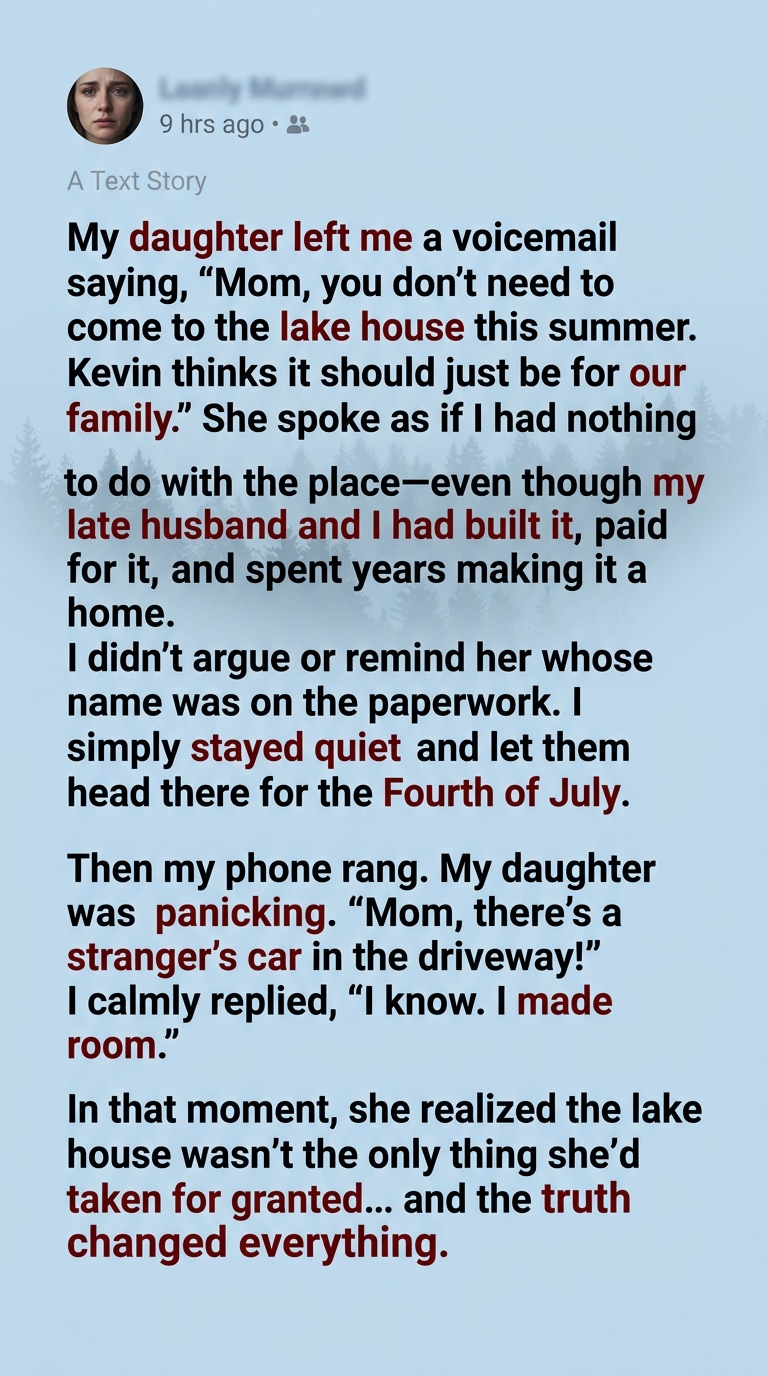
“Mom,” my daughter said cheerfully, “you don’t need to come to the lake house this summer. Kevin thinks it should just be for our family this year. We’ll see you when we get back. Love you!”
She hung up before I could answer.
I listened to it three more times.
Not because I hadn’t heard her correctly.
Because I couldn’t believe I had.
My name is Helen.
My late husband, Robert, and I bought a run-down cabin on Lake Ashford when we were twenty-eight.
Calling it a “lake house” back then would have been generous.
The roof leaked.
The dock leaned sideways.
The plumbing barely worked.
Every summer, Robert and I spent our vacation fixing something.
New windows one year.
A rebuilt porch the next.
Eventually, our two children learned to fish from that dock.
They celebrated birthdays there.
Graduations.
Anniversaries.
It became the heart of our family.
When Robert passed away, the property transferred to me exactly as we’d planned years earlier.
I never thought ownership would matter.
Family was family.
Or so I believed.
My daughter, Megan, married Kevin three years after Robert died.
Kevin was successful.
Confident.
Opinionated.
The kind of man who referred to other people’s belongings as “assets.”
At first, I ignored little comments.
“We should modernize this place.”
“You really ought to let us handle it.”
“It’s too much for one person.”
I smiled and changed the subject.
Then came the voicemail.
Not…
“Would you mind giving us one weekend?”
Not…
“Can we have some time alone?”
Just…
“You don’t need to come.”
As though I were a guest.
In my own home.
I didn’t call back.
I didn’t argue.
I simply wished them a wonderful holiday.
Then I made one phone call of my own.
Three months earlier, I’d agreed to host a nonprofit organization that provided week-long outdoor retreats for military veterans and first responders coping with trauma.
Their summer schedule had changed unexpectedly.
The director called to ask if the Fourth of July week had become available.
At the time, I’d said no.
Now…
It had.
I happily confirmed the reservation.
The group arrived Saturday morning.
Six veterans.
Two counselors.
A retired paramedic.
Quiet people looking for a peaceful place to heal.
Exactly the sort of guests Robert would have welcomed without hesitation.
Around noon, my phone rang.
Megan.
She sounded frantic.
“Mom!”
“There’s a strange SUV in the driveway!”
“I know.”
“I made room.”
Silence.
“What does that mean?”
“It means the lake house is occupied this week.”
“But…”
“We’re here!”
“I know.”
Kevin grabbed the phone.
“What is this?”
“A scheduled retreat.”
“You knew we were coming.”
“I knew you told me not to.”
Long silence.
Then…
“You rented out the house?”
“No.”
“I donated the week.”
“You can’t do that!”
I smiled sadly.
“Actually…”
“I can.”
For a few seconds, no one spoke.
Then I quietly added,
“You told me it was for your family.”
“I simply assumed that meant I wasn’t included.”
“So I made other plans.”
An hour later, Megan arrived at my house alone.
She wasn’t angry anymore.
She looked…
Ashamed.
“I didn’t think.”
“I know.”
“Kevin said…”
I gently interrupted.
“Megan…”
“I wasn’t hurt because you wanted time together.”
“I was hurt because you spoke as though I no longer belonged in the place your father and I built.”
She began crying.
“I never meant it that way.”
“I believe you.”
“But words still matter.”
The following weekend, after the retreat ended, I invited Megan to join me at the lake house.
Just the two of us.
We sat on the old dock eating sandwiches.
Exactly as we had when she was ten.
She finally asked the question she’d been avoiding.
“Who were those people?”
I smiled.
“Men and women who spent years protecting strangers.”
“They deserved a peaceful week.”
She nodded quietly.
“Dad would’ve loved that.”
“Yes.”
“He would have.”
Before we left that afternoon, I handed her a small envelope.
Inside was a copy of the original deed.
Across the top, in Robert’s handwriting, he’d written years earlier:
This house isn’t valuable because we own it.
It’s valuable because everyone who enters should feel welcome.
She read it twice.
Then whispered,
“I forgot.”
“No.”
“You got busy.”
“There’s a difference.”
Several months later, Kevin asked to meet.
“I owe you an apology.”
“You do.”
“I kept thinking of it as vacation property.”
He looked toward the lake.
“You still think of it as home.”
I smiled.
“Exactly.”
The next Fourth of July looked very different.
The veterans returned for one long weekend.
This time…
Megan volunteered to cook.
Kevin spent two days repairing the dock with several retired Marines.
Children chased fireflies across the yard.
Stories filled the porch long after sunset.
Nobody talked about ownership.
Because everyone finally understood the point.
A year later, I updated my estate plan.
Not to punish anyone.
To protect the purpose of the place.
The lake house would eventually pass to my children through a family trust.
One condition appeared at the top of the document:
The property must remain available each year for at least one charitable retreat serving military veterans, first responders, or families in need.
When Megan read it, she smiled.
“Dad would’ve approved.”
“He suggested it first.”
People often think this story is about inheritance.
It isn’t.
It’s about belonging.
A house becomes a home because people are welcomed through the front door—not because someone’s name appears on a deed.
The lake house survived storms, floods, and decades of harsh winters.
What nearly damaged it most wasn’t weather.
It was forgetting the spirit in which it had been built.
My daughter thought I’d taught her how to fish there.
How to swim.
How to make s’mores over a campfire.
In the end…
The most important lesson came much later.
Never mistake someone’s kindness for the loss of their place.
And never forget that the people who built your home should never have to ask whether they’re still welcome inside it.