The words that changed my life weren’t shouted.
They were spoken calmly across our kitchen table.
My father looked directly at me and said,
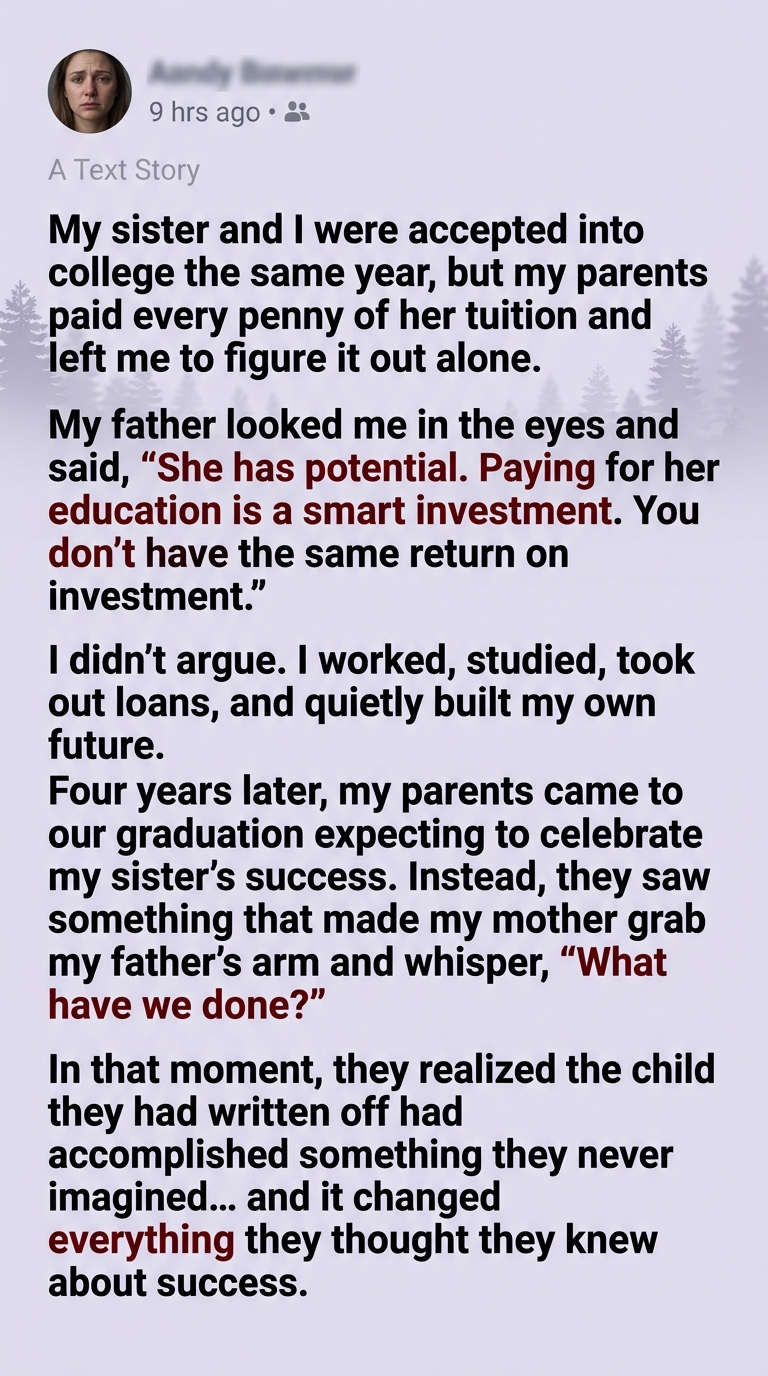
“Your sister is the better investment.”
Then he explained why.
“We only have enough savings to fully pay for one college education.”
“She has more potential.”
“Helping her makes financial sense.”
He folded his hands.
“You don’t offer the same return on investment.”
My mother didn’t disagree.
She simply nodded.
That hurt even more.
My name is Sarah.
My younger sister, Emma, had always been the family’s star.
Straight-A student.
Captain of the debate team.
Student council president.
She deserved every compliment she received.
The problem wasn’t that my parents loved her accomplishments.
It was that they treated mine as invisible.
When our acceptance letters arrived, we both celebrated.
Emma was accepted into one of the state’s best business schools.
I earned admission into an engineering program.
I still remember thinking,
“We’re both going to college.”
I had no idea only one of us would have help getting there.
My parents emptied their college fund for Emma.
Tuition.
Housing.
Books.
Meal plan.
Even spending money.
When I asked what the plan was for me, Dad answered without hesitation.
“Student loans.”
“Part-time work.”
“You’ll manage.”
He smiled as though he’d complimented me.
“You’re resilient.”
He meant it kindly.
It still broke my heart.
I didn’t argue.
There wasn’t any point.
Instead, I accepted every scholarship I could earn.
Worked evenings at a grocery store.
Tutored calculus on weekends.
Cleaned university laboratories during overnight shifts.
Some semesters I slept four hours a night.
There were weeks when instant noodles were a luxury.
I graduated owing more money than I’d ever imagined.
But I graduated.
Emma had a very different college experience.
Study abroad.
Spring break trips.
Internships arranged through family friends.
She worked hard.
She earned good grades.
None of that was her fault.
The difference was simply that she never had to wonder whether she could afford next month’s rent.
During my final year, one of my professors recommended me for a national engineering competition.
I almost declined.
The project required hundreds of unpaid hours.
Instead, I took the chance.
Our team designed an affordable water purification system for rural communities.
Against all expectations…
We won.
The project attracted attention from several companies.
One offered me a full-time position before graduation.
Another funded further research.
Everything I’d worked toward quietly began falling into place.
Graduation day finally arrived.
My parents came wearing shirts printed with my sister’s university colors.
They carried flowers for Emma.
A giant banner.
Custom balloons.
They hadn’t realized my ceremony took place in the same arena one hour earlier.
As graduates filed onto the stage, an announcer’s voice echoed through the auditorium.
“This year’s Chancellor’s Medal recognizes extraordinary academic achievement, leadership, and service.”
My father barely looked up.
He assumed the award would go to someone he’d never heard of.
Then the announcer smiled.
“This year’s recipient is…”
“Sarah Bennett.”
The arena erupted in applause.
My parents froze.
My mother slowly lowered the bouquet she’d brought for Emma.
I walked across the stage wearing gold honor cords and the university medal.
The Chancellor shook my hand.
Then continued speaking.
“Miss Bennett’s research has already been licensed for humanitarian use in several developing communities.”
“She graduates today with highest honors.”
“And begins work next month leading a research division.”
My mother whispered,
“What have we done?”
My father didn’t answer.
He couldn’t.
After the ceremony, I found them standing quietly near the entrance.
No cameras.
No celebration.
Just silence.
Finally, Dad spoke.
“I was wrong.”
I smiled gently.
“About what?”
He looked down.
“I treated my children like investment portfolios.”
“I forgot they were people.”
For a moment, nobody spoke.
Then Emma stepped beside me.
She wrapped one arm around my shoulders.
“You know…”
“I’ve been waiting four years to say something.”
Dad looked confused.
She smiled.
“Sarah wasn’t ever the risky investment.”
“You just never bothered reading the whole résumé.”
We all laughed.
Even Dad.
Through tears.
A few weeks later, my first paycheck arrived.
The amount amazed me.
Not because of the number.
Because it represented something I’d built entirely on my own.
That evening, I received a call from my father.
“I need help.”
My heart sank.
“What happened?”
He hesitated.
“We’re struggling financially.”
For a moment, I remembered every late-night shift.
Every loan payment.
Every conversation about “return on investment.”
Then I asked,
“What do you need?”
He sounded surprised.
“You’d still help us?”
I answered honestly.
“I’m helping because of who I choose to be.”
“Not because of who you were.”
Over the following years, our relationship slowly healed.
Not because anyone pretended the past hadn’t happened.
Because we finally spoke honestly about it.
Dad admitted he’d confused measurable success with predictable success.
He thought funding the child who already looked successful was the safest choice.
Life had other plans.
One Christmas, he handed me a small wrapped box.
Inside was a simple wooden plaque he’d made himself.
Burned into the wood were seven words.
Never measure potential by today’s circumstances.
I hung it in my office the next morning.
It still hangs there today.
Years later, I returned to my old university to speak with incoming first-generation students.
One young woman nervously asked,
“What if nobody believes in me?”
I smiled.
“Then borrow their doubt.”
She frowned.
“What do you mean?”
“Use it as fuel.”
“But never let someone else’s expectations become your ceiling.”
People often think this story is about college tuition.
It isn’t.
The money mattered.
The loans mattered.
But those weren’t the hardest part.
The hardest part was believing I deserved opportunities after being told I wasn’t worth investing in.
My parents eventually learned something every family should know.
Children are not financial assets.
They’re not business decisions.
Love isn’t measured by expected returns.
And the greatest mistake adults make isn’t underestimating a child’s talent.
It’s underestimating what encouragement—or the lack of it—can shape for years.
My father once believed I wasn’t a good investment.
In the end…
The most valuable lesson either of us received had nothing to do with money.
It was learning that human potential can’t be calculated on a spreadsheet.
Sometimes…
The person everyone overlooks becomes the one who changes the room simply by walking across the stage.