The moment my daughter lifted her sweater, I stopped breathing.
Dark purple bruises stretched across her ribs.
Some were fresh.
Others were already turning yellow.
No playground accident could have caused them.
No seven-year-old should ever have to hide them.
My name is Daniel.
My daughter, Lily, had always loved school.
She counted down the days until first grade.
She adored art class.
She made friendship bracelets for everyone.
Then, little by little, she changed.
She stopped asking to ride the bus.
She complained of stomachaches every Sunday night.
She begged to stay home.
Whenever I asked what was wrong, she’d whisper,
“I’m okay.”
I wanted to believe her.
I wish I hadn’t.
The school carnival was supposed to be a happy day.
Cotton candy.
Face painting.
Ring toss.
For a while, Lily smiled.
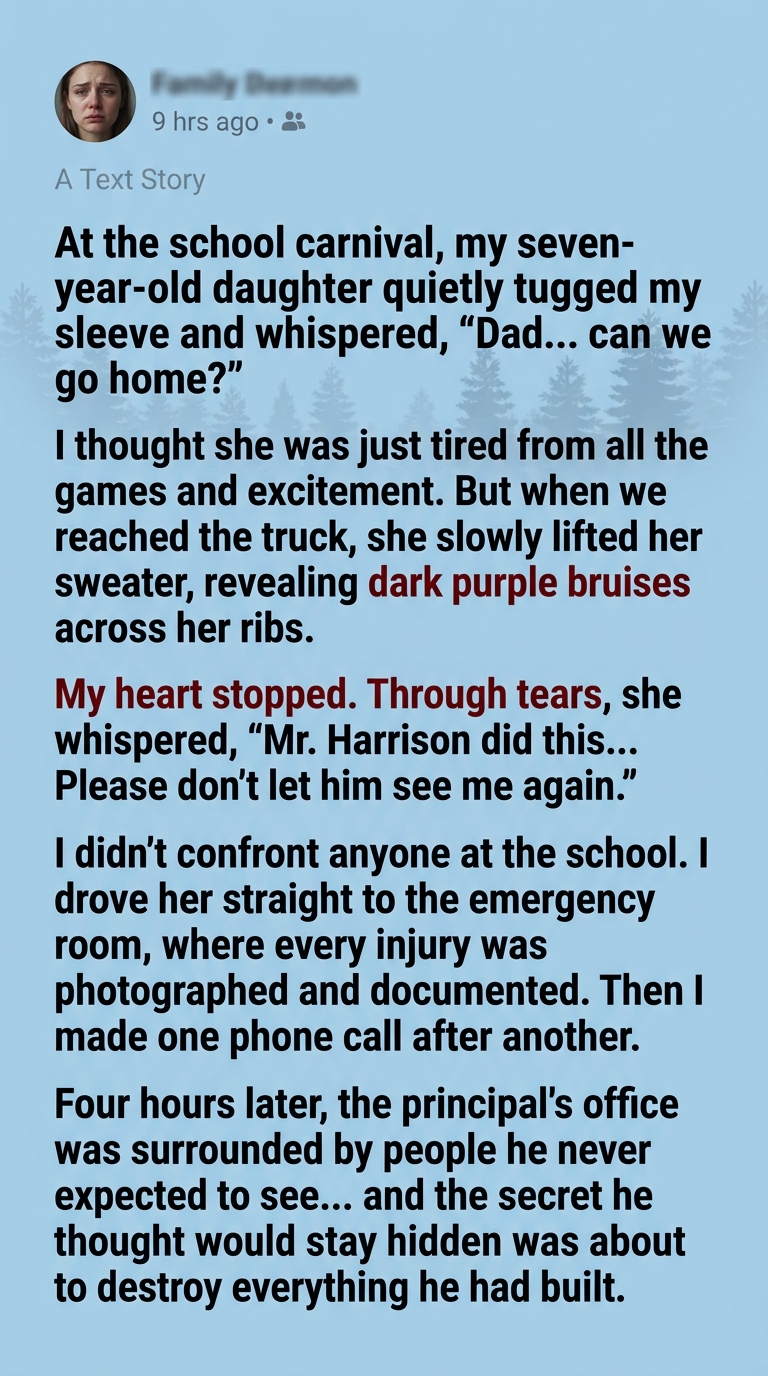
Then she quietly tugged my sleeve.
“Dad…”
“Can we go home?”
I thought she was simply tired.
We walked to my truck.
As soon as the doors closed, she burst into tears.
“Daddy…”
She slowly lifted her sweater.
I felt my heart drop.
“Who did this?”
She couldn’t look at me.
Finally, she whispered,
“Mr. Harrison.”
Then came the words no parent ever wants to hear.
“Please don’t let him see me again.”
Every instinct told me to drive back to the school.
Instead…
I drove to the emergency department.
Because anger could wait.
My daughter’s safety couldn’t.
The medical team examined her immediately.
A physician carefully documented every visible injury.
Photographs were taken according to hospital protocol.
A child-protection specialist spoke with Lily in a quiet room designed to help children feel safe.
No one pressured her.
No one interrupted her.
They simply listened.
Lily explained that Mr. Harrison had repeatedly grabbed her roughly whenever she “made mistakes.”
She believed she’d get into trouble if she told anyone.
“He said nobody would believe me.”
A social worker gently reassured her.
“You did the right thing by telling your dad.”
Those words seemed to lift a weight from her shoulders.
From there, the proper reporting process began.
Hospital staff made the required notifications to child protective authorities and law enforcement.
The school district was informed through official channels.
Everything was documented.
Everything followed established procedures.
By evening, investigators had arrived at the school.
The principal, who had been preparing to lock up after the carnival, was surprised to see multiple officials requesting immediate access to records and staff information.
No accusations were made publicly.
But the investigation moved quickly.
Over the following weeks, investigators interviewed students, parents, teachers, and school employees.
Several families came forward with concerns they’d previously dismissed because their children had been too frightened or embarrassed to explain what had happened.
Each report was examined independently.
Every child was interviewed using age-appropriate forensic procedures.
Mr. Harrison was immediately removed from classroom duties while the investigation continued.
The school district announced a full review of its reporting procedures and staff training.
Counseling services were offered to affected families.
Throughout it all, Lily asked only one question.
“Did I do something wrong?”
I knelt beside her.
“No.”
“You told the truth.”
“And telling the truth is never wrong.”
Healing took time.
For months, she startled whenever someone raised their voice.
She didn’t want to return to school.
With support from counselors, patient teachers, and a new classroom environment, she slowly regained her confidence.
One small step at a time.
Nearly a year later, Lily entered the school art show.
She painted a picture of herself standing beneath a huge oak tree with sunlight breaking through the branches.
When I asked what it meant, she smiled.
“The tree keeps little birds safe.”
I hugged her.
“I like that.”
She grinned.
“I knew you would.”
At the end of the school year, the principal invited parents to speak about ways to strengthen student safety.
I stood before the audience and said only a few words.
“The bravest person in our family isn’t me.”
“It’s my seven-year-old daughter.”
“She found the courage to tell the truth.”
“Our job as adults is to make sure every child knows someone will listen.”
The room stood in quiet applause.
Not for me.
For every child who deserves to be heard.
Looking back, people sometimes ask whether I wanted revenge.
The answer is no.
I wanted something much more important.
I wanted my daughter to know that when she trusted me with the hardest truth she’d ever spoken, I would believe her, protect her, and follow the proper steps to keep her safe.
That’s what every child deserves.
The bruises eventually faded.
The fear slowly faded too.
But one lesson remained.
When a child whispers, “Please don’t let them hurt me again,” the most powerful response isn’t anger.
It’s believing them—and making sure they never have to face that fear alone again.