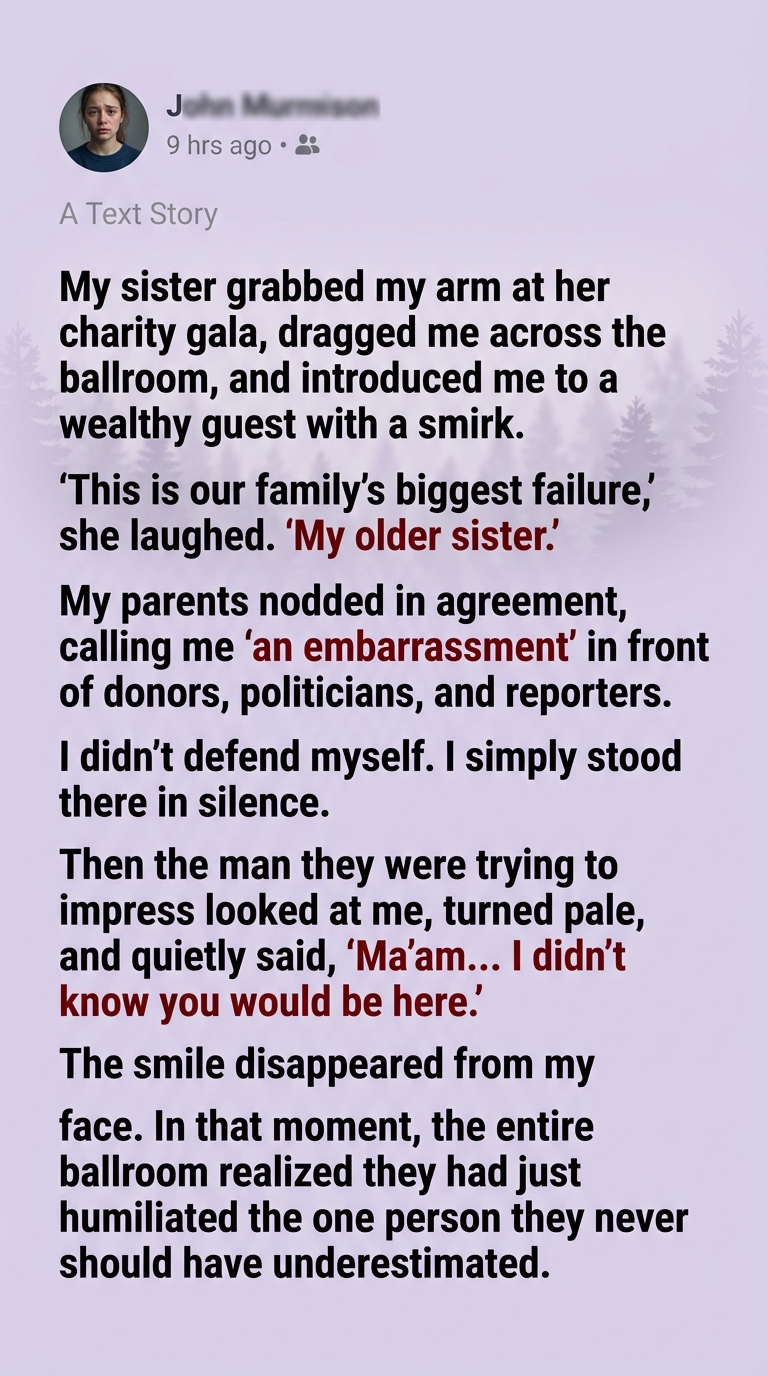
The entire ballroom heard my sister laugh.
“This,” she announced with a smile, “is our family’s biggest failure.”
Then she tightened her grip on my arm and pulled me closer to the man she’d been so eager to impress.
“My older sister.”
“My parents gave up on her years ago.”
Around us, several guests chuckled politely.
My mother nodded.
My father took a sip of his wine and added,
“We’ve learned not to expect much.”
I didn’t say a word.
Sometimes…
Silence is louder than an argument.
My name is Catherine.
For most of my childhood, I lived in my younger sister Olivia’s shadow.
She was beautiful.
Confident.
Popular.
Everything seemed to come naturally to her.
I was quiet.
Preferred libraries to parties.
Volunteering to social events.
My parents mistook quietness for lack of ambition.
When I was twenty-two, I turned down a high-paying corporate job.
Instead, I accepted a position with a nonprofit that built clean-water systems in remote communities.
My father called it foolish.
“You’ll never make real money.”
My mother sighed.
“You’re wasting your education.”
Olivia laughed.
“Have fun saving the world.”
So I did.
For twenty years, I traveled wherever I was needed.
Villages without safe drinking water.
Schools with no sanitation.
Communities rebuilding after disasters.
I rarely appeared in photographs.
The work wasn’t about recognition.
It was about results.
Eventually I became executive director of an international humanitarian foundation.
The title sounded impressive.
The work still meant muddy boots and long flights.
I never talked about it at family gatherings.
No one asked.
Every year Olivia hosted a lavish charity gala.
Ironically, she’d built her reputation around fundraising.
This year’s event attracted business leaders, elected officials, journalists, and philanthropists.
She invited me at the last minute.
I almost declined.
Then I remembered something an old mentor once told me.
“Never avoid a room simply because someone hopes you’ll feel unwelcome.”
So I went.
I wore a simple navy dress.
No designer label.
No diamonds.
Just my grandmother’s silver earrings.
Within minutes, I realized I’d made a mistake.
Nobody greeted me.
Servers assumed I was waiting for someone.
My parents barely acknowledged me.
Then Olivia spotted me.
“There you are!”
She smiled brightly.
“I want you to meet someone.”
Before I could answer, she wrapped her hand around my arm and guided me across the ballroom.
Standing near the stage was one of the evening’s honored guests.
A distinguished older gentleman surrounded by reporters.
Olivia beamed.
“Mr. Alvarez, I’d like you to meet my family.”
She paused dramatically.
“And this…”
She laughed.
“…is our family’s biggest failure.”
“My older sister.”
My father nodded.
“Catherine always had potential.”
“She just never did anything important with it.”
My mother added,
“She means well.”
The small crowd laughed politely.
I kept my eyes on Mr. Alvarez.
His expression changed completely.
He looked at me for several seconds.
Then quietly asked,
“Ma’am…”
“I didn’t know you would be here.”
The room fell silent.
Olivia frowned.
“You two know each other?”
He smiled.
“I should certainly hope so.”
He turned toward the audience.
“This is Dr. Catherine Bennett.”
“My foundation has partnered with hers for the past twelve years.”
No one spoke.
Mr. Alvarez continued.
“Every major clean-water initiative we’ve funded in East Africa…”
“Every rural health project in Central America…”
“Every emergency response program after last year’s flooding…”
“She led them.”
He looked genuinely surprised.
“You didn’t tell your family?”
I smiled softly.
“They never asked.”
The silence became almost unbearable.
Several reporters quietly lowered their cameras.
Others quickly raised them again.
Only this time…
They weren’t photographing the gala.
They were photographing me.
The master of ceremonies hurried to the microphone.
“Ladies and gentlemen…”
“It seems we’ve overlooked introducing one of tonight’s most distinguished guests.”
He glanced toward me.
“Dr. Bennett recently received the International Humanitarian Leadership Medal for overseeing projects that have improved access to clean water for millions of people.”
The ballroom erupted into applause.
Not polite applause.
Real applause.
Olivia stared at me.
“You…”
“You never said.”
I answered calmly.
“You’d already decided who I was.”
My father finally found his voice.
“We didn’t know.”
I smiled sadly.
“I know.”
The remainder of the evening felt strangely quiet.
People approached to ask about villages, medical clinics, and engineering projects.
Not once did anyone ask how much money I’d earned.
They wanted to know about impact.
Lives.
Hope.
As the gala ended, Olivia caught up with me outside.
“I’m sorry.”
I looked at her.
“For embarrassing you?”
She shook her head.
“No.”
“For spending twenty years trying to measure success with the wrong ruler.”
Months later, she asked if I’d help redesign the foundation’s charitable programs.
“Not for publicity,” she said.
“For purpose.”
We worked together for the first time in our lives.
It wasn’t perfect.
Healing rarely is.
But it was honest.
Years later, after our parents had grown older, my father visited one of the villages where our organization had completed a clean-water project.
He watched children filling bottles from a new well.
No long lines.
No contaminated river.
No fear.
On the flight home, he quietly turned to me.
“I spent years wondering why you chose this life.”
He looked out the window.
“Now I wonder why I couldn’t see its value sooner.”
I reached over and squeezed his hand.
“You’re here now.”
“That’s enough.”
People often remember the moment my sister called me the family’s biggest failure.
I remember something different.
I remember the moment the room discovered that success isn’t always loud.
It doesn’t always arrive in expensive cars or tailored suits.
Sometimes success wears sensible shoes, carries a passport full of humanitarian visas, and quietly changes lives without asking for applause.
The ballroom didn’t change who I was that night.
It simply revealed who I had been all along.
And my family learned a lesson that no amount of wealth could buy:
Never confuse a quiet life with a small one.
The people doing the greatest good often have the least interest in announcing it themselves.