The hardest part of burying my wife wasn’t watching the casket disappear beneath a blanket of white roses.
It was realizing that some of the people standing around her grave had already started talking about life after she was gone.
As if the woman we loved had become an inconvenience instead of a memory.
My name is Victor.
My wife, Elena, and I were married for thirty-two years.
She had the kind of laugh that filled an entire room.
She remembered every birthday.
Every anniversary.
Every favorite meal.
If someone came to our house hungry, they never left that way.
She believed family wasn’t something you inherited.
It was something you chose every day.
Cancer arrived quietly.
Within eighteen months, it had taken almost everything except her kindness.
Even during chemotherapy, she worried more about whether I was eating enough than about herself.
That was Elena.
Always giving.
Even when she had almost nothing left to give.
The funeral was held on a rainy Tuesday.
Friends.
Neighbors.
Former coworkers.
People from every stage of our lives came to say goodbye.
I stood beside her casket trying to memorize the flowers she’d chosen months earlier.
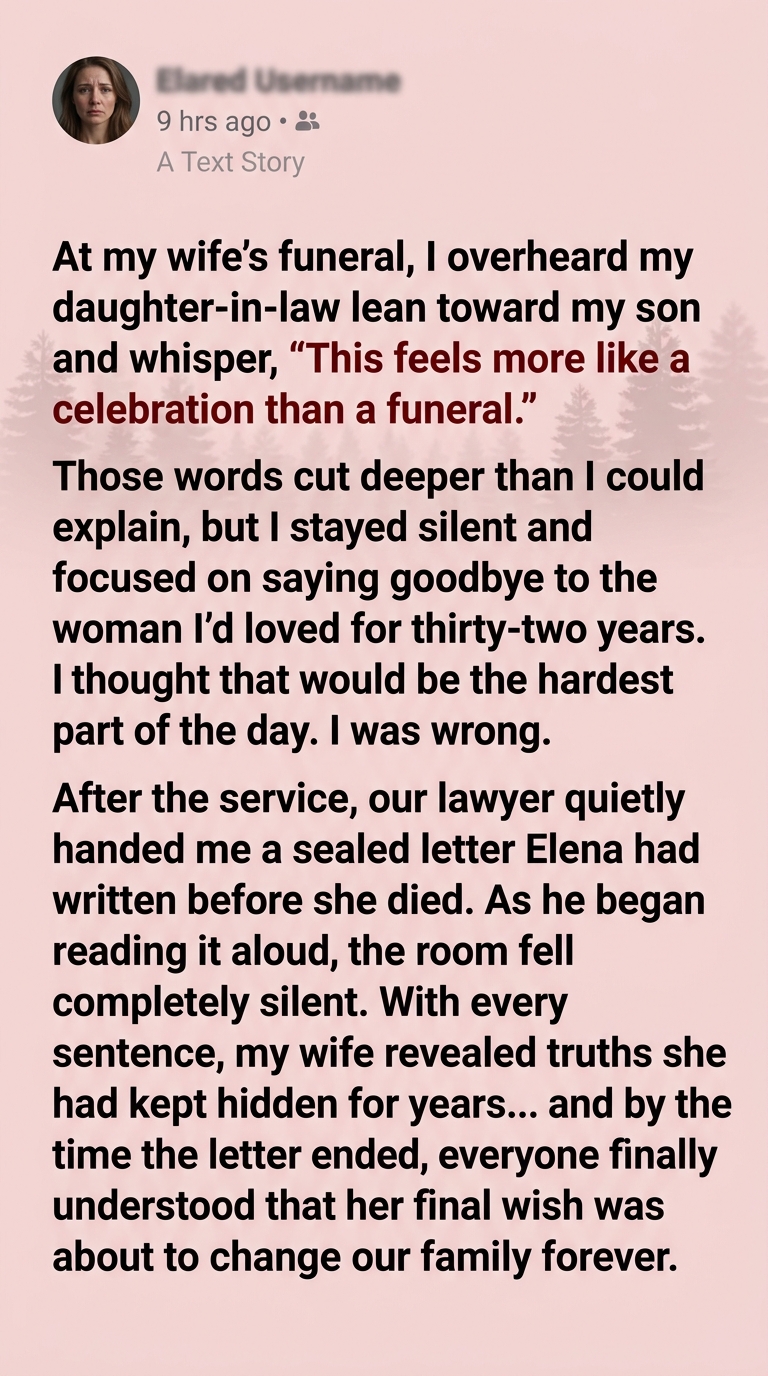
That’s when I heard my daughter-in-law.
She leaned toward my son and whispered,
“This feels more like a celebration than a funeral.”
My son gave an uncomfortable laugh.
“I know.”
“At least it’s almost over.”
I closed my eyes.
Not because I was angry.
Because I suddenly understood that grief doesn’t arrive equally for everyone.
Still…
The words hurt.
After the final guests had gathered in the reception hall, our family attorney quietly approached me.
“Victor.”
“It’s time.”
He held a sealed envelope.
On the front, in Elena’s familiar handwriting, were four simple words.
Read this together.
The room slowly became quiet.
The attorney unfolded several handwritten pages.
Then began reading.
To everyone I love,
If you’re hearing these words, then I’ve already had to say goodbye.
Please don’t spend today arguing about what I owned.
Spend it remembering why we gathered in the first place.
Several people wiped away tears.
The attorney continued.
I’ve spent months watching something happen that broke my heart.
Not the cancer.
The distance growing between people who once couldn’t imagine life without one another.
I glanced around the room.
No one spoke.
Victor,
You’ve loved me with more patience than I deserved.
Please keep living.
Promise me you won’t mistake loneliness for loyalty.
I lowered my head.
She knew me too well.
Then came something none of us expected.
To my children…
You keep talking about the lake house, the savings, and the jewelry.
I know because walls are thinner than you think, and hospital rooms have long memories.
Several faces turned pale.
You’re worried about inheritance.
I understand.
But I hope you’ll remember something important.
Nothing you’re hoping to receive was created overnight.
Every dollar represents years your father worked overtime.
Every room in our house contains sacrifices you were too young to notice.
Silence settled over the room.
The attorney reached the final pages.
I’ve already placed everything into a family trust.
Not because I don’t love you.
Because I love you enough to protect you from fighting over things that should never divide you.
The house will never be sold while your father wishes to live there.
After that, if all of you agree, keep it.
If not, sell it and divide the proceeds equally.
No one gets more because they ask louder.
Then came Elena’s final request.
Every Christmas Eve, anyone who wants to remain a beneficiary of this trust must come to the house—not for paperwork, not for gifts, but for dinner together.
If someone chooses not to come, that’s okay.
Love can’t be forced.
But family requires showing up.
A few quiet laughs broke through the tears.
That sounded exactly like Elena.
Gentle.
Practical.
Hopeful.
The attorney smiled before reading the last paragraph.
If you’re all sitting together while this letter is being read…
Then my final wish has already begun.
Please don’t waste it.
Life is far too short to spend it counting what you’ll inherit instead of appreciating who is still sitting beside you.
Take care of each other.
Especially your father.
He’ll pretend he’s stronger than he feels.
The room was completely silent.
My daughter-in-law slowly stood.
She walked across the room until she stood in front of me.
“I’m sorry.”
She couldn’t even finish the sentence before tears interrupted her.
“I wasn’t thinking.”
I nodded gently.
“I know.”
That Christmas Eve, every chair around Elena’s dining table was filled.
Not because of the trust.
Because everyone realized how close we’d come to losing something much more valuable than money.
Conversation.
Forgiveness.
One another.
Years passed.
Grandchildren filled the house with noise.
The old recipes stayed exactly the same.
Someone always burned the dinner rolls.
Someone always laughed too loudly.
Exactly the way Elena would’ve wanted.
One Christmas, my youngest grandson asked why we always left one empty chair at the table.
I smiled.
“That’s Grandma’s seat.”
“Is she coming?”
I looked around the room at my children, my grandchildren, and the laughter filling every corner.
I answered honestly.
“In a way…”
“She never really left.”
People often think this story is about an inheritance.
It isn’t.
The trust protected the money.
But Elena’s real legacy wasn’t financial.
It was understanding that wealth disappears.
Homes eventually change owners.
Jewelry gets divided.
What lasts are the traditions that remind people to keep choosing each other.
The letter didn’t save our family because it contained legal instructions.
It saved us because it reminded us that grief can either pull people apart…
…or teach them what truly matters before it’s too late.
My wife spent her final months preparing one last gift.
Not for our bank accounts.
For our hearts.
And every Christmas Eve, when the house is full again, I quietly thank her for knowing exactly what our family needed—even after she was gone.