The entire terminal went quiet.
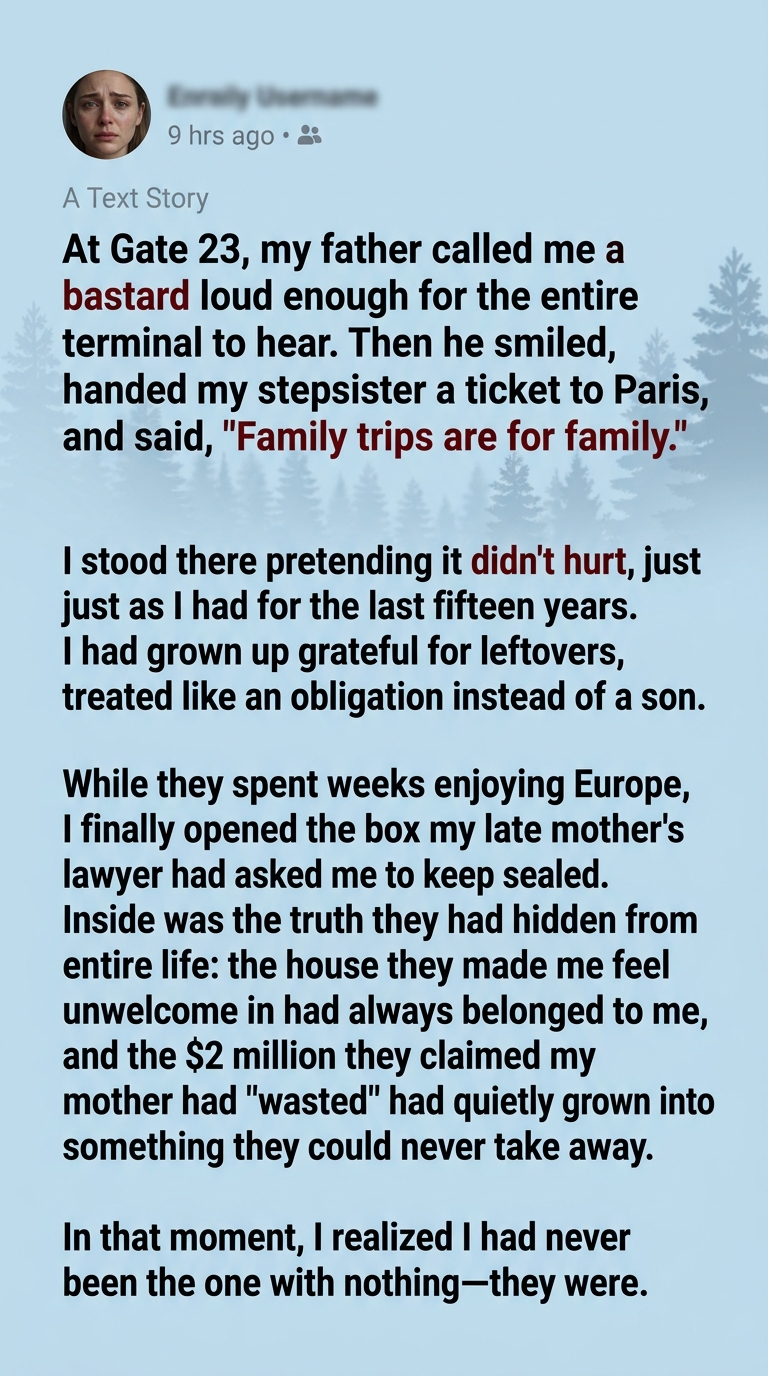
My father didn’t lower his voice.
He wanted everyone to hear.
“You’re a bastard.”
Then he slipped two boarding passes into my stepsister Emma’s hand, smiled proudly, and said,
“Family trips are for family.”
People looked away.
Some pretended to scroll through their phones.
Others stared just long enough to understand something painful was happening before returning to their own conversations.
I stood there smiling.
Not because I wasn’t hurt.
Because I’d learned long ago that crying only made my father angrier.
My name is Noah.
My mother died when I was seven.
Cancer.
Slow enough for us to say goodbye.
Too fast for me to understand what goodbye really meant.
Six months later, my father remarried.
His new wife brought along her five-year-old daughter, Emma.
At first, I thought I’d gained a sister.
Instead…
I slowly lost my place in my own family.
The rules changed without anyone ever announcing them.
Emma got a new bedroom.
I stayed in the converted laundry room.
Emma received birthday parties.
I got cake after everyone else finished celebrating.
When money was tight, I wore my father’s old clothes.
Emma always had something new.
If relatives asked why, my father laughed.
“Noah doesn’t care about those things.”
The truth was…
Nobody had ever asked me.
As I grew older, I convinced myself gratitude was enough.
Be thankful for leftovers.
Be thankful you still have a roof.
Be thankful they let you stay.
I never realized how dangerous that kind of thinking could become.
When I turned twenty-two, my father announced he was taking Emma and his wife on a three-week vacation through Europe.
Paris.
Rome.
Barcelona.
I wasn’t invited.
I hadn’t expected to be.
Still…
Watching him hand Emma her ticket hurt more than I wanted to admit.
Especially after what he said at Gate 23.
I drove home alone.
Not to my father’s house.
To the small apartment I’d been renting for almost two years.
Waiting on my kitchen table sat an old cedar box.
It had been there since my eighteenth birthday.
Delivered by my late mother’s attorney with one instruction.
Open this only when you’re ready to live without seeking your father’s approval.
For years, I’d ignored it.
That afternoon…
I finally understood what those words meant.
Inside were several folders.
Photographs.
Letters.
And one envelope marked,
Property Deed.
I frowned.
The first document transferred ownership of our family home.
Not to my father.
To a trust my mother had established before she died.
The trust named exactly one beneficiary.
Me.
My father had been appointed temporary trustee only until I reached twenty-five.
I was twenty-two.
The property had never legally become his.
He had only managed it.
My hands trembled.
There had to be some mistake.
Then I opened the next folder.
Investment statements.
My mother had left two million dollars in a conservatively managed investment trust.
She hadn’t “wasted everything on medical bills,” as I’d been told.
The funds had remained invested for fifteen years.
Carefully.
Patiently.
The account balance had grown far beyond its original value.
Alongside the statements was a letter from my mother’s attorney.
Your mother worried that grief might influence decisions made after she was gone.
She wanted you protected—not only financially, but emotionally.
That’s why everything was placed in trust until you were mature enough to manage it yourself.
I cried harder than I had in years.
Not because of the money.
Because my mother had spent her final months trying to protect a future she knew she wouldn’t live to see.
Over the following weeks, I met with the trustee and reviewed every document.
Everything had been handled exactly according to my mother’s wishes.
The house remained part of the trust until my twenty-fifth birthday.
The investments were legally mine to oversee through the trust structure.
No dramatic confrontations.
No surprise takeovers.
Just careful planning carried out over many years.
When my father returned from Europe, he called.
“We need to talk.”
“I agree.”
We met at a quiet café.
He looked tired.
Older.
Before he could begin, I placed copies of the trust documents on the table.
He stared at them for a long time.
Then quietly asked,
“You know.”
“I do.”
He closed his eyes.
“I should’ve told you.”
“You should have.”
For several minutes neither of us spoke.
Finally, he whispered,
“I kept telling myself I was protecting the family.”
I looked at him.
“Which family?”
He had no answer.
Months later, after many difficult conversations, I learned something I hadn’t expected.
My father hadn’t stolen the trust.
He hadn’t emptied the accounts.
The trustee’s oversight had prevented that.
Instead, he’d allowed resentment, guilt, and poor decisions to poison our relationship.
He’d convinced himself that treating me differently was somehow justified.
It never was.
On my twenty-fifth birthday, legal ownership of the house transferred exactly as my mother intended.
I stood alone in the front yard for a long time.
Not thinking about property values.
Thinking about childhood.
About my mother planting roses along the fence.
About summer evenings on the porch.
About the feeling of belonging.
I didn’t move into the house.
Instead, I restored it.
Then established a scholarship in my mother’s name for students who had lost a parent.
Every year, another young person received the opportunity she’d wanted for me.
That mattered far more than living there.
Several years later, Emma visited.
She looked around the restored living room and quietly said,
“I never knew.”
“I know.”
“I thought Dad was telling us the truth.”
“I believe you.”
She smiled sadly.
“I’m sorry you grew up feeling like a guest in your own home.”
I looked toward my mother’s favorite window.
“So am I.”
People often think this story is about inheritance.
It isn’t.
The house mattered.
The trust mattered.
The money created opportunities.
But none of those things healed the little boy who believed he had to earn leftovers.
Healing began the day I realized my worth had never depended on whether someone else chose to recognize it.
My mother understood that long before I did.
She couldn’t stay to protect me herself.
So she left behind something even stronger than money.
A future no one else’s rejection could erase.
Looking back…
The greatest gift she ever gave me wasn’t a house or an investment account.
It was proof that I had always belonged—even when the people around me made me feel as though I never did.