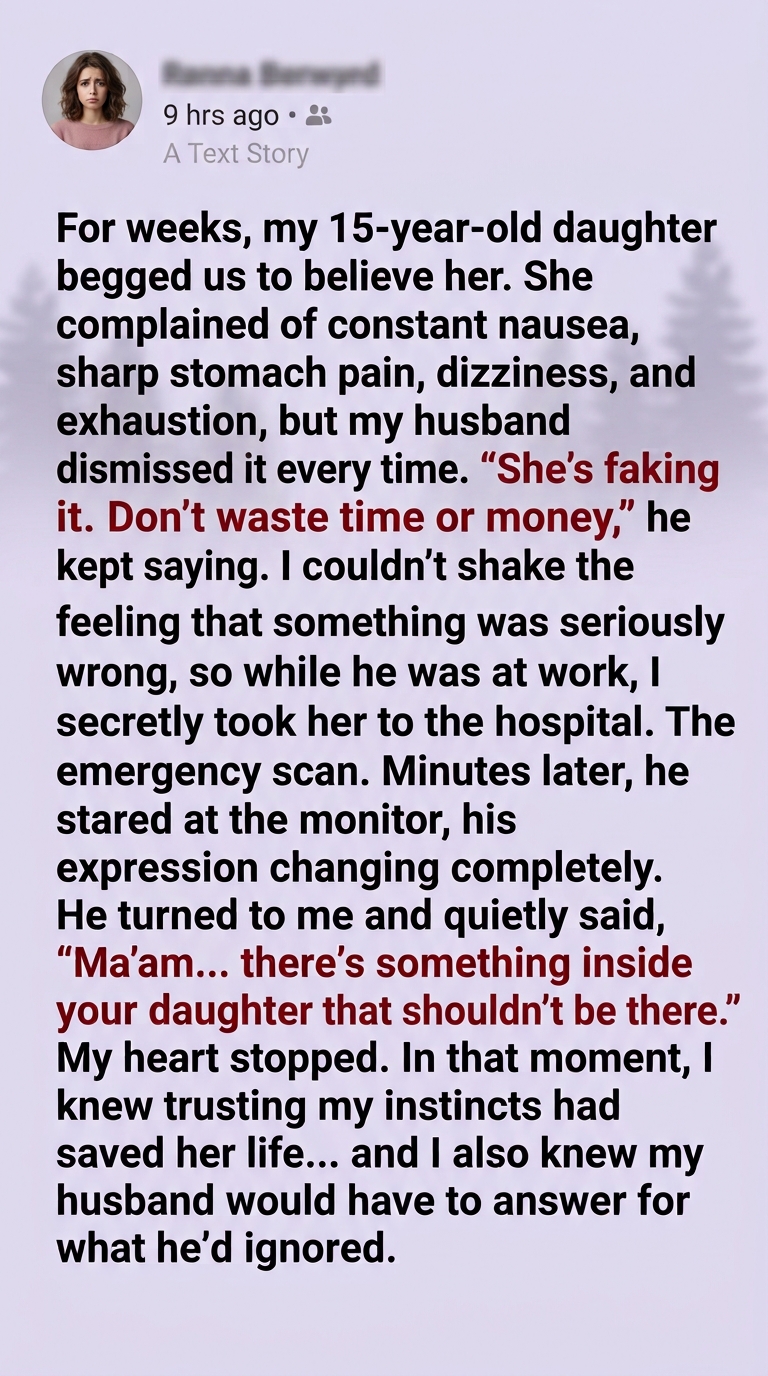
For three weeks, my daughter kept saying the same thing.
“Mom… something’s wrong.”
Every morning she woke up pale.
Every afternoon she curled into a ball on the couch.
Every night she fell asleep before dinner.
My husband had one explanation for everything.
“She’s a teenager.”
“She’s trying to skip school.”
“Don’t encourage it.”
I wanted to believe him.
Instead…
I believed my daughter.
And that decision changed everything.
My name is Laura.
My daughter, Ava, was fifteen.
She’d always been active.
Soccer practice twice a week.
Honor-roll student.
The kind of kid who apologized if she missed one homework assignment.
Then, almost overnight, she changed.
She stopped eating.
Said food made her nauseous.
She complained about sharp pains on her right side.
Sometimes she became so dizzy she had to sit on the floor.
My husband, Mark, dismissed every symptom.
“She’s exaggerating.”
“It’s stress.”
“When I was fifteen, nobody ran to the hospital every time they had a stomachache.”
Ava heard every word.
She stopped mentioning the pain around him.
But every night, when I tucked her into bed, she’d whisper,
“Mom… I’m really scared.”
One Tuesday morning, Mark left early for work.
Ava looked gray.
She could barely stand.
That was enough for me.
I grabbed my keys.
“We’re going to the hospital.”
The emergency physician listened carefully.
He didn’t interrupt Ava once.
After examining her, he ordered blood tests and an urgent abdominal scan.
I sat beside the bed trying to stay calm.
Ava squeezed my hand so tightly my fingers hurt.
Then the doctor returned.
He stared at the monitor for several long seconds.
His expression changed completely.
He looked at me and quietly said,
“Mrs. Carter…”
“There’s something inside your daughter that shouldn’t be there.”
My heart nearly stopped.
He quickly explained.
The scan showed a large mass near one of her ovaries.
They couldn’t yet say exactly what it was.
But it required immediate attention from the surgical team.
Everything suddenly moved very fast.
Specialists arrived.
More imaging was performed.
Within hours, Ava was scheduled for emergency surgery.
Those hours were the longest of my life.
Every possible thought raced through my mind.
What if we’d waited another week?
Another day?
Another hour?
I couldn’t bear to think about it.
The surgeon met me afterward.
She smiled gently.
“The operation went well.”
I felt my knees give way with relief.
She explained that the mass had been removed successfully and sent for detailed testing.
The final results would take several days, but she was optimistic because we’d acted before it caused even more serious complications.
When Mark arrived at the hospital, he looked confused.
“I thought she just had a stomach bug.”
I couldn’t answer.
Not yet.
I was too busy watching Ava sleep peacefully for the first time in weeks.
A few days later, the surgeon reviewed the pathology results with us.
The growth was not what anyone had hoped to find, but it had been discovered early enough that the doctors were confident they had an excellent treatment plan.
She looked directly at Ava.
“You did exactly the right thing by speaking up.”
Then she turned to me.
“And you did exactly the right thing by listening.”
Those words stayed with me forever.
The following months weren’t easy.
There were follow-up appointments.
Treatment.
Physical therapy.
Counseling.
Some days Ava laughed.
Some days she cried.
Healing rarely happens all at once.
One evening, Mark quietly sat beside her bed.
“I owe you an apology.”
Ava looked at him.
“I thought you didn’t believe me.”
He lowered his head.
“I didn’t.”
“And I was wrong.”
He didn’t make excuses.
He didn’t blame work or stress.
He simply admitted the truth.
It was the beginning of rebuilding something he’d almost lost.
A year later, Ava returned to the soccer field.
When she scored her first goal after recovering, she looked toward the stands.
I was cheering so loudly people around me laughed.
Mark was standing beside me, clapping with tears in his eyes.
After the game, he hugged her and whispered,
“From now on, when you tell me something’s wrong…”
“I’m listening.”
Years later, Ava spoke at a school health awareness event.
She stood in front of hundreds of students and said,
“Your body belongs to you.”
“If something doesn’t feel right, keep telling someone until you’re heard.”
Afterward, several teenagers came forward to thank her.
Some said they’d been afraid to speak up about their own symptoms.
She listened to every one of them.
People sometimes tell me this story is about a mother’s intuition.
I don’t think that’s quite right.
It wasn’t magic.
It wasn’t a special instinct.
It was something much simpler.
I listened.
My daughter knew something was wrong with her own body.
The doctors used their training to find the cause.
Together, that partnership gave her the best possible chance.
The greatest lesson our family learned wasn’t that parents always know best.
It was that children deserve to be taken seriously when they say something feels wrong.
Sometimes the bravest words a child can say are,
“I don’t feel okay.”
And sometimes the most important words a parent can say in return are,
“I believe you.”