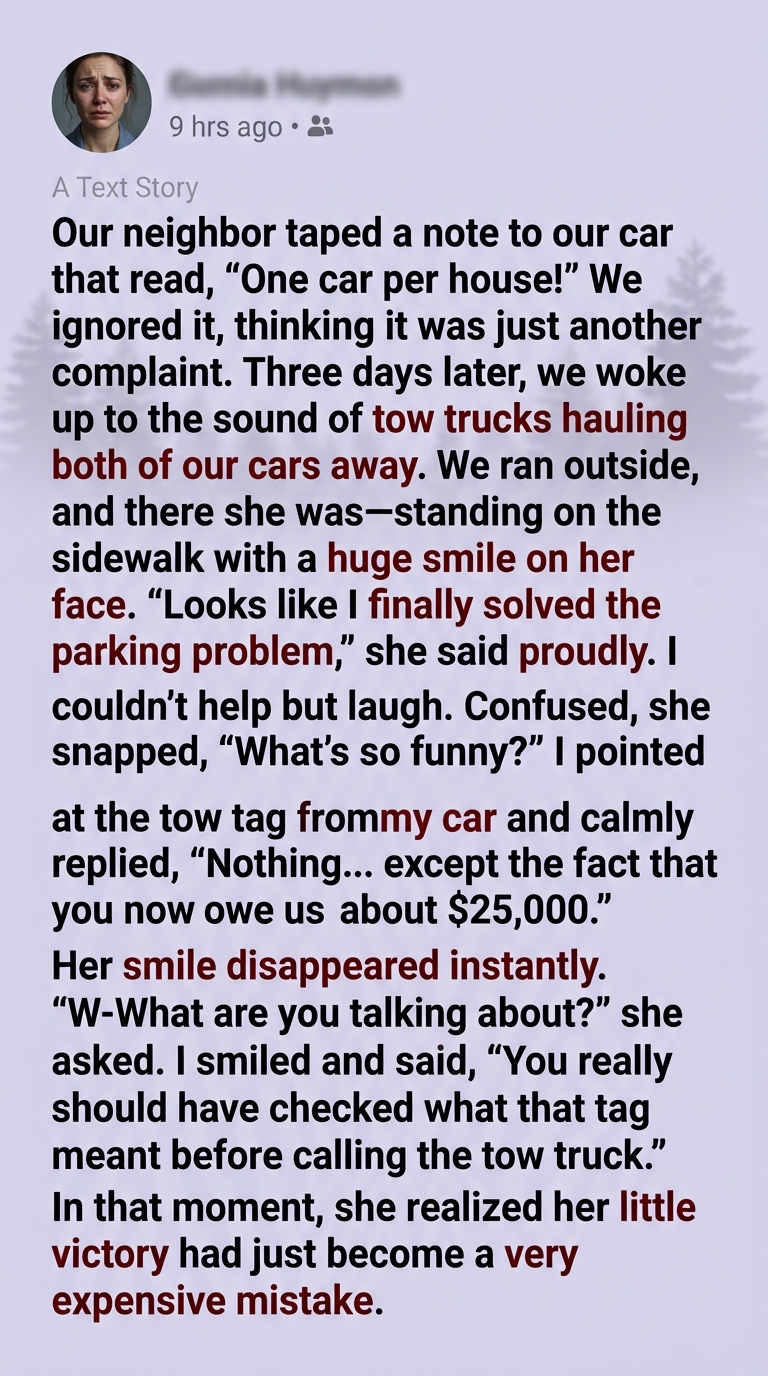
Our neighbor thought she had finally won.
She stood on the sidewalk with her arms folded, smiling as two tow trucks hauled away both of our cars.
She even waved.
“I finally solved the parking problem,” she announced proudly.
I looked at the orange tow tag fluttering from my windshield.
Then I started laughing.
She frowned.
“What’s so funny?”
I pointed toward the tag.
“Nothing.”
“Except the fact that you now owe us about twenty-five thousand dollars.”
Her smile disappeared.
“W-What are you talking about?”
I shook my head.
“You really should’ve read the tag before calling the tow company.”
My name is Michael.
My wife, Erin, and I had lived on Maple Court for six years.
It was a quiet neighborhood.
Kids rode bicycles.
People borrowed lawnmowers.
Most disagreements ended with a conversation.
Then Carol moved in next door.
Carol believed the curb in front of her house belonged exclusively to her.
It didn’t.
The street parking was public.
No assigned spaces.
No permits.
No restrictions beyond the city’s normal rules.
But that didn’t stop her.
First came handwritten notes.
ONE CAR PER HOUSE!
Then came complaints every time relatives visited us.
“If you own two cars,” she’d say, “buy a bigger driveway.”
We tried to stay polite.
“We’re parked legally.”
She hated that answer.
Three days before everything happened, she taped another note directly onto my windshield.
This one was written in thick red marker.
NEXT TIME I’M CALLING A TOW TRUCK.
I took a picture, removed the note, and went inside.
Erin laughed.
“She’s never going to stop.”
“No.”
“But eventually she’ll make a mistake.”
Neither of us realized how right that would turn out to be.
What Carol didn’t know was that one of our cars wasn’t an ordinary vehicle.
It was a fully restored 1968 Mustang.
The restoration had taken four years.
Every modification had been professionally documented.
Because of its value, our insurance company required a specialized collector-vehicle policy.
As part of that policy, the windshield carried a notice identifying the vehicle as covered under a collector insurance agreement and instructing that any unauthorized towing or damage be documented immediately.
Most people ignored the sticker.
Carol apparently never even noticed it.
Three mornings later, loud engines woke us just after sunrise.
Tow trucks.
Two of them.
Both of our cars were already being winched onto flatbeds.
I ran outside.
“So what’s going on?”
One driver replied,
“We received a complaint that these vehicles were illegally parked.”
Before I could answer, Carol stepped forward wearing the biggest smile I’d ever seen.
“Looks like I finally solved the parking problem.”
I walked over to the Mustang.
The orange tow authorization tag was hanging from the mirror.
The collector-vehicle notice was still clearly visible beneath it.
I couldn’t help laughing.
Carol looked offended.
“What’s so funny?”
I pointed at the notice.
“Nothing.”
“Except that you probably owe us about twenty-five thousand dollars.”
Her face went blank.
“What?”
The tow supervisor paused.
He leaned closer to the windshield.
Then his expression changed.
He quietly asked,
“Is this… your collector vehicle?”
“Yes.”
He immediately stopped his crew.
“What does that mean?” Carol demanded.
I answered calmly.
“It means this vehicle required specific handling procedures.”
“It also means someone falsely reported it as illegally parked.”
The supervisor sighed.
“We’re going to need to sort this out.”
The police were called—not because of the parking, but to document what had happened.
The officers confirmed what we’d been saying all along.
Our cars had been legally parked on a public street.
No parking ordinance had been violated.
The tow had been initiated based on false information.
The collector-car insurer also sent an appraiser to inspect the Mustang after it was returned, because even a careful tow can affect a high-value restored vehicle.
Fortunately, the car suffered only minor cosmetic damage.
But the investigation, inspections, transportation, and insurance claim created substantial costs.
Those costs weren’t simply assigned to Carol on the spot.
Instead, they became part of the legal and insurance process, where responsibility for the false towing request and resulting expenses was evaluated.
Several weeks later, we attended a mediation session.
Carol looked nothing like the triumphant woman from the sidewalk.
She quietly admitted she’d assumed that if she complained loudly enough, the city would automatically be on her side.
She’d never checked the actual parking rules.
She’d never expected anyone to challenge her claims.
The matter was eventually resolved through the appropriate legal and insurance channels.
The towing company corrected its procedures.
The insurer recovered the covered losses where appropriate.
Carol was responsible for significant costs related to her actions.
The exact amount mattered far less than the lesson behind it.
A month later, Carol knocked on our front door.
She wasn’t carrying another complaint.
She was carrying a pie.
“I’m sorry.”
She looked genuinely embarrassed.
“I let something small turn into something ridiculous.”
I smiled.
“It happens.”
“No.”
She shook her head.
“I convinced myself I owned something that was never mine.”
“The street.”
From that day forward, the neighborhood changed.
Not because everyone suddenly became best friends.
Because people started talking to each other before calling authorities.
If someone had guests over, neighbors simply adjusted for a day or two.
It turned out cooperation required far less effort than conflict.
Years later, new families occasionally asked why everyone on our street was so relaxed about parking.
The older neighbors would laugh.
Then someone would point toward my restored Mustang and say,
“Let’s just say we all learned that reading the rules is cheaper than making assumptions.”
People often think this story is about a collector car.
It isn’t.
The Mustang could have been any vehicle.
The real lesson was much simpler.
Being annoyed doesn’t make you right.
And trying to “win” a neighborhood disagreement by misusing rules or making false reports can create consequences far greater than the inconvenience you were trying to solve.
Sometimes the smartest move isn’t calling the tow truck.
It’s knocking on the front door.