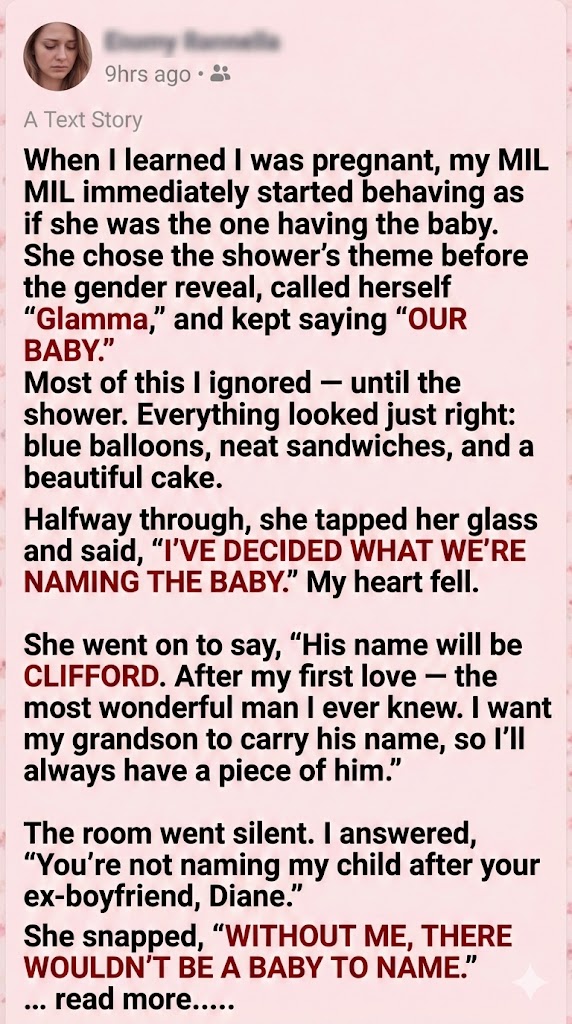
The room stayed frozen after her words. Plates hovered mid-air. Someone coughed. My husband stood up slowly, his chair scraping loud against the floor.
“Mom,” he said, calm but deadly serious, “you’re done.”
She laughed like it was a joke. “I’m just saying facts. If I hadn’t raised you, none of this would exist.”
He shook his head. “That’s not how this works. This is our child. Mine and my wife’s. You don’t get credit. You don’t get ownership. And you definitely don’t get naming rights.”
Her smile cracked. “I was just honoring someone important to me.”
I finally stood, one hand on my stomach. My voice surprised even me—steady, clear.
“This baby is not a memorial. He is not your second chance. He is not ‘our baby.’ He is my child.”
She scoffed. “You’re being emotional.”
“No,” I said. “I’m being a mother.”
I thanked everyone for coming, picked up my purse, and walked out. My husband followed without hesitation. The party ended right there—half-cut cake, untouched gifts, blue balloons drooping like they understood.
The next day, my husband sent one message to the family group chat:
There will be no more talk of names, titles, or ownership. Anyone who can’t respect our boundaries will not be part of our child’s life.
Diane didn’t speak to us for weeks. When she finally did, it was an apology—thin, careful, clearly forced. We accepted it, but nothing went back to how it was.
When our son was born, we named him Elliot. A name chosen with love, not nostalgia.
Diane met him a month later. No speeches. No claims. No “our baby.”
Just a quiet reminder, cradled in my arms, that becoming a parent means learning when to stand your ground—and who you’re standing it for.