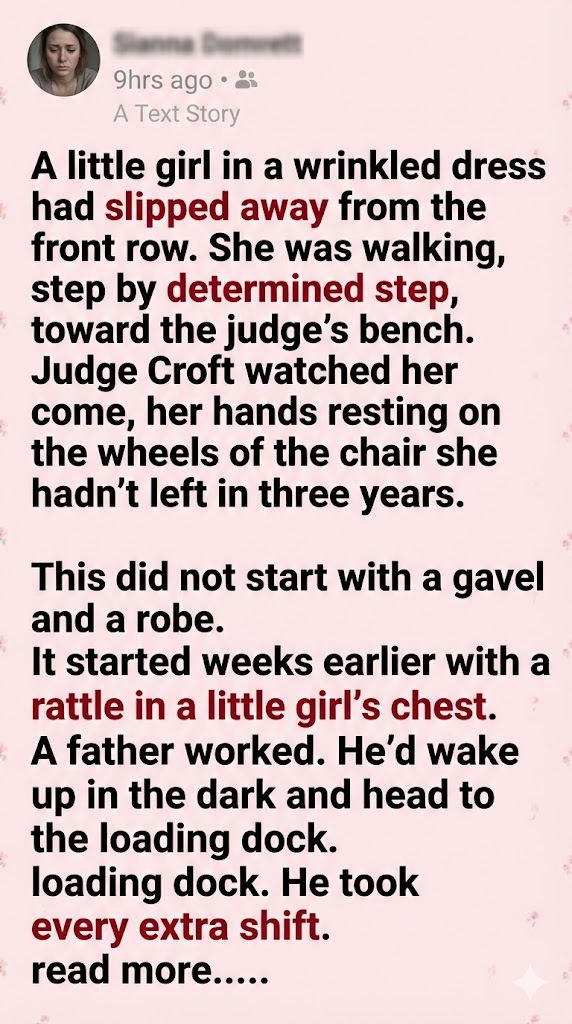
The little girl reached the rail before anyone stopped her. The courtroom held its breath.
Judge Croft leaned forward, the wheels of her chair still beneath her hands, the way they always were. She had learned long ago that power didn’t come from standing.
“What is your name, sweetheart?” she asked gently.
“Emily,” the girl said. Her voice rattled, the same sound that had haunted her father’s nights.
This did not begin with a courtroom. It began with coughs that wouldn’t go away. With steam from hot showers and cold medicine lined up on the counter. With a man counting hours instead of sleep.
Emily’s father worked the docks. Steel-toed boots. Bent back. Bruised hands.
When the doctor said the word hospitalization, he didn’t ask how bad it was—he asked how much it would cost.
So he took every extra shift.
Double nights. Weekends. Holidays. He missed school plays and bedtime stories, but he never missed a bill. When insurance stopped covering treatments, he sold his truck. When that wasn’t enough, he sold the wedding ring he never took off.
Still, it wasn’t enough.
The notice came folded in half. Final warning.
The day they shut off the power, Emily’s breathing worsened. The machines stopped. The apartment went silent except for her chest fighting for air.
He carried her six blocks in the rain.
Someone called an ambulance. Someone else called Child Services.
They said he’d neglected her.
In court, they spoke in clean words: failure to provide, unsafe conditions, removal for the child’s best interest. They didn’t talk about the extra shifts. Or the empty fridge because prescriptions came first. Or the way he slept in the hospital chair every night, afraid she’d stop breathing if he closed his eyes.
Emily stood at the rail now, hands shaking.
“They say my daddy didn’t take care of me,” she said, looking straight at Judge Croft. “But he did. He always did.”
The courtroom shifted.
“He sings when I can’t sleep,” Emily continued. “And he makes my medicine taste less bad. And he told me if I got scared, I should remember he’s right there—even if I can’t see him.”
She turned, pointing to the man sitting alone at the defense table, shoulders folded inward like he was trying to disappear.
Judge Croft felt the familiar ache in her legs—useless, silent—but her voice was steady.
“Emily,” she said softly, “do you know why you’re here today?”
The girl nodded. “Because grown-ups forgot something.”
The judge waited.
“They forgot that loving someone doesn’t always look clean.”
Silence fell hard and heavy.
Judge Croft reached for the gavel, then stopped. Instead, she rested both hands on the bench.
“This court recognizes neglect,” she said slowly, eyes sweeping the room. “But it also recognizes sacrifice. And today, the evidence shows a father who gave everything he had—and then kept giving.”
She ruled custody restored. Emergency assistance granted. Charges dismissed.
Emily ran to her father. He dropped to his knees, crying into her hospital sweater, holding her like the world might try to take her again.
Judge Croft watched them leave together.
That night, she rolled herself to the window of her chambers and looked out at the city lights. Justice, she knew, wasn’t about rules alone.
Sometimes, it was about listening to the smallest voice in the room.