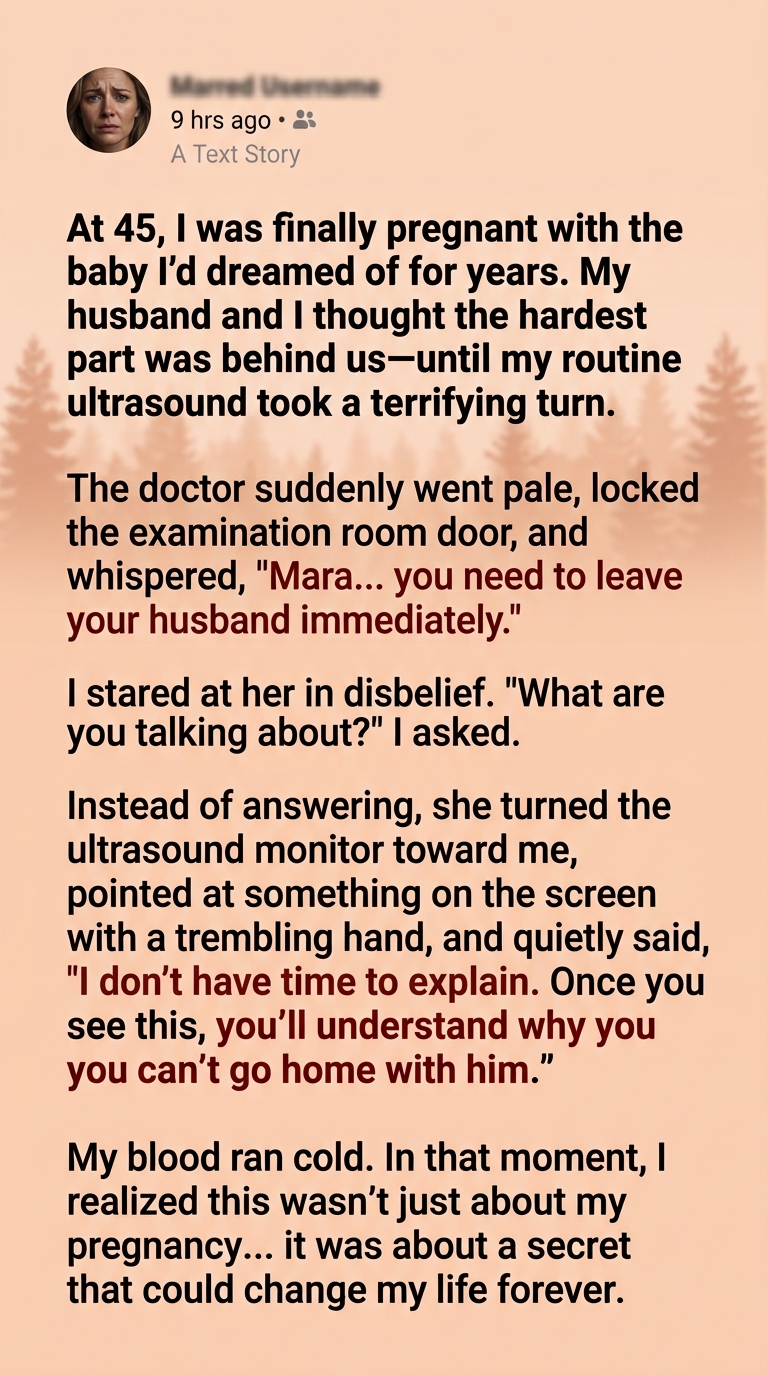
At forty-five, I thought the hardest part was finally over.
Years of infertility.
Three miscarriages.
Countless appointments.
More tears than I could ever count.
When I finally saw two pink lines on the pregnancy test, I cried for an hour.
My husband, Nathan, cried with me.
We believed our miracle had finally arrived.
We had no idea how quickly fear could replace joy.
My name is Mara.
I was twenty-two weeks pregnant when we went in for what we expected would be a routine anatomy scan.
Nathan sat beside me holding my hand.
We laughed as our daughter kicked against the ultrasound probe.
The technician smiled.
“She’s very active.”
Everything felt perfect.
Then the technician stopped smiling.
She quietly excused herself to “grab the doctor.”
A few minutes later, Dr. Alvarez entered the room.
She carefully repeated part of the ultrasound herself.
Her expression became serious.
She asked Nathan politely,
“Would you mind waiting in the lobby for just a few minutes? I’d like to discuss a medical finding with Mara first.”
He looked surprised but nodded.
“Of course.”
After he left, she closed the examination room door—not because she was hiding something from him, but to give us privacy while discussing sensitive medical information.
She sat beside me.
“Mara, I need to talk with you alone.”
My heart began pounding.
“Is my baby okay?”
She took a slow breath.
“We’ve found something concerning.”
She turned the ultrasound monitor toward me.
Not to show me anything about my husband.
To show me my baby.
“There appears to be a serious abnormality that needs immediate evaluation by a maternal-fetal medicine specialist.”
I stared at the screen without understanding.
Then she asked a question that seemed completely unrelated.
“Mara… are you safe at home?”
I blinked.
“What?”
“Has anyone ever physically hurt you?”
“No.”
“Has anyone threatened you or tried to control your medical care?”
Again, I answered,
“No.”
She nodded thoughtfully.
Then explained.
The pattern of injuries and findings she was seeing could sometimes occur for many different reasons.
Most often, they were related to medical or genetic conditions.
Occasionally, they prompted doctors to privately ask every patient routine safety questions to ensure no one was being harmed or pressured.
She emphasized that she was not accusing anyone of anything.
She simply needed to ask.
I felt relief wash over me.
Nathan wasn’t the mystery.
My baby was.
And that was frightening enough.
Within hours, I was transferred to a regional fetal medicine center.
There, specialists performed more detailed imaging.
After several anxious days and additional testing, they identified the likely cause.
Our daughter had a rare congenital condition affecting the development of part of her skeleton.
It wasn’t caused by anything either of us had done.
It wasn’t anyone’s fault.
It simply happened.
The good news was that the team believed it could be managed with specialized care after birth.
When I told Nathan everything, he hugged me so tightly I could barely breathe.
“I thought they’d found something wrong with me.”
I laughed through tears.
“I think we both imagined the worst.”
The following months were filled with appointments.
Surgeons.
Genetic counselors.
Neonatal specialists.
Every visit taught us something new.
Every visit reminded us that uncertainty is one of the hardest parts of becoming a parent.
Our daughter, Grace, arrived six weeks early.
The neonatal team was waiting.
She cried immediately.
The sweetest sound I’d ever heard.
Within hours, specialists confirmed the diagnosis and began treatment.
Her road wouldn’t be easy.
But she had one.
And that was everything.
Years later, Grace learned to walk with the help of braces and countless hours of therapy.
She loved painting.
Hated broccoli.
And never met a dog she didn’t want to pet.
One afternoon, she asked why there were so many baby pictures of doctors holding her.
I smiled.
“Because a lot of people worked together to help you get here.”
At one of Grace’s follow-up appointments, I saw Dr. Alvarez again.
She remembered us immediately.
“I still think about that day.”
“So do I.”
I thanked her—not because she had frightened me, but because she had taken every concern seriously, protected my privacy, and made sure I received expert care without delay.
People often ask whether that ultrasound changed my life.
It did.
Not because it revealed some hidden conspiracy or secret about my husband.
Because it reminded me how important careful medicine is.
Doctors sometimes ask difficult questions in private.
They do it to protect patients, gather accurate information, and make sure everyone is safe.
Those questions can feel frightening in the moment.
But they’re part of providing compassionate care.
The biggest lesson from that day wasn’t about fear.
It was about trust.
Trusting skilled professionals to investigate concerns.
Trusting each other enough to face uncertainty together.
And discovering that the strongest marriages aren’t built by avoiding frightening moments—
They’re built by walking through them side by side.