I Gave a Stranger My Last $20. Two Days Later, She Changed My Life.
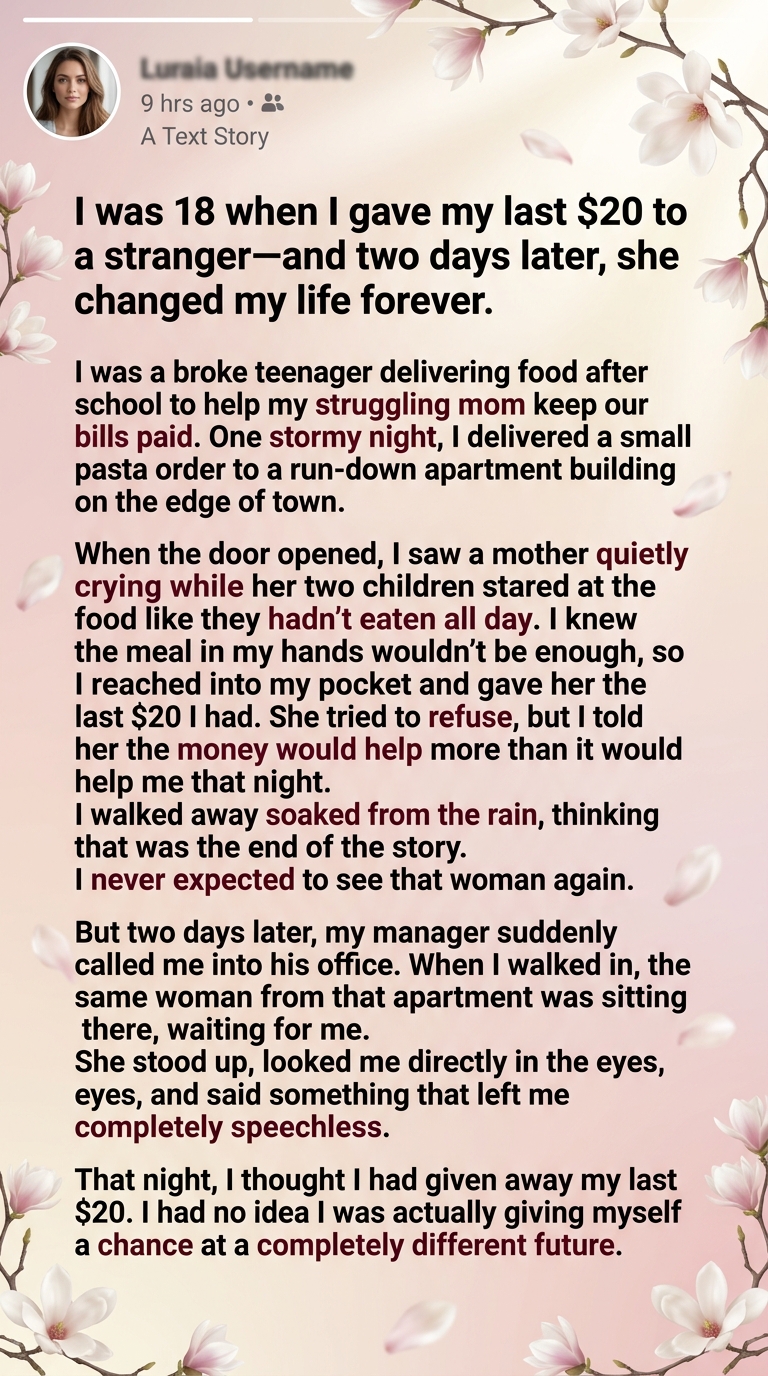
I was eighteen when I gave away my last $20.
At the time, I didn’t think it was anything special.
I was just a broke teenager trying to help my mom keep the lights on.
I went to school during the day and delivered food after classes.
Every dollar mattered.
My mom worked too, but between rent, groceries, utilities, and everything else, there was never enough.
That night, a storm rolled into town.
Rain hammered the roads.
My manager almost sent everyone home.
But I needed the money.
So I grabbed one last delivery.
A small pasta order.
The address was an old apartment building on the edge of town.
The hallway smelled damp.
Several lights were burned out.
I knocked.
A woman opened the door.
She looked exhausted.
Behind her stood two little children.
They weren’t crying.
They weren’t complaining.
They were just staring at the food in my hands.
The way hungry children stare at food is something you don’t forget.
The woman looked embarrassed.
“I’m sorry,” she whispered.
“For what?”
“I thought I had enough for dinner.”
I looked inside.
There was almost nothing in the apartment.
No groceries.
No full refrigerator.
Just two children waiting quietly.
She reached for the food.
“Thank you.”
Then I noticed her hands were shaking.
I knew the meal wasn’t going to be enough.
So I reached into my pocket.
I had one $20 bill.
It was the last money I had until payday.
I held it out.
She immediately shook her head.
“No.”
“Please.”
“I can’t take your money.”
“You can.”
“I don’t even know you.”
I smiled.
“Tonight, it will help you more than it helps me.”
She stared at me.
Then tears filled her eyes.
“I can’t repay you.”
“You don’t have to.”
She finally took the money.
“Thank you.”
I nodded.
“Take care.”
Then I walked back into the storm.
Soaked.
Cold.
And completely broke.
I didn’t think I’d done anything extraordinary.
I just hoped those kids got something else to eat.
Then I forgot about it.
Or tried to.
Two days later, my manager called me into his office.
“Ethan, come in here.”
I thought I was in trouble.
I had missed a delivery the previous week.
Maybe someone had complained.
I walked inside.
Then I stopped.
The woman from the apartment was sitting in the chair across from my manager.
I stared at her.
She stood.
“It’s you.”
I couldn’t speak.
She smiled.
“I’ve been trying to find you.”
My manager looked between us.
“You two know each other?”
The woman nodded.
“He gave me his last $20.”
My manager looked at me.
“What?”
I shrugged.
“It wasn’t a big deal.”
The woman shook her head.
“It was to me.”
She reached into her purse.
Then placed a folder on the desk.
“My name is Margaret.”
She took a breath.
“I own this company.”
I stared at her.
My manager smiled.
“I told you she wanted to meet you.”
I looked at Margaret.
“You own this company?”
She nodded.
“I was visiting my daughter that night.”
She explained that the apartment belonged to her late sister.
She had gone there because she was dealing with a family emergency.
Her two children had been staying with her temporarily.
But she’d been going through a terrible financial crisis.
“I hadn’t eaten all day,” she said.
“And neither had the children.”
I remembered their faces.
She continued.
“Your delivery was the first food they’d seen that day.”
I looked down.
“And the $20?”
She smiled.
“That was the moment I realized someone still cared.”
I thought she was going to give me the money back.
Instead, she pushed the folder toward me.
“Open it.”
Inside was a letter.
I read it.
Then looked up.
“I don’t understand.”
Margaret smiled.
“I’ve been looking for someone to help manage a new community program.”
“What kind of program?”
“A scholarship and employment program for young people who are struggling financially.”
I stared at her.
“Me?”
“Yes.”
“But I don’t have experience.”
“You don’t need experience to understand what it’s like to struggle.”
She pointed toward the folder.
“Your manager tells me you’ve never been late, you’ve never stolen a delivery, and you’ve turned down tips when customers couldn’t afford them.”
I laughed.
“He told you that?”
“He did.”
My manager smiled.
“She asked about you.”
Margaret continued:
“I want to pay for your college education.”
I froze.
“What?”
“Tuition.”
“Books.”
“Transportation.”
“Everything.”
I couldn’t speak.
She looked at me.
“And after graduation, if you want it, I’ll offer you a position with the foundation.”
I stared at her.
“You’re serious?”
“Completely.”
I went home that night and told my mother.
She thought I was joking.
Then she started crying.
“Someone is paying for college?”
I nodded.
She hugged me.
I had been accepted into a local university but had planned to postpone it because we couldn’t afford tuition.
Now I didn’t have to.
I enrolled that fall.
Margaret kept her promise.
She paid for everything.
But she didn’t just give me money.
She became my mentor.
She taught me about business.
Leadership.
Charity.
And something even more important:
How to help people without making them feel ashamed for needing help.
I eventually graduated with a degree in business administration.
Then Margaret offered me a job.
I accepted.
Years later, I became the director of the foundation.
We helped hundreds of young people attend college.
We provided emergency grocery assistance.
Paid utility bills.
Helped families find housing.
And every year, we gave one special scholarship.
It was called:
The $20 Scholarship.
The requirement was simple.
Applicants had to write about a time they helped someone when they had almost nothing themselves.
Margaret and I selected the winner together.
One year, a seventeen-year-old girl won.
She had given her lunch to another student who hadn’t eaten.
When she came to accept the scholarship, she asked:
“Why did you choose me?”
I smiled.
“Because you reminded me of someone.”
“Who?”
I laughed.
“My younger self.”
Margaret and I stayed close for the rest of her life.
She never forgot that rainy night.
Neither did I.
Years later, when she became sick, I visited her in the hospital.
She looked at me and smiled.
“Do you remember the apartment?”
“Yes.”
“The pasta?”
“Yes.”
“The $20?”
I laughed.
“How could I forget?”
She smiled.
“That was the best money anyone ever gave me.”
I shook my head.
“It wasn’t much.”
“It changed everything.”
She paused.
“Not just for me.”
I knew what she meant.
It had changed my life too.
Before she died, Margaret handed me a small envelope.
Inside was the original $20 bill.
The same bill I’d given her that night.
She had kept it all those years.
I stared at it.
“You kept this?”
She smiled.
“Of course.”
“Why?”
“Because you thought you were giving me money.”
She squeezed my hand.
“But you were really giving me hope.”
I looked at the old bill.
Then she said:
“And I want you to keep giving it away.”
After Margaret died, I framed that $20 bill.
It hangs above my desk.
Not as a reminder of how much I received.
As a reminder of how little it sometimes takes to change someone’s life.
That night, I thought I had given away my last $20.
I thought I’d have to go home with nothing.
Instead, that $20 opened a door I didn’t even know existed.
It paid for a meal.
Then a scholarship.
Then a career.
Then hundreds of scholarships for people who came after me.
Looking back, I realize Margaret didn’t change my life because she was wealthy.
She changed my life because she recognized something in me before I recognized it myself.
She saw a broke eighteen-year-old standing in the rain.
I saw a hungry family.
She saw someone willing to give when he had almost nothing.
And that was enough.
So whenever someone asks me why our foundation is called the $20 Foundation, I tell them the truth.
Because once, when I was eighteen, I thought I was giving away my last $20.
I was wrong.
I wasn’t losing my last $20.
I was investing it in the person I was about to become.