Every Summer at My Dad’s House, My Body Got Sick. Then I Found What He Was Hiding.
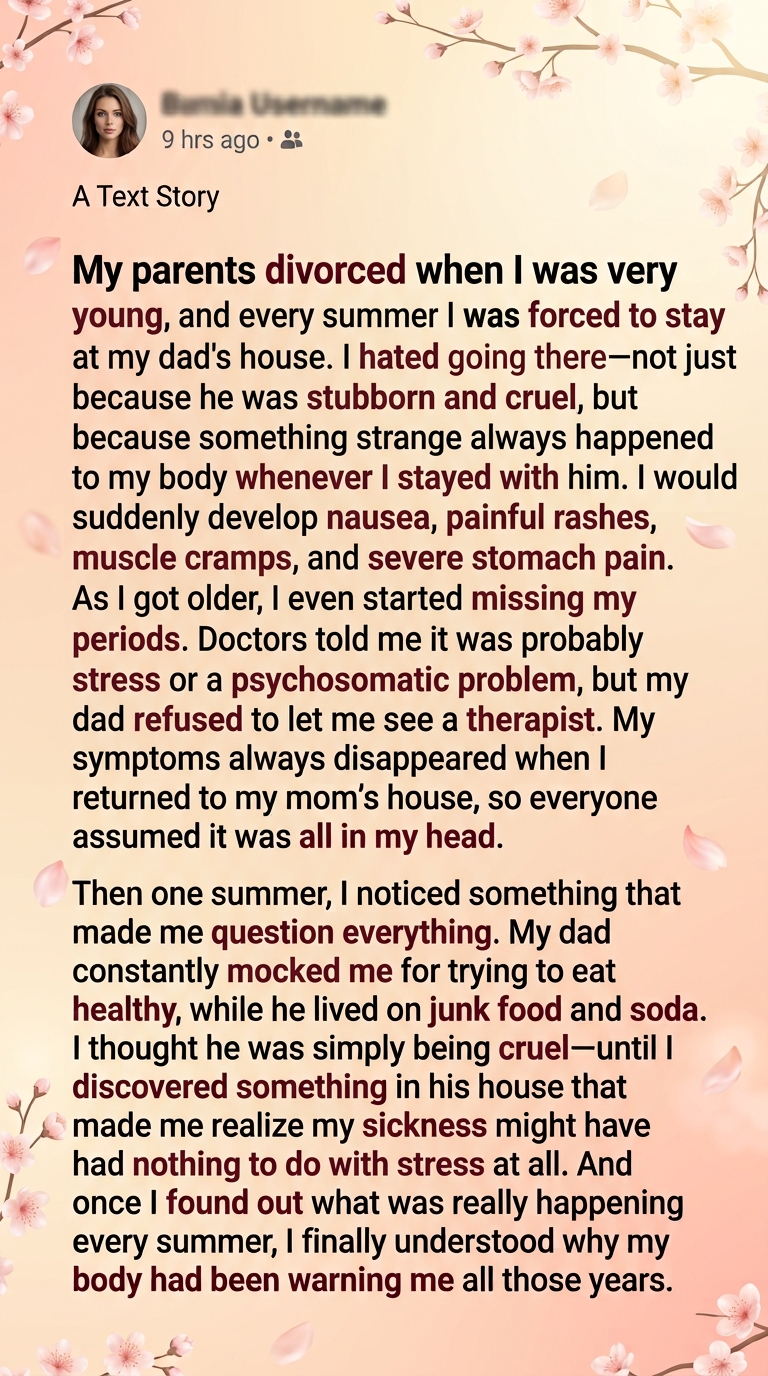
My parents divorced when I was five.
I lived with my mother, but every summer, I was sent to my father’s house for several weeks.
I hated those summers.
Not because I missed my mom.
Not because I disliked being away from home.
I hated them because my body seemed to change the moment I arrived.
The first summer, I was seven.
I developed a strange rash across my arms and stomach.
Then came the nausea.
The stomach cramps.
The headaches.
My father said I was being dramatic.
“She’s always looking for attention,” he’d tell my mother.
But my symptoms were real.
I could feel them.
Every summer, they got worse.
By the time I was twelve, the pattern was impossible to ignore.
I’d arrive at Dad’s house healthy.
Within a few days, I’d feel sick.
My stomach would hurt so badly that I’d curl up on the couch.
Sometimes my muscles cramped.
Sometimes I couldn’t keep food down.
Then, after returning to Mom’s house, I’d slowly recover.
Doctors couldn’t figure it out.
One doctor suggested stress.
Another said it could be psychosomatic.
My father loved that explanation.
“See?” he’d say.
“It’s all in her head.”
But I knew something was wrong.
Because my body didn’t get sick randomly.
It got sick at his house.
When I was sixteen, my periods became irregular.
Then they stopped for months at a time.
My mother was terrified.
We went to another doctor.
Blood tests.
Hormone tests.
More questions.
More uncertainty.
The doctor suggested stress could be affecting my body.
My father immediately agreed.
“She worries about everything.”
I wanted to scream.
I wasn’t imagining the pain.
I wasn’t imagining the nausea.
I wasn’t imagining the rashes.
And I certainly wasn’t choosing to get sick every summer.
But no one knew what to look for.
Then Dad refused to let me see a therapist.
He said:
“She doesn’t need one.”
Mom argued with him.
He refused.
I was stuck.
When I was eighteen, I started noticing something else.
My father hated the way I ate.
I had learned to be careful with food because certain things seemed to make my stomach worse.
I ate fresh fruit.
Vegetables.
Rice.
Chicken.
I drank water.
Dad mocked me constantly.
“Look at Miss Healthy.”
He’d laugh while drinking soda.
“You’re going to turn into a rabbit.”
I’d ignore him.
But one afternoon, I noticed something strange.
He had several large boxes in the pantry.
They weren’t normal food packages.
They were old-fashioned glass jars.
Each one had a faded handwritten label.
I asked:
“What’s that?”
Dad immediately closed the pantry door.
“Nothing.”
I thought that was odd.
Then he said:
“Don’t touch anything in there.”
That was the first time I became suspicious.
A few days later, Dad went to work.
I was home alone.
I opened the pantry.
The jars were still there.
I picked one up.
The label was barely readable.
It listed ingredients.
I didn’t recognize most of them.
But one word stood out.
Pesticide.
I put the jar down immediately.
My heart started racing.
I took photographs.
Then I opened another cabinet.
More jars.
More chemicals.
Some had no labels at all.
And then I noticed something else.
A large plastic container connected to a hose.
It was attached to the house’s old water system.
I stared at it.
Then I remembered something.
Every time I stayed at Dad’s house, I drank water from the kitchen tap.
At Mom’s house, I drank bottled or filtered water.
I had never thought about it.
Until then.
I called Mom.
“Mom, don’t panic.”
She immediately knew something was wrong.
“What happened?”
“I found chemicals in Dad’s pantry.”
“What kind?”
“I don’t know yet.”
I sent her the photographs.
There was silence.
Then she said:
“Don’t touch anything else.”
I didn’t.
Mom called a water-testing company.
The next morning, while Dad was at work, a technician came.
He tested the tap water.
Then the outdoor faucet.
Then a storage tank.
The results came back two days later.
There was contamination.
A chemical used in pest control had entered part of the home’s water system.
It wasn’t enough to make a healthy adult collapse immediately.
But repeated exposure could cause serious symptoms.
Nausea.
Skin irritation.
Abdominal pain.
Muscle problems.
Hormonal disturbances.
Suddenly, my entire childhood made sense.
But there was something even worse.
The technician asked:
“Has anyone been treating the property for pests?”
Mom said:
“Not that we know of.”
He looked at the photographs.
“These containers shouldn’t be stored inside a home.”
Then he pointed to one of the labels.
“This product is not approved for use around residential drinking-water systems.”
I felt sick.
“So this caused my symptoms?”
He looked at me carefully.
“I can’t diagnose you, but your symptoms are consistent with repeated chemical exposure. You need to see a doctor and bring them this information.”
For the first time in years, someone was telling me:
You weren’t imagining it.
We went to a specialist.
I brought every medical record I had.
We showed them the water-test results.
The doctor reviewed everything.
Then asked me a question.
“When do your symptoms disappear?”
“When I leave my father’s house.”
“How quickly?”
“Usually within days.”
He looked at Mom.
“That pattern is important.”
Additional testing was ordered.
The results showed abnormalities that required treatment and monitoring.
The doctor couldn’t prove that every symptom I’d ever experienced came from the house.
But the timing and exposure history were concerning enough that he told me to avoid the property completely until it was made safe.
I started crying.
Not because I was afraid.
Because someone finally believed me.
Then Dad came home.
He saw the testing equipment.
He saw Mom.
And he immediately became angry.
“What are you doing here?”
Mom held up the report.
“We tested the water.”
Dad’s face changed.
“You had no right.”
I looked at him.
“Why?”
“Because it’s my house.”
I asked:
“What are those chemicals?”
He didn’t answer.
“Why are they connected to the water system?”
He became defensive.
“They’re for the garden.”
“Then why were they inside?”
Silence.
Mom asked:
“Did you know the water was contaminated?”
Dad looked away.
That was the moment I knew.
He knew something.
Maybe he hadn’t understood how dangerous it was.
Maybe he’d been careless.
But he knew the chemicals were there.
And he had never told anyone.
My father finally admitted he’d been using an old pest-control system for years.
He had bought concentrated chemicals cheaply and stored them in the basement.
A damaged container had leaked.
The contamination had spread through an old line connected to the house.
He claimed he never intended to hurt me.
“I didn’t know.”
I stared at him.
“You knew I got sick every summer.”
“I thought you were anxious.”
“You watched me vomit.”
“I thought it was stress.”
“You told everyone I was imagining it.”
He didn’t answer.
That hurt more than anything.
Because whether he’d intended to harm me or not, he had spent years dismissing my pain.
The investigation that followed uncovered another problem.
The house had several safety violations.
Improper chemical storage.
A damaged water connection.
Poor ventilation.
And no records showing that the system had been professionally inspected in years.
Dad was ordered to stop using the system until it could be completely repaired and tested.
He was furious.
But I wasn’t interested in punishing him.
I wanted answers.
And I finally had them.
The strangest part was what happened afterward.
Once I stopped visiting that house, my symptoms improved dramatically.
My skin cleared.
The stomach pain became less frequent.
My energy returned.
And over time, my periods became regular again.
My doctors continued monitoring me.
They warned me that recovery could take time.
But I knew something important now.
My body had never been betraying me.
It had been protecting me.
Every summer, it had been saying:
Something is wrong here.
I just hadn’t known how to listen.
Years later, I asked my mother why she had believed the doctors when they said stress might be causing everything.
She looked at me sadly.
“Because I was trying to find an explanation.”
“I know.”
“And your father convinced me.”
I nodded.
“He convinced everyone.”
She took my hand.
“But I should have listened to you sooner.”
I smiled.
“You listened eventually.”
She hugged me.
“I wish I’d listened sooner.”
“So do I.”
My relationship with my father never became what it had been.
Maybe it never could.
He apologized.
More than once.
He admitted he had been wrong.
He even said:
“I should have protected you.”
I believed that he was sorry.
But forgiveness didn’t mean forgetting.
And it didn’t mean returning to the same environment.
I never stayed at his house again.
Years later, I keep one photograph on my desk.
It’s a picture of me at seven years old.
I’m sitting on my mother’s porch.
Healthy.
Smiling.
Holding a glass of water.
I used to look at that picture and wonder why I couldn’t feel that way at Dad’s house.
Now I know.
My body knew something my mind couldn’t explain.
The rashes.
The nausea.
The cramps.
The stomach pain.
The missing periods.
They weren’t weakness.
They weren’t attention-seeking.
They weren’t simply “all in my head.”
They were warning signs.
And the reason they disappeared whenever I went back to my mother’s house was because my body finally had a chance to recover.
I sometimes think about that little girl who kept telling doctors:
“I get sick at Dad’s house.”
She didn’t have the vocabulary to explain chemical exposure.
She didn’t know about contaminated water.
She didn’t understand environmental toxins.
She only knew one thing.
Something was wrong.
And she was right.
That’s what I wish I’d understood sooner.
When your body keeps telling you something is wrong, you deserve to be heard.
Not dismissed.
Not mocked.
Not told you’re imagining it.
Because sometimes the body notices danger long before the mind understands it.
For years, everyone thought my father was right.
They thought I was stressed.
They thought I was sensitive.
They thought it was psychological.
But my body had been keeping a record the entire time.
Every summer.
Every symptom.
Every warning.
And when I finally discovered what was inside that house, the mystery of my childhood finally made sense.
I wasn’t weak.
I wasn’t imagining it.
My body had been warning me all along.