I Finally Told My Sister “No.” The Next Morning, I Opened Her Door.
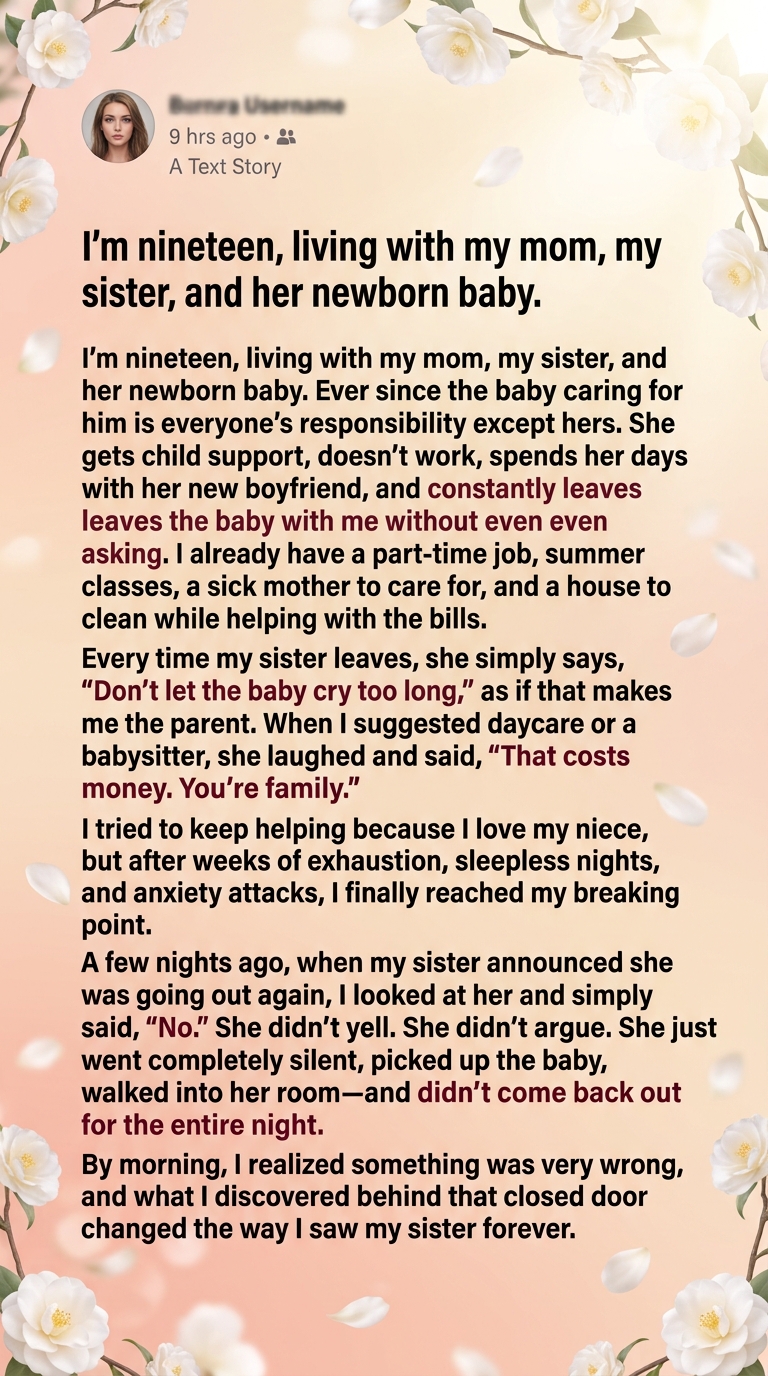
I’m nineteen, and for the past month, I had slowly become the mother of a baby who wasn’t mine.
My sister, Chloe, had given birth four weeks earlier.
She loved her son.
I knew that.
But she seemed to believe loving him was enough.
The actual work?
She expected everyone else to handle that.
She received child support.
She didn’t have a job.
Most afternoons, she went out with her new boyfriend.
And whenever she wanted to leave, she simply handed the baby to me.
“Don’t let him cry too long.”
That was it.
No asking.
No planning.
No thank you.
Just an instruction.
As if I were the babysitter she didn’t have to pay.
I already had enough on my plate.
I worked part-time at a pharmacy.
I was taking summer classes.
My mother had been sick for months, and I helped with her medications, meals, and appointments.
I also helped clean the house and contribute to the bills.
Then there was the baby.
At first, I didn’t complain.
He was my nephew.
I loved him.
I loved the way his tiny fingers wrapped around mine.
I loved his sleepy smile.
I even loved rocking him at three in the morning.
But there is a difference between helping someone and becoming responsible for their child.
And slowly, my sister crossed that line.
One afternoon, I suggested daycare.
Chloe laughed.
“Daycare costs money.”
“So?”
“You’re family.”
I stared at her.
“I have school.”
“So do I.”
“You don’t go.”
She rolled her eyes.
“Exactly. That’s why you can help.”
I didn’t know what to say.
She walked away.
I looked down at her son.
He was sleeping peacefully.
And I realized I was angry at the wrong person.
He hadn’t asked for any of this.
The weeks became harder.
I slept in short bursts.
Sometimes I studied with the baby sleeping beside me.
Sometimes I went to work after being awake half the night.
My grades started slipping.
My manager noticed I was exhausted.
My mother kept telling me:
“You need to take care of yourself.”
I laughed.
“With what time?”
She didn’t have an answer.
Then one night, I had what I thought was a panic attack.
My hands were shaking.
My chest felt tight.
I couldn’t catch my breath.
I locked myself in the bathroom and sat on the floor until it passed.
When I came out, Chloe barely looked up from her phone.
“I’m going out.”
I stared at her.
“Again?”
“Yeah.”
“Who’s watching him?”
She smiled.
“You are.”
Something inside me finally broke.
“No.”
She stopped.
“What?”
I repeated it.
“No.”
She stared at me.
For once, she didn’t argue.
She didn’t yell.
She didn’t insult me.
She simply went completely silent.
Then she picked up her baby.
Walked into her bedroom.
Closed the door.
And didn’t come back out.
At first, I thought she was angry.
I went to bed.
I tried to sleep.
But something felt wrong.
Around midnight, I heard nothing from her room.
No television.
No footsteps.
No crying baby.
Nothing.
I told myself she was finally taking care of him.
By morning, I was uneasy.
I knocked.
“Chloe?”
No answer.
I knocked again.
“Chloe, are you awake?”
Nothing.
I opened the door.
And stopped.
The room was dark.
The baby was asleep in his bassinet.
But Chloe was sitting on the floor beside the bed.
Still.
She was staring at her phone.
There were dozens of unopened messages on the screen.
Her boyfriend had been texting.
Her friends had been texting.
Her caseworker had been texting.
She didn’t seem to notice me.
“Chloe?”
She looked up.
Her face was wet with tears.
“What happened?”
She shook her head.
“Nothing.”
I looked at the room.
Then I noticed a stack of envelopes on the floor.
Bills.
Letters.
Official notices.
And one document with a government logo at the top.
I picked it up.
Chloe immediately reached for it.
“Don’t.”
I handed it back.
“What is it?”
She whispered:
“They’re reviewing my benefits.”
I frowned.
“Why?”
She looked down.
“Because someone reported that I wasn’t caring for the baby.”
I stared at her.
“Who?”
She shook her head.
“I don’t know.”
Then she said something that made my anger disappear.
“I think they’re going to take him.”
I sat down beside her.
“What happened?”
She finally told me the truth.
Her boyfriend wasn’t helping.
He had been telling her that the baby was “her problem.”
Her child’s father had stopped answering her calls.
The money she received wasn’t enough to cover everything.
She had been pretending she was fine.
Pretending she had everything under control.
And every time she left the baby with me, she wasn’t simply being lazy.
She was running away.
From the bills.
From motherhood.
From the fear that she wasn’t capable of doing it.
“I was scared,” she whispered.
“You could have told me.”
“I was embarrassed.”
I looked at her.
“You made me do everything.”
“I know.”
“You left me exhausted.”
“I know.”
“You made me feel like I couldn’t say no.”
She started crying.
“I know.”
Then she admitted something else.
She had been having thoughts about disappearing.
Not hurting herself.
Just leaving.
Getting in her car and driving somewhere no one knew her.
She said she had even packed a small bag.
I looked at the baby.
Then at her.
“You need help.”
“I know.”
“Real help.”
She nodded.
“Not me.”
She looked at me.
“You.”
I shook my head.
“I can help you find help.”
“But I can’t raise your son.”
“I know.”
That was the first time she’d said it without arguing.
I woke Mom.
We sat together in the kitchen.
For the first time, Chloe told all of us the truth.
She admitted she had been overwhelmed.
She admitted she was struggling.
She admitted she had been relying on me because I kept saying yes.
Mom listened.
Then she said:
“We’re going to help you.”
Chloe started crying.
“But I don’t deserve it.”
Mom shook her head.
“This isn’t about deserving help.”
She looked at me.
“And it doesn’t mean your sister becomes the baby’s parent.”
I nodded.
That mattered.
Because helping Chloe couldn’t mean sacrificing me.
The next morning, we made a plan.
Chloe contacted her caseworker.
She arranged counseling and parenting support.
She applied for childcare assistance.
Her son’s father was contacted through the appropriate legal channels.
And most importantly, Chloe agreed to stop leaving the baby with me without asking.
If I couldn’t babysit, the answer was no.
No guilt.
No argument.
No “but you’re family.”
Just no.
Her relationship with her boyfriend ended soon afterward.
He had been encouraging her to avoid responsibility rather than helping her face it.
She eventually realized he wasn’t going to become the partner she needed.
That breakup hurt.
But it forced her to stop pretending he was part of the solution.
She started attending parenting classes.
She learned how to establish a routine.
She found part-time work that fit around childcare.
It wasn’t easy.
There were setbacks.
There were nights when she called Mom crying.
There were mornings when she wanted to give up.
But she kept going.
A few months later, I came home from class and found Chloe sitting on the floor with her son.
She was helping him stack colorful blocks.
He knocked them over.
She laughed.
He laughed.
I stood in the doorway.
She looked at me.
“I owe you an apology.”
I smiled.
“You’ve said that.”
“I know.”
She picked up another block.
“But I finally understand something.”
“What?”
“You weren’t refusing to help me.”
I waited.
“You were refusing to disappear.”
I felt tears fill my eyes.
She continued:
“I made you believe that being family meant you couldn’t have boundaries.”
I nodded.
“You did.”
“And I was wrong.”
Later that night, she came into my room.
“Can I ask you something?”
“Sure.”
“Do you hate me?”
I looked at her.
“No.”
“Are you angry?”
“Yes.”
She nodded.
“I understand.”
“But I’m not giving up on you.”
She smiled.
“Thank you.”
I smiled back.
“But don’t confuse that with me babysitting every night.”
She laughed.
“I won’t.”
A year later, Chloe was doing well.
Not perfectly.
But well.
She had a steady job.
A reliable childcare arrangement.
A healthier relationship with her son.
And, most importantly, she had learned how to ask for help before reaching a breaking point.
My mother was doing better too.
And I finally had time to focus on school.
I finished my summer classes.
My grades recovered.
I even started saving money.
The baby was now a happy toddler who ran toward me every time I visited.
One afternoon, he held up a toy and shouted:
“Auntie!”
I picked him up.
Chloe smiled.
“You know, he loves you.”
“I love him too.”
She nodded.
“But now you get to be his aunt.”
I looked at her.
“Not his second mom.”
She smiled.
“Not his second mom.”
Looking back, I used to think saying “no” was the cruelest thing I could do to my sister.
It wasn’t.
It was the most honest thing I had ever done for her.
Because every time I said yes, she became more dependent on me.
And every time I took over, she had less reason to learn how to handle her own life.
That night, when I finally said no, she didn’t punish me.
She went into her room because she had reached her own breaking point.
And when I opened that door the next morning, I discovered something I hadn’t understood before.
My sister wasn’t simply careless.
She was overwhelmed, ashamed, and terrified.
But understanding her didn’t mean excusing what she’d done to me.
It meant helping her in a way that didn’t destroy me too.
I learned that boundaries aren’t the opposite of love.
Sometimes they’re what makes real love possible.
My sister needed help.
I needed boundaries.
And her baby needed a mother who was present and capable of asking for help when she needed it.
So I still help my sister.
I still love my nephew.
But now, when Chloe asks:
“Can you watch him?”
Sometimes I say yes.
And sometimes I say no.
And she respects both answers.
Because family isn’t supposed to mean one person carries everyone else until they collapse.
Family means helping each other stand—without making one person responsible for holding everyone up.