After 33 Years, They Called Me “Replaceable.” Then I Walked Into Their Awards Dinner.
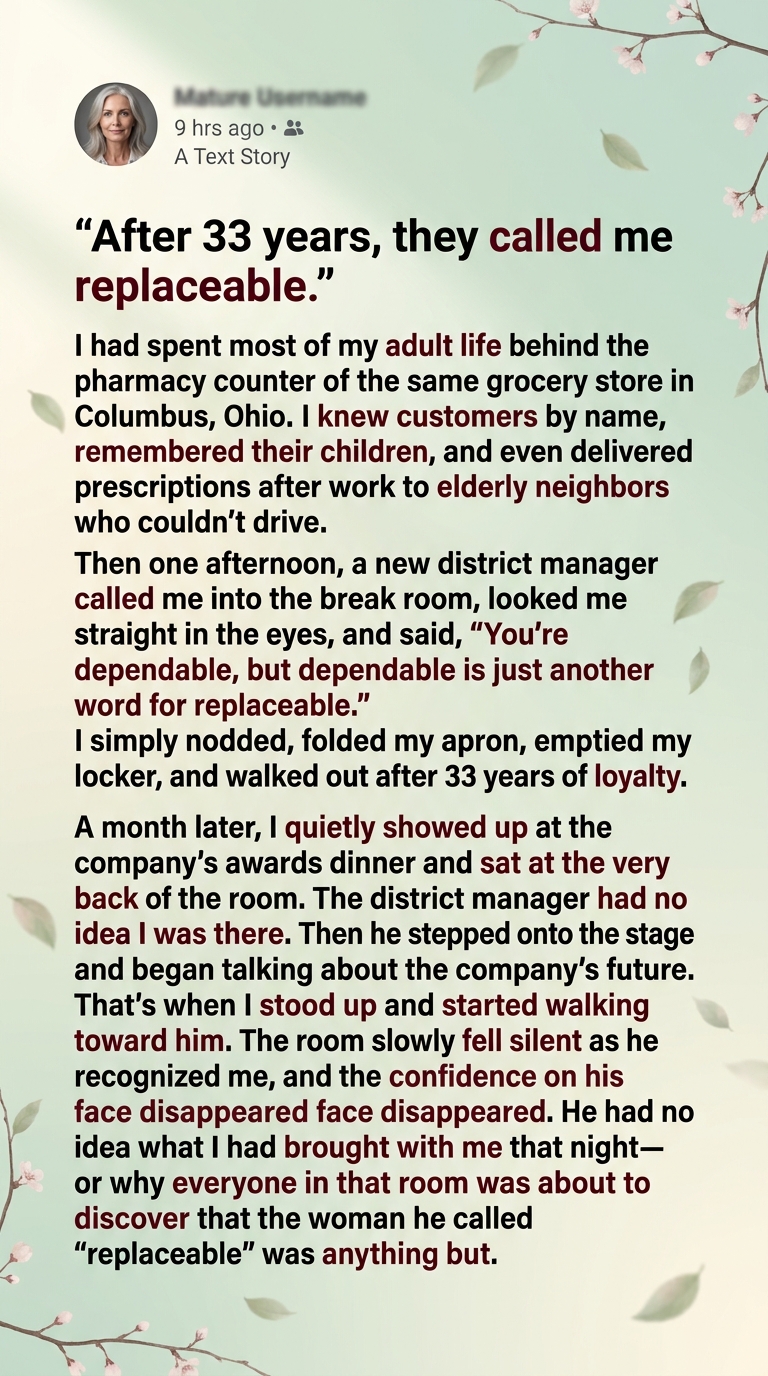
After thirty-three years, they called me replaceable.
I had spent most of my adult life behind the pharmacy counter of the same grocery store in Columbus, Ohio.
I started there when I was twenty-four.
By the time I left, I was fifty-seven.
I had watched the neighborhood change.
I watched children grow into parents.
I watched old customers become grandparents.
And somehow, through all those years, the pharmacy counter became more than a workplace.
It became part of my life.
I knew customers by name.
I remembered which medications made them nervous.
Which elderly customers couldn’t drive.
Which parents were worried about their children’s prescriptions.
Sometimes, after my shift, I delivered medications to elderly neighbors who had no transportation.
I never thought of it as extraordinary.
It was simply what you did when people trusted you.
Then everything changed.
The new district manager was named Kevin.
He was thirty-eight.
He had been with the company for less than a year.
He wore expensive suits and carried himself like every room belonged to him.
During his first visit to our store, he shook my hand.
“Thirty-three years,” he said.
“That’s impressive.”
I smiled.
“Thank you.”
He nodded.
“You must know this place better than anyone.”
“I probably do.”
He laughed.
“Good. We need people like you.”
I believed him.
That was my mistake.
A few months later, I was called into the break room.
Kevin was sitting at the table.
There was another manager beside him.
I immediately knew something was wrong.
Kevin gestured toward the chair.
“Sit down.”
I did.
He folded his hands.
“You’ve been here a long time.”
“Yes.”
“You’re dependable.”
I smiled.
“Thank you.”
Then he said:
“But dependable is just another word for replaceable.”
I stared at him.
For a moment, I thought I’d misunderstood.
“What?”
He leaned back.
“The company is restructuring.”
“We need younger employees.”
“People who can adapt to the new direction.”
I looked at him.
“After thirty-three years?”
He shrugged.
“It’s business.”
I felt something inside me go completely quiet.
Not angry.
Not surprised.
Just finished.
I nodded.
“Understood.”
I stood up.
Folded my apron.
Emptied my locker.
I took the photograph of my children.
The little card a customer had given me years earlier.
A photograph of my first pharmacy team.
Then I walked out.
No argument.
No tears.
No begging.
Thirty-three years ended in less than twenty minutes.
For the first few weeks, I was devastated.
Not because I missed the paycheck.
I missed the people.
Mrs. Patterson, who always came on Tuesday mornings.
Mr. Lewis, who couldn’t read the tiny print on his prescription bottles.
The young mother who had once called me crying because she couldn’t understand her child’s medication instructions.
The elderly man who used to say:
“You’re the only person here who remembers me.”
I missed them.
But slowly, I realized something.
They hadn’t fired the part of me that cared.
So I kept helping.
I started volunteering at a community senior center.
Then I began helping people organize their medications.
Word spread.
Soon, people were calling me.
Not because I worked for the grocery store.
Because they trusted me.
One afternoon, I received a letter.
It was from the company.
An invitation to the annual awards dinner.
I almost threw it away.
Then I read the final line.
“We would be honored to recognize employees who have contributed to our company’s success.”
I laughed.
I wasn’t an employee anymore.
But I kept the invitation.
Something told me I should go.
A month later, I quietly walked into the awards dinner.
I wore a simple black dress.
Nothing expensive.
Nothing flashy.
I sat at the very back of the room.
Nobody noticed me.
Kevin was at the front.
He looked confident.
He was now responsible for several stores.
He stood on stage and talked about the company’s future.
“Efficiency.”
“Modernization.”
“Adaptability.”
“Moving forward.”
Then he said:
“We cannot build the future by holding onto the past.”
I looked around the room.
Several longtime employees shifted uncomfortably.
Then Kevin smiled.
“Sometimes you have to replace what no longer serves the organization.”
I stood up.
The room became quiet.
Kevin stopped speaking.
I started walking toward the stage.
One step.
Then another.
People began recognizing me.
Whispers spread across the room.
“Is that Linda?”
“What is she doing here?”
Kevin stared at me.
Then his confidence disappeared.
“Linda?”
I smiled.
“Hello, Kevin.”
He looked uncomfortable.
“I didn’t know you were coming.”
“I know.”
I reached the stage.
Then I held up a folder.
And said:
“I brought something.”
Kevin stared at the folder.
“What is that?”
“Records.”
“What records?”
“Thirty-three years of pharmacy records.”
The room became silent.
I turned toward the audience.
“For thirty-three years, I kept copies of every medication error we caught before it reached a customer.”
People began murmuring.
Kevin looked confused.
I continued.
“Every insurance issue.”
“Every prescription discrepancy.”
“Every time a computer system failed.”
“Every time a pharmacist or technician caught something dangerous.”
Kevin interrupted.
“Those records belong to the company.”
“No.”
I smiled.
“They belong to the people who made them.”
Then I pulled out another document.
“This is a report I gave management twelve years ago.”
Kevin looked at it.
“What report?”
“The report warning that the company’s new automated prescription system had a serious safety flaw.”
The room went completely silent.
I held up the report.
“I submitted it.”
“My pharmacy manager submitted it.”
“Three other pharmacists submitted it.”
“Nothing was done.”
Kevin’s face changed.
I opened the folder.
“Six months later, the system made an error.”
“A customer’s prescription was flagged incorrectly.”
“One of our technicians caught it before the medication reached the patient.”
The audience was listening carefully.
“After that, I created a manual verification process.”
“Every prescription with certain warning codes was checked twice.”
Kevin stared at me.
“And how many years did you continue that?”
“Twenty-two.”
Someone in the audience whispered:
“Twenty-two years?”
I nodded.
“Without being asked.”
Then I pulled out another document.
“This is a letter from the state pharmacy board.”
Kevin stepped forward.
“Linda, I don’t think this is appropriate.”
I looked at him.
“You told me I was replaceable.”
“Yes.”
“You said dependable was another word for replaceable.”
He looked away.
“So tonight, I thought everyone should understand exactly what you were replacing.”
I opened the letter.
The state pharmacy board had recognized our store for its unusually low medication-error rate.
The reason?
The verification system I had created.
The system Kevin’s department had recently eliminated as part of its “modernization.”
The room erupted in whispers.
Then the company president stood up.
His name was Michael.
I’d met him only twice during my thirty-three years.
He walked toward the stage.
“Linda.”
I turned.
“Mr. Harris.”
He looked at the documents.
“Did you create this system?”
“Yes.”
“And you trained the staff?”
“Yes.”
“And the company has used it for more than twenty years?”
“Yes.”
He looked toward Kevin.
“Why wasn’t I aware of this?”
Kevin didn’t answer.
Michael looked back at me.
“Did you leave because Kevin told you your position was being eliminated?”
“Yes.”
“And did he know about your work?”
“I told him.”
Michael’s expression hardened.
“He told me you were resistant to change.”
I almost laughed.
“I was resistant to unsafe change.”
The room went silent again.
Michael asked:
“What happened to the verification program after you left?”
I looked at him.
“They stopped using it.”
“When?”
“Three days after I left.”
Michael’s face changed.
“Why?”
“Kevin said it was inefficient.”
A pharmacist from another store suddenly spoke from the audience.
“We’ve already had three near-misses.”
Everyone turned.
He looked nervous.
“The new system has been producing errors.”
Kevin stared at him.
“That’s not accurate.”
The pharmacist shook his head.
“I documented them.”
Another employee stood.
“So did I.”
Then another.
“I reported one last week.”
The room erupted.
For the first time, Kevin looked frightened.
Michael raised his hand.
“Everyone stop.”
The room became quiet.
He looked at me.
“Do you still have the original training materials?”
“Yes.”
“Would you be willing to let us review them?”
“Yes.”
“Would you be willing to help us rebuild the program?”
I paused.
“I don’t work for you anymore.”
“I know.”
“And I’m not coming back as an employee.”
He nodded.
“Then what would you consider?”
I looked at him.
“An independent safety consultant.”
Kevin immediately objected.
“That’s ridiculous.”
Michael turned toward him.
“Why?”
Kevin opened his mouth.
Then closed it.
Michael looked at me.
“What would your terms be?”
I smiled.
“First, I want the safety program reinstated.”
“Agreed.”
“Second, I want every pharmacy employee retrained.”
“Agreed.”
“Third, I want the people who raised safety concerns to be protected from retaliation.”
Michael nodded.
“Agreed.”
“And fourth…”
I looked directly at Kevin.
“I don’t want to report to him.”
The room became completely silent.
Michael looked at Kevin.
Then back at me.
“You won’t.”
Kevin was removed from the restructuring project that night.
An internal investigation followed.
The company discovered that several safety reports had been ignored because management considered them “inefficient.”
Kevin’s decision to eliminate the verification system had been made without fully reviewing its history.
He had seen a labor cost.
He hadn’t seen the people behind the numbers.
And he had made one terrible mistake.
He had assumed experience was the same thing as being outdated.
It wasn’t.
Six months later, I returned to the pharmacy.
Not as an employee.
As a consultant.
The old staff applauded when I walked in.
Mrs. Patterson was still there.
Mr. Lewis had passed away, but his daughter came to see me.
She hugged me.
“You saved my dad more than once.”
I shook my head.
“We all looked after each other.”
She smiled.
“That sounds like you.”
Eventually, the company created a new position:
Director of Pharmacy Safety and Community Care.
They offered it to me.
I declined.
Instead, I created my own consulting practice.
I trained pharmacies.
Helped senior citizens manage medications.
And taught young pharmacy technicians something I wished Kevin had understood.
Technology is useful.
Efficiency matters.
But people aren’t numbers.
And experience isn’t something you throw away because a spreadsheet says someone is expensive.
A year after the awards dinner, I received another invitation.
This time, I was the keynote speaker.
I stood on the same stage where Kevin had once called me replaceable.
Hundreds of employees were sitting in the room.
I looked at them.
Then smiled.
“I want to tell you something about the word replaceable.”
The room became quiet.
“Yes, companies can replace employees.”
“They can replace positions.”
“They can replace systems.”
“But they cannot easily replace thirty-three years of knowledge.”
“They cannot replace trust.”
“They cannot replace relationships.”
“And they certainly cannot replace the people who quietly protect others when nobody is watching.”
I paused.
“Never confuse someone’s salary with their value.”
After the speech, an employee approached me.
She was young.
Maybe twenty-two.
“I’ve only been here six months,” she said.
“I feel like nobody listens to me.”
I smiled.
“Then keep learning.”
“Keep documenting.”
“Keep speaking up when something isn’t safe.”
“And don’t let anyone convince you that your worth depends on whether they need you today.”
She smiled.
“Thank you.”
I nodded.
Then I walked out.
I still think about the day Kevin told me:
“Dependable is just another word for replaceable.”
For a while, I believed him.
Thirty-three years of loyalty suddenly felt worthless.
But he had confused something.
He thought my value came from my position behind that pharmacy counter.
It didn’t.
My value came from the people I helped.
The customers who trusted me.
The coworkers I trained.
The mistakes I prevented.
The lives I touched.
And the knowledge I carried with me when I walked out that door.
Kevin thought he had replaced me.
He hadn’t.
He had simply removed me from the room where my value was easiest to see.
Then, one month later, I walked back into that awards dinner carrying thirty-three years of proof.
And when I stood in front of everyone, the room finally understood what Kevin never had.
A person can be replaced on a schedule.
But the impact they leave behind is much harder to replace.