His Letters Stopped in 1971. Fifty-Five Years Later, I Found Him Again.
I was sixteen when my English teacher gave our class an unusual assignment.
“Write a letter to a soldier serving overseas.”
We were told to introduce ourselves.
Tell them about home.
Ask about their lives.
Remind them that someone was thinking about them.
I remember sitting at my desk and wondering what I could possibly say to someone fighting a war on the other side of the world.
Then I received a name.
Eddie.
He was a young soldier from Kentucky.
I wrote my first letter that afternoon.
I told him about school.
My mother’s cooking.
The terrible weather we’d been having.
And how nervous everyone felt whenever the news showed another report from overseas.
I didn’t expect much.
Then, three weeks later, Eddie wrote back.
His first letter was short.
He thanked me for writing.
Then he said something I’ll never forget.
“Mail from home makes a place like this feel a little less far away.”
So I wrote again.
And again.
For two years, we exchanged letters.
He told me about the heat.
The dust.
The exhaustion.
The fear.
He never described anything too horrible.
Maybe because he knew I was sixteen.
Instead, he told me about Kentucky.
His mother’s cooking.
The creek behind his family’s house.
The old truck he wanted to fix when he came home.
I told him about school dances.
My friends.
My dreams.
The silly things that happened in our neighborhood.
Once, I sent him a photograph of the snow outside our house.
He wrote back:
“I’ve never wanted to see snow so badly.”
Our letters became a routine.
Every few weeks, I’d check the mailbox.
And when his letter arrived, I’d recognize his handwriting immediately.
Sometimes I’d read his words three times.
I never thought of myself as important to him.
I was just a teenage girl writing to a soldier.
But Eddie once wrote:
“You don’t know what your letters mean over here.”
“You make me remember that there is a world worth coming home to.”
I kept that sentence for decades.
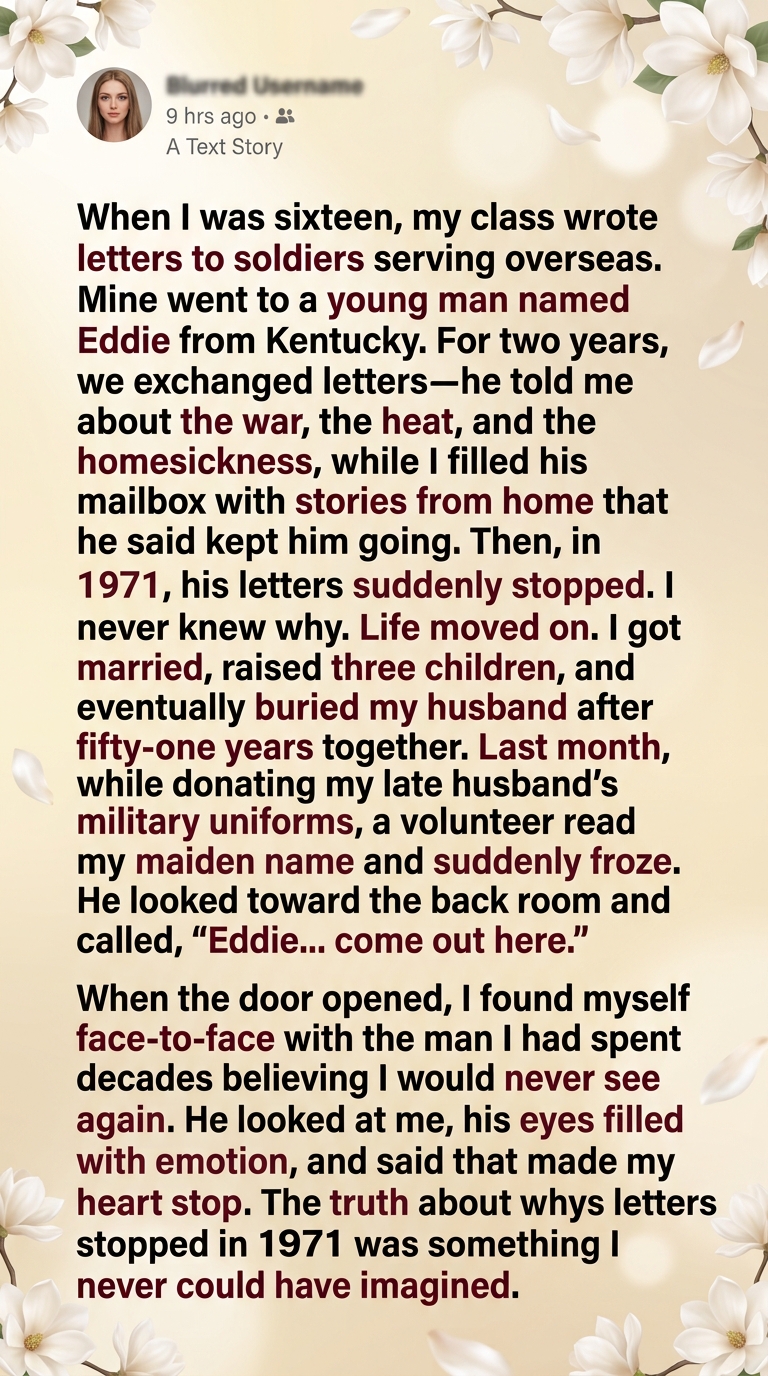
Then, in 1971, his letters stopped.
Completely.
I waited.
One week.
Then two.
Then a month.
I wrote again.
No response.
I wrote another letter.
Nothing.
I asked my teacher if she knew what had happened.
She didn’t.
Eventually, life moved forward.
And Eddie became one of those people I wondered about only occasionally.
I got married.
Raised three children.
Built a life.
My husband and I stayed together for fifty-one years.
We had ordinary arguments.
Ordinary holidays.
Ordinary joys.
And ordinary disappointments.
It wasn’t perfect.
But it was ours.
When he died, a huge part of my world went quiet.
For a long time, I couldn’t bring myself to touch his belongings.
Eventually, I decided to donate his old military uniforms.
I packed everything into boxes.
Uniforms.
Medals.
Old photographs.
A few documents.
Then I drove them to a local veterans’ donation center.
I thought it would be a simple errand.
I was wrong.
A volunteer began sorting through the boxes.
He pulled out one of my husband’s uniforms.
Then he saw my name on the donation paperwork.
He stopped.
“Excuse me.”
I looked up.
“Yes?”
He stared at the page.
Then at me.
“What’s your maiden name?”
I told him.
He froze.
His expression changed completely.
He looked toward the back room.
Then called:
“Eddie…”
My heart skipped.
“Eddie, come out here.”
I laughed nervously.
“I’m sorry?”
The volunteer didn’t answer.
A door opened.
An older man stepped into the room.
Gray hair.
Thin face.
A slight limp.
He looked at me.
I looked at him.
And somehow, before he said anything, I knew.
“Eddie?”
He stopped.
His eyes filled with tears.
Then he smiled.
“It’s you.”
I couldn’t move.
For fifty-five years, I had imagined Eddie as the young soldier from my memories.
Twenty-something.
Tired.
Homesick.
Waiting for mail.
But the man standing in front of me was in his seventies.
His hair was gray.
His hands trembled.
Yet his eyes were exactly the same.
“I thought you were dead,” I whispered.
He nodded.
“I thought you had forgotten me.”
“I never forgot you.”
He looked down.
“I kept every letter.”
My breath caught.
“Every one?”
“Every single one.”
Then he said the words that made my heart stop.
“I didn’t stop writing to you in 1971.”
I stared at him.
“What?”
“I wrote.”
“Then why didn’t I receive them?”
His eyes filled with tears.
“Because I was told you didn’t want them.”
I didn’t understand.
“Who told you that?”
He hesitated.
“My commanding officer.”
I stared at him.
“What?”
He explained.
In 1971, Eddie had been injured.
Not in combat.
He had been involved in an accident during a transfer.
He spent weeks in a military hospital.
When he was finally discharged, he discovered that his personal belongings had been damaged or misplaced.
Including his letters.
He wrote to me anyway.
But the letters were returned.
Then something even stranger happened.
A letter arrived from someone claiming to be my family.
It said I had gotten married.
That I no longer wanted contact with him.
That I had moved on.
He believed it.
“I thought you were happy,” he said.
“I didn’t want to interfere with your life.”
I shook my head.
“I didn’t get married until years later.”
He looked at me.
“I know that now.”
Then he reached into his jacket.
He pulled out a small envelope.
It was yellowed with age.
The handwriting was unmistakable.
Mine.
I recognized it immediately.
“How did you get that?”
He smiled.
“This was the last letter you sent me.”
I remembered it.
I had written:
“I hope you come home.”
Then I had told him about my upcoming school graduation.
I had asked him to write back.
But he never did.
He turned the envelope over.
It had been returned to him.
Across the front was a handwritten note:
“Recipient unavailable.”
I touched the paper.
“I never knew.”
“I didn’t either.”
Then Eddie told me something else.
For decades, he had wondered about me.
He had married too.
He had children.
He had built a life.
But he never threw away my letters.
When his wife died several years earlier, he began sorting through old boxes.
There they were.
Hundreds of pages.
My handwriting.
My teenage stories.
My questions.
My jokes.
My life.
He said he reread them.
“I realized something.”
“What?”
“You were the person who reminded me that I was still human.”
I started crying.
“I was just writing letters.”
“No.”
He shook his head.
“You were giving me a reason to think about tomorrow.”
I asked him why he was volunteering at the donation center.
He smiled.
“Because I wanted to stay around veterans.”
Then he laughed.
“And because I needed something to do after retirement.”
I smiled.
“Still stubborn?”
“Absolutely.”
I laughed.
For the first time in decades, I heard that familiar voice again.
Then he asked about my husband.
I told him the truth.
“He was a good man.”
Eddie nodded.
“I’m glad.”
“I loved him.”
“I know.”
I looked at him.
“How?”
“Because your letters changed after you married.”
I laughed.
“You could tell?”
“Of course.”
“You remember them?”
“Every word.”
He smiled.
“You wrote about him all the time.”
I looked down.
“I was happy.”
“I know.”
There was no sadness in his voice.
Only peace.
Before I left, Eddie asked:
“Do you still write?”
I laughed.
“Not much.”
He reached into his pocket.
Pulled out a blank envelope.
Then handed it to me.
“You should start again.”
I smiled.
“Where would I send it?”
He pointed toward the donation center.
“Same place.”
I shook my head.
“After fifty-five years?”
He smiled.
“Why not?”
A few weeks later, I wrote him a letter.
I told him about my children.
My grandchildren.
My husband’s favorite holiday.
The flowers growing in my backyard.
And the strange little things that had happened since we found each other again.
At the end, I wrote:
“I always wondered what happened to the boy from Kentucky who wrote to me from overseas.”
Then I added:
“Now I know he grew into a very good man.”
He wrote back.
His handwriting was shakier now.
But it was still unmistakably Eddie’s.
He wrote:
“And I always wondered what happened to the girl who kept me alive with stories about home.”
Then:
“I’m glad she kept writing.”
We never became some romantic story.
There was no dramatic reunion where we suddenly tried to rewrite our lives.
We had both lived those lives already.
We had loved other people.
Raised families.
Lost people we couldn’t replace.
We weren’t teenagers anymore.
We were two old friends who had somehow survived enough decades to find each other again.
And maybe that’s what made it so beautiful.
Because our story wasn’t about what might have been.
It was about what had been.
Two teenagers.
One war.
Hundreds of letters.
A friendship separated by thousands of miles.
And one unanswered question that lasted more than half a century.
Sometimes I think about that sixteen-year-old girl sitting at her desk, writing a letter to a soldier she had never met.
She had no idea that her words would travel across an ocean.
She had no idea that a homesick young man would save every letter.
She had no idea that decades later, those letters would still exist.
And she certainly couldn’t have imagined that one day, while donating her husband’s old military uniforms, she’d hear a voice call:
“Eddie… come out here.”
When that door opened, time seemed to disappear.
For one moment, I wasn’t seventy-something.
I wasn’t a widow.
I wasn’t a grandmother.
I was sixteen again.
Waiting for a letter from a young soldier named Eddie.
Except this time, he wasn’t writing from overseas.
He was standing right in front of me.
And the truth about why his letters stopped in 1971 wasn’t that he had forgotten me.
He hadn’t stopped caring.
He had simply been separated from the person who had been writing back.
And after fifty-five years, we finally got to finish the conversation we thought we’d lost forever.
Some letters take longer than others to arrive.
Ours took fifty-five years.