I Broke My Wrist. Then a Paramedic Recognized the Birthmark That Could Reveal Who My Mother Really Was.
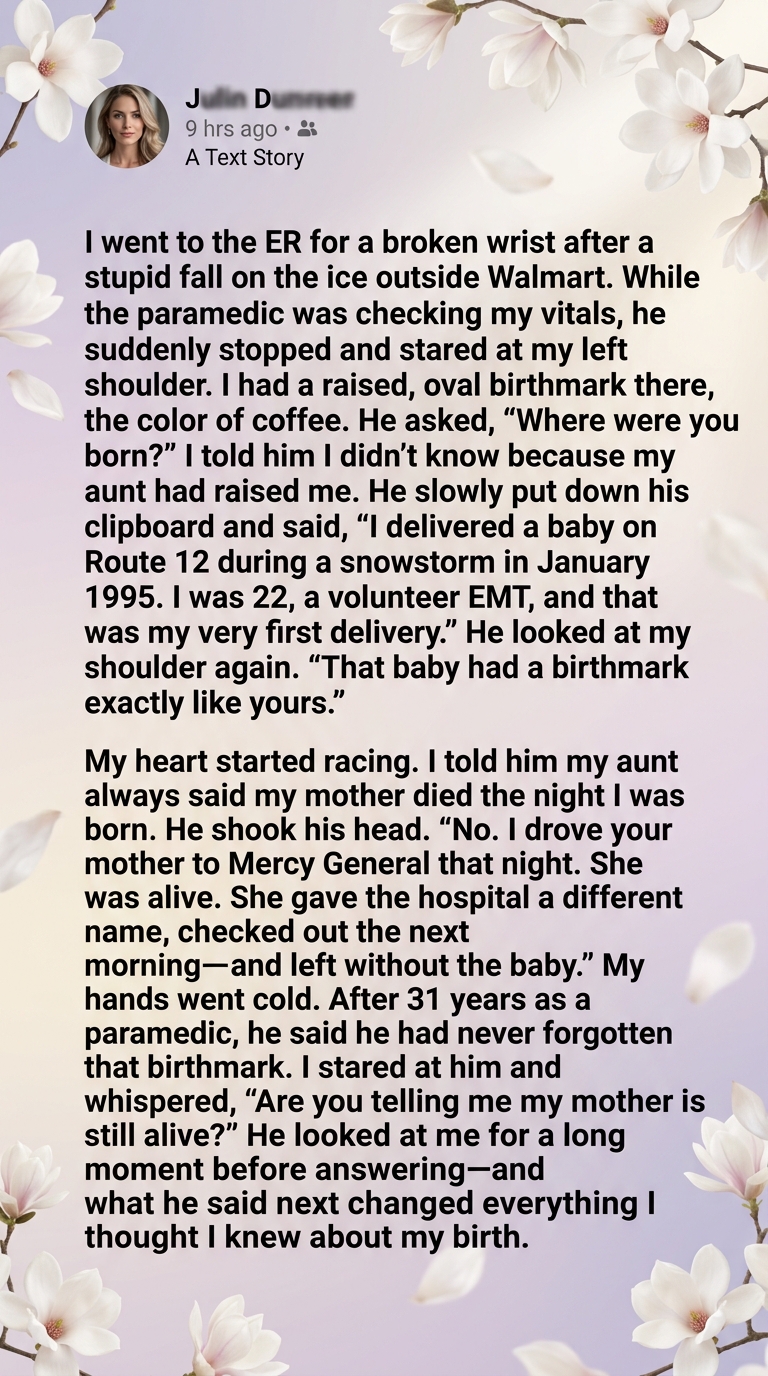
I went to the ER with a broken wrist after a stupid fall on the ice outside Walmart.
I was embarrassed.
I was in pain.
And I was mostly annoyed with myself.
At fifty-one, I had learned that winter sidewalks were not my friends.
The paramedic who brought me in was an older man named Ray.
He was checking my blood pressure when suddenly his hand stopped.
He stared at my left shoulder.
“Excuse me,” he said.
I looked at him.
“What?”
He pointed.
“That birthmark.”
I glanced down.
I’d had it my entire life.
A raised, oval patch the color of coffee.
“What about it?”
He didn’t answer immediately.
Instead, he asked:
“Where were you born?”
I laughed.
“I don’t know.”
“You don’t know?”
“My aunt raised me.”
He slowly lowered his clipboard.
“What was your aunt’s name?”
I told him.
His expression changed.
Then he said:
“I delivered a baby on Route 12 during a snowstorm in January 1995.”
I stared at him.
He continued.
“I was twenty-two. A volunteer EMT.”
He looked at my shoulder again.
“It was my first delivery.”
My heart began pounding.
“That baby had a birthmark exactly like yours.”
I thought he was mistaken.
There was no way.
Birthmarks weren’t fingerprints.
Thousands of people had them.
I told him that.
He nodded.
“I know.”
“But you recognized mine?”
“I recognized the location.”
He pointed to the exact spot.
“Left shoulder. Raised. Oval. Dark coffee color.”
My mouth went dry.
“That’s me?”
“I think so.”
He pulled up a chair.
“Your fall can wait a minute.”
I stared at him.
“What happened that night?”
He took a breath.
“It was snowing heavily.”
“Route 12 was almost impossible to drive.”
“A car had broken down near the shoulder.”
“Inside was a young pregnant woman.”
“She was in labor.”
“There wasn’t enough time to get her to the hospital.”
“So we delivered the baby in the ambulance.”
I whispered:
“Me.”
He nodded.
“I remember the baby because of the birthmark.”
I told him what I’d been told my entire life.
“My aunt said my mother died the night I was born.”
Ray shook his head.
“No.”
My heart stopped.
“What?”
“I drove your mother to Mercy General that night.”
“She was alive.”
“She was awake.”
“She was talking.”
“She held the baby.”
I stared at him.
“You’re sure?”
“I’ve never forgotten her.”
“Why?”
“Because after the delivery, she asked me a strange question.”
“What?”
“She asked whether the baby had any identifying marks.”
I touched my shoulder.
He nodded.
“I told her about the birthmark.”
My hands began shaking.
“What happened at the hospital?”
“She gave them a different name.”
“What name?”
He told me.
It wasn’t my mother’s name.
Then he continued.
“She checked out the next morning.”
“Without me?”
He nodded.
“She left without the baby.”
I couldn’t breathe.
“My aunt said my mother died.”
Ray looked at me.
“Your mother didn’t die that night.”
I whispered:
“Then where did she go?”
“I don’t know.”
“But you saw her.”
“Yes.”
“Did she say why she was leaving?”
“No.”
“Did she seem sick?”
“No.”
“Was she afraid?”
Ray thought about it.
“She seemed scared.”
“Of what?”
“I don’t know.”
My wrist suddenly didn’t matter anymore.
Neither did the hospital.
I needed answers.
Ray finished his paperwork and gave me his contact information.
“Get your wrist treated.”
“I will.”
“But then start with your birth records.”
I nodded.
“Why?”
“Because if your aunt’s story was false, there may be more.”
Three days later, I went to the county records office.
I requested my original birth certificate.
The clerk brought it out.
I stared at the page.
My mother’s name was listed.
But there was something strange.
The surname didn’t match the one I’d grown up with.
And the father’s name was blank.
I asked for the amended records.
There had been one.
Six months after my birth, my birth certificate had been changed.
My mother’s name had been altered.
The father’s section remained blank.
And the person who requested the amendment?
My aunt.
I sat there staring at the document.
She had changed my records.
Why?
I went home and searched through the few papers my aunt had left behind.
She had died twelve years earlier.
Most of her belongings were gone.
But I remembered an old wooden box in my closet.
Inside were photographs.
Tax documents.
Letters.
And a small envelope.
On the front, in my aunt’s handwriting, were four words:
“Do not tell her.”
My hands started shaking.
I opened it.
Inside was a letter.
It was dated six months after my birth.
The first sentence said:
“She believes you are dead.”
I stopped breathing.
I read it again.
Then again.
The letter was from a woman named Margaret.
My aunt’s sister.
It said my mother had disappeared after leaving the hospital.
My aunt had taken custody of me.
But there was a detail that changed everything.
My mother had not abandoned me willingly.
She had been told I was dead.
I couldn’t believe it.
I kept reading.
According to the letter, my mother had been sedated after giving birth because she had complications.
When she woke, she was told the baby had died.
She was devastated.
She left the hospital.
My aunt later learned the baby was alive.
Me.
But instead of telling my mother, she took custody.
Why?
The letter didn’t fully explain.
It said only:
“She thinks she is protecting the child.”
Then another line:
“She believes the father will come looking.”
I stared at the words.
The father.
Who was he?
I went back to Ray.
He remembered something else.
He had kept a copy of his original EMT report.
He pulled out an old file.
There was the ambulance report from January 1995.
The mother’s name was listed differently.
Not the name on my birth certificate.
The name was Elena Marquez.
My heart stopped.
“That was my mother’s real name.”
Ray nodded.
“How do you know?”
“My aunt told me once.”
He looked at me.
“She wasn’t Elena on the hospital record.”
“She used another name.”
Then he found a note attached to the report.
A hospital social worker had written:
“Mother requesting confidentiality.”
Another line:
“Patient states father of child is dangerous.”
I stared at Ray.
“Dangerous?”
He nodded.
“That’s all it says.”
I started searching for Elena.
It took months.
Eventually, I found an old newspaper article from a small town two states away.
A woman named Elena had worked at a diner there in 1996.
The photograph was blurry.
But I knew her face immediately.
It was my mother.
She was alive.
She had been alive for decades.
I found another article.
Then another.
Elena had eventually married.
She had moved several times.
She had worked as a nurse’s aide.
She had volunteered at a church.
She had lived quietly.
And according to public records, she had never had another child.
I called the number associated with her last known address.
An elderly woman answered.
“Hello?”
I couldn’t speak.
“Who is this?”
I finally said:
“My name is Anna.”
There was silence.
Then:
“Anna who?”
I swallowed.
“Anna Elena.”
The phone went completely quiet.
Then I heard a broken whisper.
“My baby?”
We met two weeks later.
I was terrified.
What if she didn’t recognize me?
What if she regretted leaving?
What if the truth wasn’t what I thought?
Then she walked into the café.
She was seventy-one.
Gray hair.
Thin frame.
Hands trembling.
She looked at me.
And started crying.
“You have my eyes.”
I cried too.
“I was told you died.”
She shook her head.
“They told me you died.”
We stared at each other.
Then she whispered:
“I looked for you.”
She told me everything.
She had given birth to me on Route 12 during the snowstorm.
She remembered Ray.
She remembered the ambulance.
She remembered holding me.
She remembered the birthmark.
Then she remembered waking at the hospital.
A nurse told her the baby had died.
She was devastated.
She left the hospital.
She believed her daughter was gone.
She changed her name because she was afraid of the baby’s father.
She never knew I was alive.
Until years later.
Then she received an anonymous letter.
It said:
“Your daughter survived.”
She tried to find me.
But by then, my records had been changed.
My aunt had made sure she couldn’t locate me.
“Why would my aunt do that?”
Elena looked down.
“She believed she was protecting you.”
“From my father?”
She nodded.
“He was dangerous.”
“What did he do?”
“He threatened me.”
She hesitated.
“He didn’t want me to have you.”
“Why?”
“He was involved with people I didn’t trust.”
She didn’t give me every detail.
She didn’t need to.
I understood enough.
My aunt had believed that keeping me away from both of them was the safest option.
But somewhere along the way, protection had become a lie.
I asked Elena the question I’d carried my entire life.
“Did you leave me?”
She grabbed my hand.
“No.”
Her eyes filled with tears.
“Never.”
“I thought you died.”
“I thought you died.”
We both cried.
All those years.
All those birthdays.
All those questions.
Both of us had been grieving the same person.
Each other.
Later, we took a DNA test.
The result confirmed what we already knew.
She was my mother.
My aunt’s story had been false.
My mother had never abandoned me.
She had been lied to.
And I had spent fifty-one years believing a woman I loved had died on the night I was born.
She hadn’t.
She had been living with the same unanswered question.
What happened to my baby?
I eventually learned why Ray had remembered me.
It wasn’t just the birthmark.
It was the circumstances.
A young EMT.
A snowstorm.
A roadside delivery.
A frightened mother.
A newborn baby with a distinctive mark.
He had written the details down because it was his first delivery.
Thirty-one years later, that tiny detail became the thread that connected me to the mother I thought I’d lost forever.
I still have the old EMT report.
I keep it beside my birth certificate.
One represents the lie I was raised with.
The other represents the truth.
My mother and I now talk every Sunday.
Sometimes for hours.
Sometimes only for ten minutes.
We’re making up for a lifetime we never got to share.
She knows my favorite foods.
I know hers.
She has seen photographs of my childhood.
I have seen photographs of her when she was young.
Sometimes we sit together and laugh at how much we look alike.
Other times, we cry.
There are still painful questions.
There are things we may never completely understand.
But we have each other now.
And that’s enough.
Sometimes I think about that winter night in January 1995.
A young woman was trapped in a snowstorm.
A twenty-two-year-old volunteer EMT delivered her baby on the side of Route 12.
That baby had a small birthmark on her left shoulder.
Thirty-one years later, that same birthmark was seen by the same man.
Not in an ambulance.
Not in a snowstorm.
But in an ER after a silly fall on the ice.
I had spent my entire life thinking my mother died the night I was born.
The truth was almost the opposite.
She was alive.
She had been searching.
And the person who finally connected us wasn’t a detective.
It wasn’t a DNA database.
It wasn’t some miracle in a courtroom.
It was a paramedic who remembered a baby he’d delivered three decades earlier.
He remembered one tiny mark.
And because he did, I finally found my mother.
I used to think the birthmark was just something I happened to be born with.
Now I look at it differently.
It is the mark that survived the lie.
The mark that survived thirty-one years of separation.
The mark that brought a mother and daughter back to each other.
And whenever my mother sees it, she touches my shoulder and smiles.
Then she says the words I waited my whole life to hear:
“I knew I’d find you someday.”