My Hospice Patient Asked Me to Lock the Door. His Final Secret Changed Three Families.
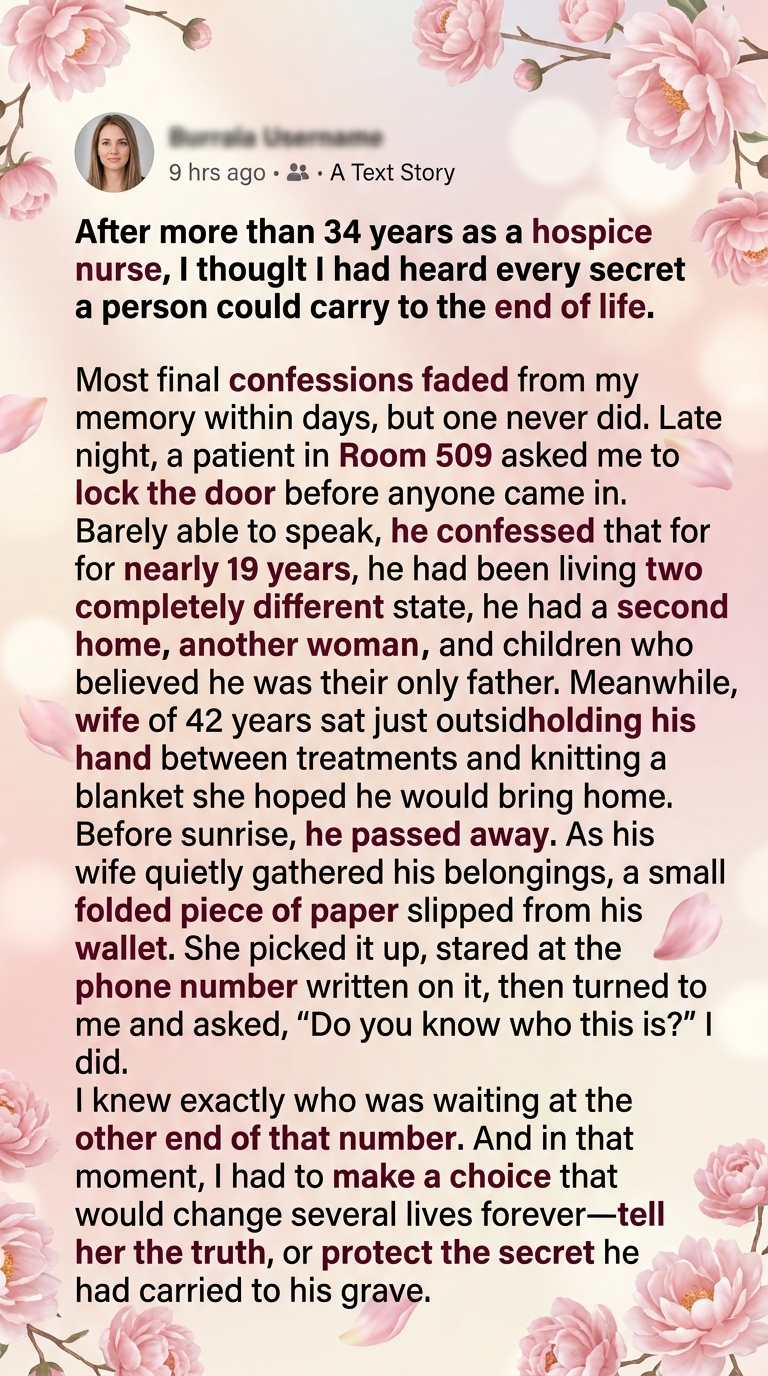
After more than thirty-four years as a hospice nurse, I thought I had heard every secret a person could carry to the end of life.
People confessed things they had never told their spouses.
Things they regretted.
Things they were ashamed of.
Sometimes they confessed affairs.
Sometimes debts.
Sometimes mistakes they had carried for decades.
Most of those confessions faded from my memory within days.
But one never did.
It happened in Room 509.
And it began with a locked door.
His name was Walter.
He was seventy-one years old.
He had been married to his wife, Evelyn, for forty-two years.
She was one of those spouses you remembered.
She never left his side.
She arrived before visiting hours.
She held his hand during treatments.
She read to him when he couldn’t sleep.
And every evening, she sat in the chair beside his bed and knitted a blanket.
“I want him to have it when we go home,” she told me once.
I didn’t have the heart to tell her that Walter probably wouldn’t be going home.
She already knew.
But hope was sometimes the only thing keeping her upright.
One night, shortly after midnight, Walter pressed the call button.
I walked into Room 509.
“Can I get you something?”
He shook his head.
Then he whispered:
“Lock the door.”
I stopped.
“Walter?”
“Please.”
I closed the door.
He looked toward the hallway.
Then toward the chair where Evelyn usually sat.
She had gone downstairs to get coffee.
Walter took a shallow breath.
“I need to tell you something.”
I pulled up a chair.
“You don’t have to tell me anything you don’t want to.”
“I do.”
He looked terrified.
Not of dying.
Of being remembered.
“I’ve been living two lives.”
I didn’t respond.
He continued.
“For nineteen years.”
He told me about a second house.
A small home in another state.
He had purchased it under a different name.
There was another woman.
Her name was Marianne.
And there were two children.
A son and a daughter.
Both adults now.
Both believed Walter was their father.
He had been living with them for nearly nineteen years.
He spent part of every month there.
He celebrated birthdays.
Christmas.
Graduations.
He had attended his son’s wedding.
He had taught his daughter how to drive.
Then he returned home to Evelyn.
His wife of forty-two years.
The woman who believed she knew everything about him.
I listened in silence.
Walter began crying.
“I love them all.”
I looked at him.
“That doesn’t make what you did less painful.”
“I know.”
“Does Evelyn know?”
He shook his head.
“No.”
“Does Marianne know about Evelyn?”
“No.”
I stared at him.
“You’ve kept this secret for nineteen years?”
He nodded.
Then he told me why.
It wasn’t a good excuse.
There wasn’t one.
Walter had met Marianne through work.
He said the relationship was supposed to be temporary.
Then she became pregnant.
He panicked.
He didn’t leave Evelyn.
He didn’t tell Marianne the truth.
Instead, he built a second life.
A house.
A second bank account.
A second phone.
Two birthdays.
Two Christmas mornings.
Two families.
He became an expert at lying.
And eventually, the lie became his life.
“I kept telling myself I’d tell them tomorrow.”
His voice cracked.
“Tomorrow became nineteen years.”
I asked him why he was telling me.
He stared at the ceiling.
“Because I’m dying.”
“I know.”
“I thought I could take it with me.”
“Then why tell me?”
He closed his eyes.
“Because someone has to know.”
I didn’t like that answer.
“Why me?”
“Because you’re the only person here who knows both sides of what I’ve done.”
I shook my head.
“I don’t know Marianne.”
“Yes, you do.”
I frowned.
“What do you mean?”
He whispered:
“She called the hospital last week.”
I froze.
“She asked about me.”
“Why?”
“She knew I was sick.”
“How?”
“I told her.”
“Does she know you’re here?”
“Yes.”
“Does she know about Evelyn?”
He shook his head.
“She thinks I’m divorced.”
My stomach tightened.
“You told her you were divorced?”
“I had to explain why I couldn’t bring her here.”
“You didn’t have to.”
He closed his eyes.
“I know.”
Before sunrise, Walter died.
Quietly.
Evelyn was holding his hand.
The blanket she had been knitting was folded across her lap.
She kept whispering:
“I’m here.”
When the monitor finally went silent, she kissed his forehead.
“Go home, sweetheart.”
I looked away.
I’d seen death hundreds of times.
But that moment hurt.
Because she believed she was saying goodbye to the man she had known for forty-two years.
She didn’t know there was another woman somewhere who believed the same man belonged to her.
After the funeral preparations, Evelyn returned to his room to gather his belongings.
She was quiet.
Almost numb.
She folded his clothes.
Packed his glasses.
Placed his watch inside a small bag.
Then she picked up his wallet.
A folded piece of paper slipped out.
She opened it.
There was a phone number written on it.
Nothing else.
She stared at it.
Then looked at me.
“Do you know who this is?”
I did.
I knew exactly who was waiting at the other end.
Marianne.
My stomach dropped.
Evelyn held out the paper.
“Who is she?”
I couldn’t answer.
“She?”
I looked at the number.
“There’s a name?”
“No.”
“Then why do you think it’s a woman?”
She stared at me.
“Because my husband had a second phone.”
My heart stopped.
“What?”
She sat down.
“I found it three months ago.”
“Why didn’t you say anything?”
“Because he told me it was for work.”
She laughed bitterly.
“I believed him.”
Then she looked at the number again.
“Is this the woman?”
I didn’t speak.
She understood.
“Oh God.”
She began crying.
Not loudly.
Just silent tears.
“Does she know he’s dead?”
I shook my head.
“I don’t know.”
That was true.
Walter had told me Marianne knew he was sick.
He hadn’t told me whether she knew how serious it was.
Evelyn stood.
“Then I need to call her.”
I reached for her hand.
“Evelyn…”
She looked at me.
“You knew.”
I couldn’t lie.
“Yes.”
“How long?”
“Since last night.”
She stared at me.
“And you said nothing.”
“He asked me to keep his confidence.”
She shook her head.
“Of course he did.”
I expected her to be furious.
Instead, she asked:
“Did he love her?”
I thought about the question.
“I can’t answer that.”
“Did he love those children?”
I hesitated.
“Yes.”
She closed her eyes.
Then whispered:
“Then they’re going to lose their father without knowing why.”
That was the moment I understood something.
The secret wasn’t Walter’s anymore.
He was dead.
Whatever consequences remained belonged to the living.
Evelyn didn’t call the number that day.
She took it home.
Three days later, she returned.
“I called.”
I looked at her.
“What happened?”
“She answered.”
“What did you say?”
“I said I was Walter’s wife.”
I held my breath.
“What did she say?”
“She started crying.”
Marianne had apparently known about Evelyn.
Not everything.
But enough.
She had discovered years earlier that Walter was still married.
He had told her the marriage was essentially over.
He said he was staying only because of finances.
She had believed him.
Then she found documents proving otherwise.
She confronted him.
He promised to tell Evelyn.
He never did.
So Marianne stayed.
Not because she was happy.
Because by then, two children were involved.
And she was afraid of destroying their family.
Evelyn asked her:
“Did Walter love you?”
Marianne answered:
“Yes.”
Then she asked:
“Did he love me?”
There was a long silence.
Finally, Marianne said:
“I think he did.”
Evelyn closed her eyes.
That answer hurt more than if Marianne had said no.
Because it meant the betrayal wasn’t simple.
Walter hadn’t stopped loving Evelyn.
He had simply chosen to deceive her.
The hardest part came next.
Evelyn told Marianne:
“I want to meet your children.”
Marianne was shocked.
“Why?”
“Because they’re Walter’s children.”
“And?”
“They deserve to know their father wasn’t just a name on a death certificate.”
Marianne began crying.
“I don’t know if I can do that.”
“You don’t have to do it today.”
Then Evelyn said something I’ll never forget.
“But someday, they’ll ask why their father disappeared.”
“And someone should tell them the truth.”
Months passed.
The two families remained separate.
At first.
Then, slowly, the truth began to emerge.
Walter’s son, Daniel, was thirty-one.
His daughter, Claire, was twenty-eight.
Both were devastated.
Not simply because their father had died.
Because the man they thought they knew had been living another life.
Daniel refused to speak to Evelyn.
Claire did.
She came to Evelyn’s house one afternoon.
She brought a photograph of Walter holding her when she was a baby.
“I don’t know what to call you,” Claire said.
Evelyn smiled sadly.
“You don’t have to call me anything.”
Claire started crying.
“I’m sorry.”
Evelyn shook her head.
“You didn’t do anything.”
“But I feel like I stole him from you.”
“You didn’t.”
“He was your husband.”
“Yes.”
“And my father.”
“Yes.”
They sat in silence.
Then Evelyn said:
“That’s the tragedy.”
Eventually, the families met.
Not as one happy family.
There was too much pain for that.
But they sat around the same table.
Daniel brought photographs.
Claire brought letters.
Evelyn brought the blanket she had been knitting.
She unfolded it.
“I was making this for him.”
Marianne touched the edge.
“It’s beautiful.”
Evelyn looked at her.
“You can keep it.”
Marianne shook her head.
“No.”
She pushed it back.
“It belongs with you.”
Evelyn thought for a moment.
Then she said:
“Then we’ll share it.”
Years later, I still think about that night in Room 509.
Walter asked me to lock the door because he was afraid.
But he wasn’t afraid of death.
He was afraid of what would happen after he was gone.
He wanted me to protect the secret.
For a few hours, I did.
Then I realized something.
There is a difference between protecting someone’s privacy and protecting a lie that is actively hurting innocent people.
Walter had spent nineteen years deciding who deserved the truth.
After he died, that decision no longer belonged to him.
It belonged to the people whose lives had been built around his deception.
I sometimes wonder whether I did the right thing.
I never told Evelyn directly.
She discovered the number herself.
I didn’t reveal details that weren’t mine to reveal.
But when she asked me whether I knew who was on the other end, I couldn’t continue lying for a dead man.
I told her enough to find the truth.
She made the rest of the choices herself.
And perhaps that was the most important distinction.
I didn’t destroy Walter’s secret.
I stopped carrying it for him.
Evelyn eventually finished the blanket.
She kept it folded at the end of her bed.
Not because she forgave Walter.
She never completely did.
But because it represented the last thing she had made for the man she thought she knew.
Marianne kept photographs.
Daniel kept his father’s old watch.
Claire kept the letters.
And the two families remained in occasional contact.
Not because Walter deserved to have two families.
But because none of them deserved to lose one another because of his choices.
One afternoon, years after Walter’s death, Evelyn came to visit me.
She brought the blanket.
“I thought you might want to see it.”
I smiled.
“It turned out beautifully.”
She nodded.
Then she said:
“You know what I’ve learned?”
“What?”
“Some secrets die with people.”
She folded the blanket carefully.
“But some secrets don’t belong in the grave.”
I looked at her.
She continued:
“Walter thought taking the truth to his grave would protect everyone.”
She smiled sadly.
“It only meant we had to carry it afterward.”
After thirty-four years in hospice care, I’ve learned that people often imagine death as the end of a story.
It isn’t.
Sometimes it’s the moment everything left unsaid finally catches up with the living.
Walter thought his secret would disappear when he did.
It didn’t.
It became a question.
Then a phone call.
Then a confrontation.
Then tears.
Then two families sitting across a table, trying to understand how one man had managed to create so much love and so much pain at the same time.
I still remember Room 509.
The locked door.
His shaking hands.
His confession.
And the folded piece of paper that fell from his wallet after he died.
If I had answered Evelyn’s question with a lie, I might have protected Walter’s secret.
But I would have forced everyone else to keep living inside it.
So I told her the truth I could tell.
And she chose what to do with it.
That choice changed several lives.
Not because the truth was painless.
It wasn’t.
But because eventually, everyone deserved the chance to live in a life that was actually theirs.
And that is the lesson Walter left behind.
A secret can protect someone for a day.
A lie can protect them for years.
But eventually, the truth asks to be let out.