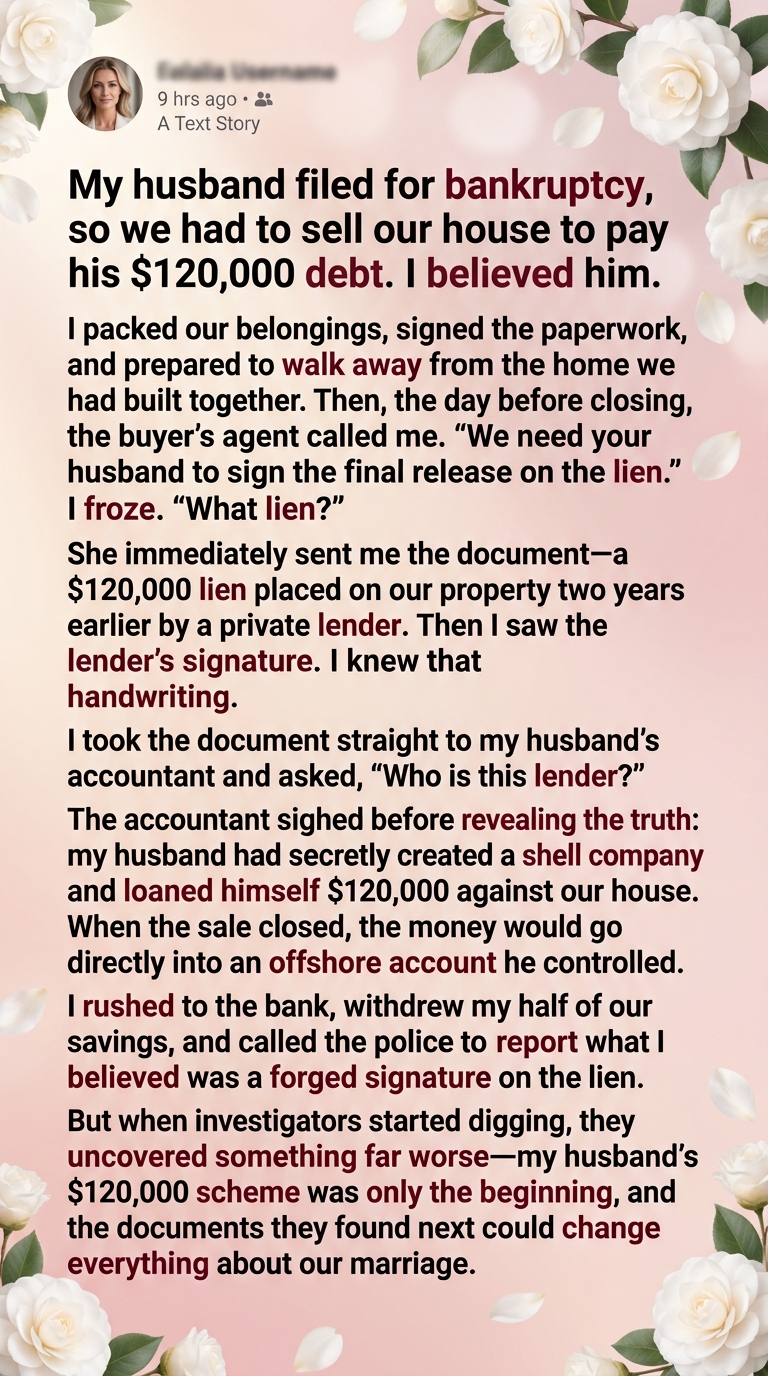
My Husband Said We Were Selling Our House to Pay His $120,000 Debt. Then I Found the Lien.
“My husband filed for bankruptcy, so we have to sell the house.”
Those were the words that changed my life.
For weeks, I believed them.
I believed my husband when he told me he had accumulated $120,000 in debt.
I believed him when he said bankruptcy wasn’t enough to protect our home.
And I believed him when he said selling the house was the only way to make everything right.
I had no reason to think otherwise.
We had been married for seventeen years.
I trusted him completely.
That trust almost cost me everything.
The house had been ours for twelve years.
It wasn’t a mansion.
It wasn’t even particularly large.
But every room carried a memory.
The kitchen where we made Sunday breakfasts.
The hallway where we measured our children’s heights.
The backyard where we celebrated birthdays.
Selling it felt like cutting out a piece of our history.
But my husband kept telling me:
“We don’t have a choice.”
So I packed.
I filled boxes.
I donated furniture.
I watched strangers walk through rooms that had once belonged only to us.
Every time I cried, my husband told me:
“It’ll be okay.”
“We’ll rebuild.”
“I promise.”
I believed him.
The closing was scheduled for Friday.
On Thursday afternoon, I received a phone call from the buyer’s agent.
“Hi, we have one final issue.”
My stomach tightened.
“What kind of issue?”
“We need your husband’s signature on the final release for the lien.”
I frowned.
“What lien?”
There was a pause.
“You’re aware of the $120,000 lien against the property?”
“No.”
Another silence.
“I’m going to email you the document.”
A minute later, it arrived.
I opened it.
And everything inside me went cold.
There was a lien against our house.
For exactly:
$120,000.
The same amount my husband claimed we owed.
I stared at the document.
Then I saw the lender’s name.
And the signature.
My husband’s handwriting.
I called him.
“What is this?”
He didn’t answer immediately.
“What?”
“The lien.”
“Oh.”
That single word terrified me.
“What lender?”
“It’s complicated.”
“Who is it?”
“Don’t worry about it.”
“I am worried about it.”
He became irritated.
“That’s part of the debt.”
“Then why didn’t you tell me?”
“I didn’t think it mattered.”
I hung up.
Something was wrong.
Very wrong.
I took the document to his accountant.
I didn’t tell my husband where I was going.
The accountant looked at the paper.
His face changed.
“Where did you get this?”
“The buyer’s agent.”
He rubbed his forehead.
“I’m afraid you’re going to have to ask your husband.”
“I’m asking you.”
He looked at the signature.
Then quietly said:
“This company doesn’t have any normal business activity.”
“What company?”
He turned the document around.
The lender was a company I’d never heard of.
A private corporation registered in another state.
I stared at him.
“Who owns it?”
He hesitated.
“Your husband.”
My stomach dropped.
“What?”
“He created it two years ago.”
“Why?”
The accountant sighed.
“Your husband used it to loan himself money.”
I couldn’t speak.
He explained the structure.
My husband had created a shell company.
Then transferred $120,000 from our business accounts into it.
The shell company then “loaned” the money back to him.
He secured the loan with our house.
On paper, it looked like legitimate debt.
In reality, he had created the debt himself.
And the money?
It had been moved into an offshore account.
I stared at the accountant.
“Why?”
He looked at me.
“That’s what I don’t understand.”
“What happens when we sell?”
“The lien gets paid.”
“To whom?”
“The shell company.”
“And then?”
He didn’t answer.
I already knew.
“The money goes offshore.”
He nodded.
I drove home shaking.
My husband wasn’t there.
I went into his office.
I opened his desk.
Bank statements.
Business records.
Tax documents.
I searched everything.
Then I found a folder labeled:
PROPERTY / CLOSING
Inside were copies of the lien.
The shell company documents.
And something else.
A transfer authorization.
It had my signature on it.
Except I had never signed it.
I stared at the page.
Then I called the bank.
They confirmed that someone had used the document to authorize a transfer.
I told them:
“That isn’t my signature.”
The bank immediately flagged the transaction.
I withdrew my half of our savings.
Then I called the police.
I didn’t know exactly what my husband had done.
I only knew that someone had used my name on financial documents without my permission.
Investigators arrived.
They reviewed the lien.
The shell company.
The transfers.
The bank records.
At first, it looked like a sophisticated financial fraud scheme.
Then they found something else.
Something much worse.
An investigator asked:
“Did your husband ever tell you he was filing for bankruptcy?”
“Yes.”
“Did you see the filing?”
“No.”
“Did you sign anything?”
“No.”
He looked at another investigator.
Then back at me.
“Because we can’t find a bankruptcy filing under his name.”
I felt the room spin.
“What?”
“There is no bankruptcy.”
I sat down.
“My husband told me he filed.”
“He didn’t.”
The entire story had been fabricated.
The $120,000 debt.
The bankruptcy.
The sale.
All of it.
He had created a fake financial crisis to make me voluntarily sell our house.
Then the lien would ensure that $120,000 of the sale proceeds went to his shell company.
And he expected me to believe it was repayment of a legitimate debt.
But why?
That was the question.
Then investigators examined the offshore account.
The account wasn’t empty.
There was far more money there than $120,000.
Hundreds of thousands.
Then more.
Over the previous two years, my husband had been moving money out of our businesses and into accounts we didn’t know existed.
The $120,000 was only one transaction.
It was part of a much larger scheme.
Investigators subpoenaed his financial records.
That’s when they discovered another company.
Then another.
Each one had different names.
Different addresses.
Different bank accounts.
But they all led back to my husband.
Money had been moving through them for years.
Some transfers were disguised as business expenses.
Others were labeled as loans.
There were payments to people I had never heard of.
And then they found a spreadsheet.
It listed names.
Amounts.
Dates.
And one column labeled:
“Exit Plan.”
My name was on the list.
I stared at it.
“What does this mean?”
The investigator looked uncomfortable.
“We’re still determining that.”
“What does my name next to an amount mean?”
“We don’t know yet.”
Then he pointed to another line.
My husband’s name.
Beside it was a number.
Far larger than the amount I’d ever known about.
Then another column.
“After closing.”
I felt sick.
He wasn’t simply trying to hide money.
He had been planning his life after leaving me.
The house sale was part of that plan.
The investigators eventually discovered emails between my husband and an attorney.
The emails discussed moving assets before the divorce.
There were references to:
“protecting funds.”
“minimizing exposure.”
“separating marital assets.”
And one sentence that made me cry:
“She won’t question the sale if I tell her it’s debt.”
I stared at the screen.
My husband had known exactly how to manipulate me.
He knew I trusted him.
He knew I hated financial conflict.
He knew I would sacrifice our home to protect our family.
He used all of that against me.
Then came the final discovery.
Investigators found evidence that my husband had been preparing to leave the country.
He had purchased property overseas.
He had obtained a second passport through legal residency.
He had transferred money into accounts under another identity.
And he had already rented an apartment in another city.
The house wasn’t the end of his plan.
It was the beginning.
He intended to sell our home.
Move the money.
Leave.
And let me believe he had simply disappeared because the marriage had collapsed under financial pressure.
He was arrested before the closing.
The buyer’s agent canceled the sale.
The lien was challenged.
The forged documents were investigated.
The offshore accounts were frozen where possible.
And suddenly, the house I’d thought I had lost was still mine.
At least temporarily.
But emotionally, it no longer felt like home.
Every room reminded me of how easily someone I trusted could build an entirely different life behind my back.
Months later, I finally understood something.
My husband hadn’t simply stolen money.
He had stolen my ability to know what was real.
Every bill.
Every argument about finances.
Every time he told me we couldn’t afford something.
Every time he said:
“Trust me.”
I had trusted him.
And he had been preparing to leave.
The legal process took years.
Some money was recovered.
Some wasn’t.
The shell companies were dismantled.
The offshore accounts became part of a much larger investigation.
Several other people were eventually questioned.
I never learned every detail.
Some truths weren’t mine to know.
But I learned enough.
Enough to understand that the $120,000 lien wasn’t the crime.
It was the bait.
The house wasn’t the target.
I was.
He wanted me to willingly hand over the asset that represented the biggest piece of our shared wealth.
He didn’t need to force me.
He only needed me to believe him.
I kept the house.
Not because I wanted to preserve my marriage.
That marriage was already gone.
I kept it because I refused to let his deception determine where I would live.
Eventually, I changed the locks.
Changed the bank accounts.
Changed the passwords.
Changed my will.
And most importantly, I stopped believing that asking questions was the same thing as being difficult.
A year after everything happened, I received a letter from the buyer’s agent.
She wrote:
“I still think about the day I called you about the lien.”
“So do I.”
She said she was glad she had noticed the discrepancy before closing.
I was too.
Because one phone call exposed the first crack in a lie that had been built for years.
If she hadn’t called me, the house might have sold.
The lien might have been paid.
The money might have disappeared.
And my husband might have been halfway around the world before I ever understood what happened.
Sometimes I still think about that first sentence:
“My husband filed for bankruptcy.”
I believed it because I trusted him.
And that’s what makes betrayal so dangerous.
A stranger doesn’t need to convince you of a lie.
A stranger has to prove himself.
Someone you love only has to say:
“Trust me.”
My husband said those words for seventeen years.
And I believed him.
Until a stranger called me about a lien.
That $120,000 document wasn’t just a piece of paper.
It was the first crack in the story my husband had built.
Behind it were shell companies.
Hidden accounts.
Forged signatures.
An offshore fortune.
And an escape plan.
He thought he was selling our house to pay a debt.
In reality, he was trying to sell me a lie.
And the moment I saw that lien, I stopped signing anything I didn’t understand.
I stopped accepting explanations without proof.
And I stopped confusing love with blind trust.
Because sometimes the most dangerous financial fraud doesn’t begin with a stranger.
It begins with the person sitting across from you at the dinner table saying:
“Don’t worry. Trust me.”