I Chose My Career Over My Three-Year-Old Daughter. Twenty-One Years Later, She Made Me Understand What I Lost.
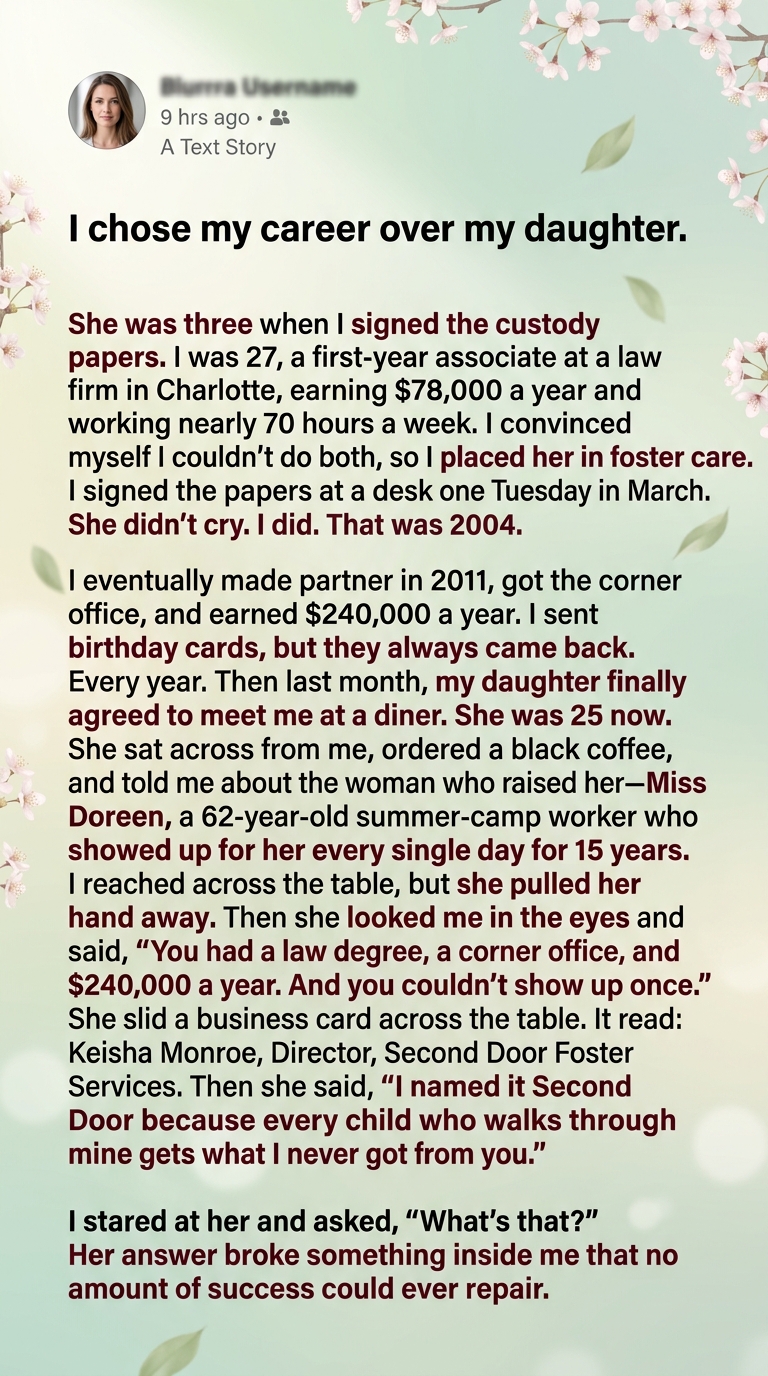
I was twenty-seven when I signed away custody of my daughter.
She was three.
I still remember the desk.
The beige walls.
The fluorescent lights.
The stack of paperwork in front of me.
And the pen in my hand.
My daughter was in another room.
She didn’t cry.
I did.
That was 2004.
At the time, I told myself I was making the responsible choice.
I was a first-year associate at a law firm in Charlotte.
I earned $78,000 a year.
I worked nearly seventy hours a week.
I was exhausted.
Ambitious.
Terrified of failing.
And convinced that I couldn’t be a good mother and build the career I wanted.
So I signed.
I told myself she would be better off somewhere else.
I told myself it was temporary.
I told myself I was doing it for her.
Those were the lies I needed in order to walk out that door.
The first few months were unbearable.
I asked for updates.
I called.
I sent letters.
Then the foster agency stopped giving me details.
I told myself it was because of privacy rules.
Eventually, I began sending birthday cards.
Every year.
I never received a reply.
Most of them came back.
Return to sender.
Sometimes there was no explanation.
Sometimes the envelope was marked with a new address.
I kept every returned card.
I put them in a drawer.
Then I went back to work.
My career took off.
I became a senior associate.
Then a partner.
In 2011, I got the corner office I’d spent years dreaming about.
My salary climbed to $240,000.
I bought a beautiful house.
I traveled.
I attended conferences.
I became the attorney younger associates wanted to impress.
People told me I had made something of myself.
They were right.
I had.
But every year, when my daughter’s birthday came around, I remembered that little three-year-old sitting in a foster-care office.
The one who hadn’t cried.
The one who watched me walk away.
I tried to find her.
Several times.
I hired someone to help locate her.
I searched public records.
I contacted the agency.
But because of the circumstances surrounding her placement, I couldn’t simply walk back into her life.
And after enough failed attempts, I started telling myself something dangerous:
Maybe she was happier without me.
Maybe I should leave her alone.
Maybe contacting her would only reopen old wounds.
It was easier to believe that than to admit the truth.
I was afraid.
Afraid she hated me.
Afraid she had forgotten me.
Afraid she would ask why I chose work over her.
Because I didn’t have a good answer.
Then, last month, I received an email.
The subject line contained one word:
“Mom.”
I stared at it for nearly five minutes.
The message was short.
If you still want to meet, I’ll be at the diner on Saturday at 10.
There was an address.
And a name.
Keisha.
I cried before I even finished reading it.
My daughter had finally agreed to meet me.
She was twenty-five.
I arrived twenty minutes early.
I sat in a booth near the window.
I couldn’t drink my coffee.
At exactly 10:02, she walked in.
I knew immediately.
Not because she looked exactly like the three-year-old I remembered.
She didn’t.
She was a grown woman.
Confident.
Quiet.
She had dark hair pulled back into a simple ponytail.
She walked toward my table.
“Hi.”
I stood.
“Hi.”
We hugged.
Or rather, I tried to hug her.
She allowed it for about two seconds.
Then stepped back.
We sat down.
She ordered black coffee.
I ordered nothing.
I wanted to tell her everything.
How much I had thought about her.
How many birthday cards I’d sent.
How often I’d searched for her.
How sorry I was.
But before I could begin, she said:
“I know.”
I looked at her.
“You know what?”
“That you sent cards.”
My throat tightened.
“You got them?”
“Some.”
“Why didn’t you answer?”
She looked out the window.
“Because I didn’t know what to say.”
I nodded.
“I understand.”
“No.”
She looked at me.
“You don’t.”
I swallowed.
“Then help me understand.”
She told me about the woman who raised her.
Her name was Doreen.
She was sixty-two now.
She had worked at a summer camp when my daughter was little.
She wasn’t wealthy.
She didn’t have a corner office.
She didn’t make $240,000 a year.
But she showed up.
Every day.
She packed lunches.
Helped with homework.
Sat beside her during nightmares.
Went to school plays.
Remembered birthdays.
Learned which foods she hated.
Which songs made her happy.
Which teachers she trusted.
When my daughter got sick, Doreen stayed awake all night.
When she graduated high school, Doreen sat in the front row.
When she got her first job, Doreen was the person she called.
“She’s my mother,” my daughter said.
I nodded.
“She earned that.”
Then my daughter reached into her purse.
She pulled out a small photograph.
It showed her as a child.
Standing beside Doreen.
They were smiling.
I looked at the picture.
“You look happy.”
“I was.”
I smiled through tears.
“I’m glad.”
She put the photograph away.
Then she looked at me.
“You want to know what I remember about you?”
I couldn’t answer.
“The day you left.”
My chest tightened.
“I was three.”
“I know.”
“I didn’t understand why you were crying.”
I looked down.
“I thought you were mad at me.”
My eyes filled with tears.
“I wasn’t.”
“I know that now.”
She took a breath.
“But I didn’t know then.”
I reached across the table.
She pulled her hand away.
The movement was small.
But it felt like a door closing.
Then she said:
“You had a law degree.”
“You had a corner office.”
“You made $240,000 a year.”
She looked directly into my eyes.
“And you couldn’t show up once.”
I couldn’t breathe.
She continued:
“Not once.”
“I sent cards.”
“I know.”
“I tried to find you.”
“I know.”
“Then why didn’t you come?”
She was crying now.
“Because you gave me away.”
There was nothing I could say.
Because she was right.
She slid a business card across the table.
I picked it up.
It read:
Keisha Monroe
Director
Second Door Foster Services
I looked at her.
“You started this?”
She nodded.
“Why?”
She stared at the card.
“Because I wanted to make sure other kids had someone.”
I felt my throat tighten.
“What does Second Door mean?”
She smiled sadly.
“Every child who walks through mine gets what I never got from you.”
I whispered:
“What?”
She looked directly at me.
“Someone who shows up.”
I cried.
Not the quiet tears I had shed in court twenty-one years earlier.
These were different.
They came from somewhere deeper.
I had spent twenty-one years building a career around responsibility.
I had argued cases about families.
Written briefs about children’s welfare.
Spoken confidently about what people owed one another.
And yet my daughter had reduced my entire life to one sentence.
You couldn’t show up.
She was right.
I asked about Second Door.
She told me she had started it after college.
She wanted to help foster children transition into adulthood.
She provided tutoring.
Mentorship.
Job training.
Temporary housing.
Most importantly, consistent adults.
People who answered the phone.
People who remembered birthdays.
People who stayed.
She had named it after the moment she believed her life had changed.
Walking through one door when I left.
And eventually finding another.
“A second door,” she explained.
“One where someone actually waits for you.”
I cried again.
I asked:
“Can I help?”
She looked at me.
“How?”
“I can donate.”
She shook her head.
“I don’t need your money.”
That hurt.
But I understood.
“What do you need?”
She thought for a moment.
“Show up.”
I nodded.
“How?”
“Come volunteer.”
“I will.”
“Not once.”
“I won’t.”
“Not because you feel guilty.”
“I won’t.”
“Come because you’re willing to stay.”
I looked at her.
“I can do that.”
She didn’t smile.
Not yet.
But she nodded.
The following Saturday, I walked into Second Door Foster Services.
I expected my daughter to be there.
She wasn’t.
For a moment, I felt disappointed.
Then I understood.
This wasn’t about her forgiving me.
It was about me learning how to show up without expecting something in return.
So I stayed.
I helped organize donated backpacks.
I sorted school supplies.
I helped a teenager fill out a job application.
I listened to a sixteen-year-old talk about how scared she was about aging out of foster care.
I didn’t tell her what to do.
I simply listened.
Before I left, she asked:
“Are you coming back next week?”
I smiled.
“Yes.”
She nodded.
“Okay.”
I came back the next week.
And the week after.
Then the week after that.
Eventually, my daughter began stopping by.
Sometimes we talked.
Sometimes we worked in the same room without speaking.
It wasn’t a movie.
She didn’t suddenly call me Mom.
She didn’t forgive me overnight.
She didn’t pretend twenty-one years hadn’t happened.
And I didn’t ask her to.
One afternoon, she handed me a box.
“What’s this?”
“Open it.”
Inside were dozens of birthday cards.
Mine.
The ones I’d sent over the years.
Some were unopened.
Some had been opened.
Some still had the envelopes.
I looked at her.
“You kept them?”
She nodded.
“I wasn’t ready to read them.”
I touched the top card.
“Why give them to me now?”
She shrugged.
“I thought you should know they mattered.”
I started crying.
“So you did know I thought about you.”
“Yes.”
“Then why did you wait so long?”
She looked at me.
“Because I needed to know whether you would still be there when I was ready.”
I couldn’t speak.
Months passed.
Our relationship remained complicated.
There were good days.
Bad days.
Long conversations.
Long silences.
Sometimes she was angry.
Sometimes I was.
But something had changed.
I wasn’t trying to become her mother again.
I was trying to become someone she could trust.
And trust isn’t built with a single apology.
It’s built through repetition.
Showing up.
Again.
And again.
And again.
One evening, after a long day at Second Door, my daughter walked me to my car.
She stood beside the driver’s door.
Then she said:
“You know what?”
“What?”
“I think you’re finally getting it.”
I smiled.
“Getting what?”
“That success isn’t what you thought it was.”
I looked at her.
She continued:
“You spent years trying to build a life worth being proud of.”
I nodded.
“And you did.”
She smiled.
“But you forgot that the people you love are part of that life.”
I looked down.
“I know.”
She reached for my hand.
This time, she didn’t pull away.
A year after our first meeting, she invited me to a ceremony at Second Door.
Several former foster children were graduating from the program.
She introduced me to them.
“This is my mother.”
The word stopped me.
Mother.
She had said it.
Not because she had forgotten what happened.
But because she had decided I was finally earning the right to hear it.
I couldn’t stop crying.
Afterward, she hugged me.
A real hug.
Longer than two seconds.
And whispered:
“You showed up.”
I held her tightly.
“I’ll keep showing up.”
I still have my corner office.
I still practice law.
But I work fewer hours now.
I turned down promotions I once would have fought for.
I spend one day a week at Second Door.
I attend events.
I help with legal paperwork.
I mentor young adults aging out of foster care.
And every year, I make sure I never miss my daughter’s birthday.
Not with a card.
Not with flowers sent by someone else.
I show up.
Sometimes people ask me if I regret my career.
I don’t.
I regret believing that success required me to sacrifice my daughter.
I regret convincing myself that I had to choose.
I regret the day I signed those papers.
But most of all, I regret the years I spent thinking that sending a card was the same as being present.
It wasn’t.
A birthday card doesn’t sit beside a sick child.
A salary doesn’t attend a school play.
A corner office doesn’t answer a frightened teenager’s phone call.
And a law degree can’t undo the pain caused by walking away.
My daughter once told me something that I will carry for the rest of my life.
“You can’t go back and become the mother I needed at three.”
She paused.
“But you can become someone I can trust at twenty-five.”
That was the second chance I didn’t deserve.
But I intend to spend the rest of my life earning it.
Because I finally understand what she was trying to tell me at that diner.
I thought I had chosen my career over my daughter.
The truth was worse.
I had convinced myself that success could compensate for absence.
It couldn’t.
I had spent twenty-one years measuring my life by salaries, titles, promotions, and accomplishments.
My daughter measured it differently.
She measured it by who showed up.
And now I know the truth I wish I had understood when she was three:
The most important place I could ever have been was beside my child.
And no corner office in the world was worth missing it.