The $950,000 My Family Stole
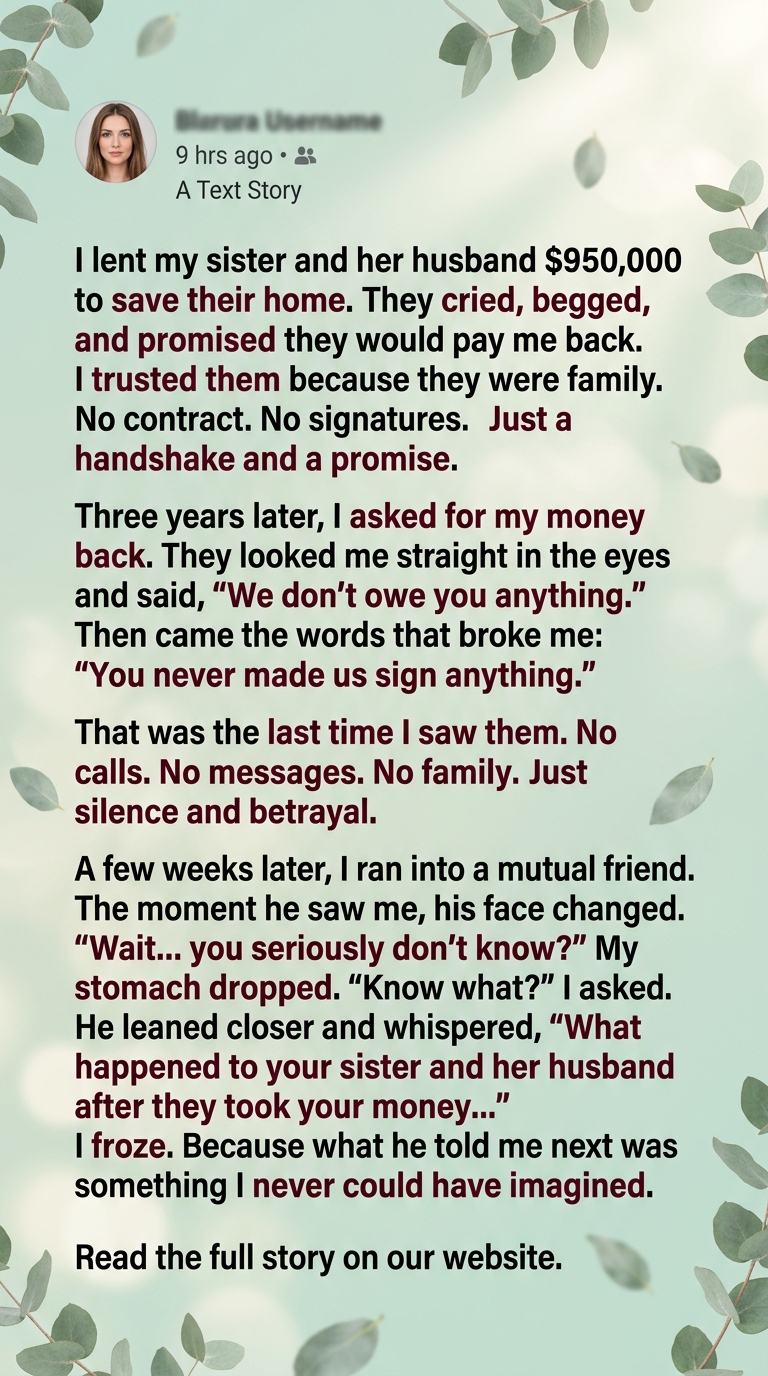
I lent my sister and her husband $950,000 to save their home.
They cried when they asked me.
They begged.
They promised me they would pay every dollar back.
And because they were family, I trusted them.
There was no contract.
No signatures.
No lawyer.
Just a handshake and a promise.
Three years later, I finally asked for my money back.
I thought it would be uncomfortable.
I didn’t expect them to look me directly in the eyes and say:
“We don’t owe you anything.”
I thought I had misunderstood.
“What?”
My sister shrugged.
“You gave us the money.”
Her husband leaned back in his chair.
“You never made us sign anything.”
Those words broke something inside me.
I had saved for years.
I had trusted them with almost everything I had.
And now they were using the absence of paperwork as an excuse to pretend the loan had never happened.
I stood up and left.
That was the last time I saw them.
No calls.
No messages.
No family gatherings.
Nothing.
They simply disappeared from my life.
For weeks, I couldn’t understand how two people I had loved my entire life could do that to me.
Then, one afternoon, I ran into an old family friend at a coffee shop.
The moment he saw me, his face changed.
“Wait.”
He stared at me.
“You seriously don’t know?”
My stomach tightened.
“Know what?”
He looked around before lowering his voice.
“What happened to your sister and her husband after they took your money.”
I froze.
“What happened?”
He sat down.
“They didn’t keep the house.”
I stared at him.
“What?”
“The bank foreclosed.”
I couldn’t speak.
He explained that my sister and her husband had never actually used all the money to save their home.
They had used part of it to pay immediate debts.
Then they spent the rest trying to keep their failing business alive.
The business collapsed anyway.
They lost the house.
They lost the business.
And then, apparently, they had filed for bankruptcy.
I felt sick.
“Why didn’t they tell me?”
My friend looked at me sadly.
“Because there was something else.”
“What?”
“They told everyone you gave them the money as a gift.”
My heart sank.
“They said you wanted to help them because you had more money than you needed.”
I couldn’t believe it.
“They told people I gave them $950,000?”
He nodded.
“That’s what they said.”
Then he pulled out his phone.
“There was an article about the bankruptcy. Your sister gave an interview.”
I didn’t want to read it.
But I did.
She claimed that family had helped them financially during a difficult period.
There was no mention of a loan.
No mention of repayment.
No mention of the promise they had made to me.
I closed my eyes.
Then my friend said:
“There’s one more thing you need to know.”
He showed me another document.
It was a list of creditors from the bankruptcy proceedings.
My name wasn’t there.
I stared at the page.
“Why isn’t my name listed?”
“Because they never admitted the debt.”
That was when I understood.
They hadn’t simply refused to pay me.
They had decided that if they denied the loan existed, they could make me disappear from the story entirely.
But there was one problem.
I had kept records.
Not a contract.
Not a signed agreement.
But bank statements.
Transfer confirmations.
Emails.
Text messages.
And, most importantly, messages from my sister thanking me for “saving the house.”
I had never expected to need them.
I simply hadn’t deleted them.
I contacted an attorney.
He reviewed everything carefully and explained that the lack of a formal contract did not automatically mean there was no claim, but that proving the terms of a large family loan could be complicated.
We gathered every piece of evidence.
The bank transfer.
The messages.
The dates.
The conversations.
The promises to repay.
Then came the hardest part.
My sister and her husband were contacted through the proper legal process.
For the first time in three years, my sister called me.
I almost didn’t answer.
When I did, she was crying.
“Please don’t do this.”
I was stunned.
“Do what?”
“You know what.”
“No,” I said. “I don’t. You told me you didn’t owe me anything.”
She was silent.
Then her husband got on the phone.
“We were desperate.”
“So was I,” I said.
“You had the money.”
“And you had my trust.”
Neither of them spoke.
Then my sister whispered:
“We thought we’d fix everything before you ever needed the money back.”
“You should have told me.”
“We were ashamed.”
I closed my eyes.
“You didn’t just lie about the money.”
“You lied about me.”
She began crying.
“I know.”
Eventually, the evidence was enough for the matter to be addressed through the appropriate legal proceedings.
The outcome wasn’t the miracle I had once imagined.
I didn’t suddenly receive $950,000 back in one check.
The bankruptcy process meant recovery would be complicated and limited.
But the debt was no longer something they could simply erase by saying it never existed.
And for me, that mattered.
Not because money was everything.
Because the truth mattered.
Months later, I received a letter from my sister.
I almost threw it away.
Instead, I opened it.
She wrote:
“I thought the worst thing you could do was take us to court.”
“I was wrong.”
“The worst thing I did was convince myself that because you loved me, I didn’t have to keep my promise.”
“You trusted me when I had nothing left.”
“And when I was given the chance to repay that trust, I chose to betray you instead.”
I read the letter twice.
Then I put it away.
I didn’t forgive her immediately.
Maybe I never completely will.
But I finally stopped asking myself the question that had haunted me for years:
How could my own sister do this?
The answer was painfully simple.
Because being family doesn’t automatically make someone honest.
Love doesn’t guarantee loyalty.
And a handshake means nothing if the person holding your hand has already decided to let go.
I had once believed the $950,000 was the biggest thing I had lost.
It wasn’t.
I lost a sister.
I lost the family I thought I knew.
But I also learned something I wish I had never needed to learn:
Trust is valuable.
And when someone asks you to put nearly a million dollars in their hands, love should never be the only protection you have.
My sister thought she had found a loophole because we had no contract.
Instead, she discovered that promises leave traces.
And sometimes the truth survives even when people try to erase it.
I never got the ending I wanted.
But I got something I needed.
The truth.
And after three years of being told that I had imagined the promise, I finally knew I hadn’t.
She had promised to pay me back.
She broke that promise.
And I would never again confuse being someone’s family with being unable to protect myself.