The Marks on Her Wrists
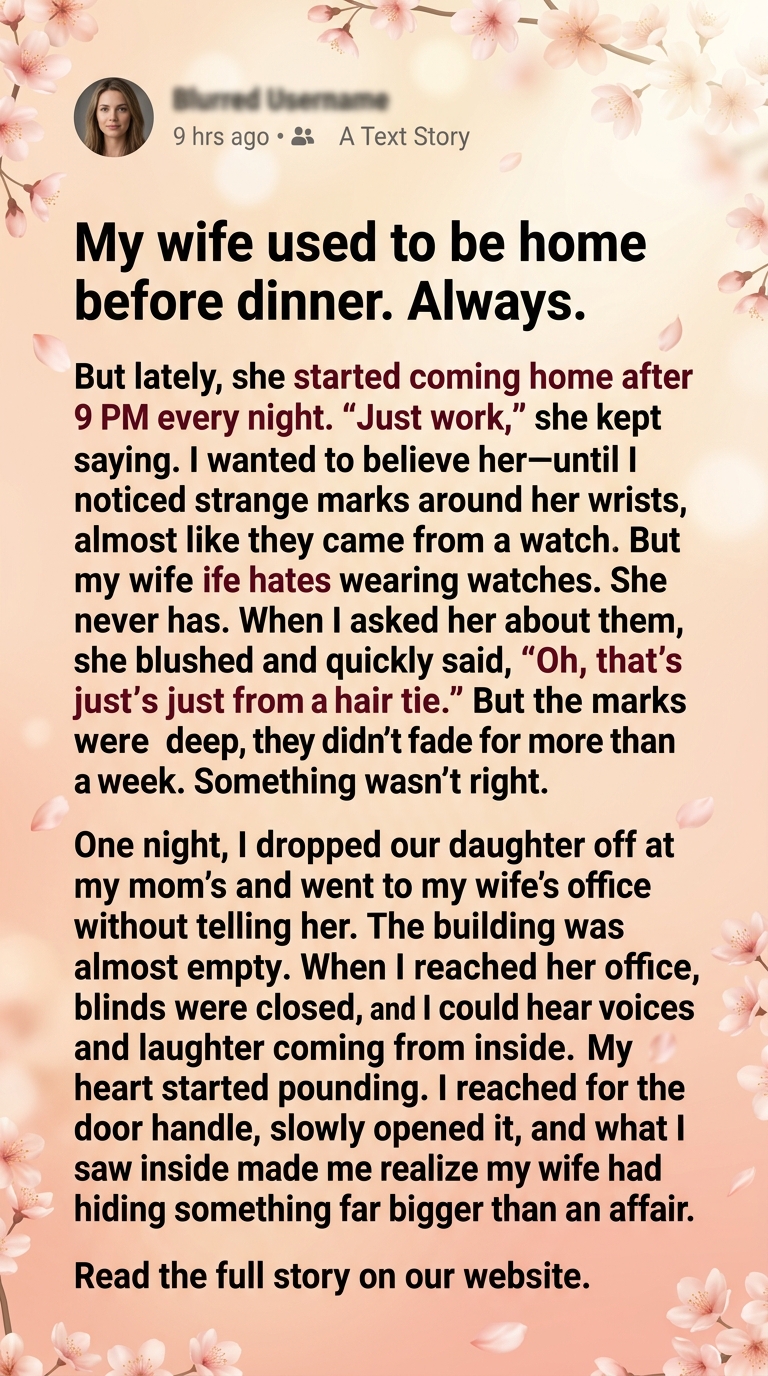
My wife used to be home before dinner.
Always.
For twelve years, I could practically set the clock by her routine.
She left work around five.
Picked up our daughter.
Came home.
Made dinner with me.
Helped with homework.
Then we watched something stupid on television before bed.
It wasn’t exciting.
But it was our life.
Then, suddenly, she started coming home after nine every night.
“Just work,” she kept saying.
I wanted to believe her.
I really did.
But something felt different.
She started keeping her phone face down.
She stopped answering calls around me.
And then I noticed the marks.
They were around both of her wrists.
Thin, dark lines.
Almost like the marks left by a watch.
Except my wife hated wearing watches.
She never had.
“What’s that?” I asked one morning.
She looked at her wrist.
For half a second, her expression changed.
Then she smiled.
“Oh, that? Just a hair tie.”
But I knew my wife.
Those weren’t hair-tie marks.
They were too deep.
And they didn’t fade.
A week later, they were still there.
I asked again.
She became defensive.
“I told you. It’s nothing.”
So I stopped asking.
But I started paying attention.
Her late nights continued.
Sometimes she came home exhausted.
Sometimes she seemed strangely quiet.
Once, I noticed a small bruise near her shoulder.
She quickly covered it.
I wanted to confront her.
I wanted to ask whether there was another man.
But something inside me kept saying this wasn’t about an affair.
One night, I dropped our daughter off at my mother’s house.
Then I drove to my wife’s office.
I didn’t tell her I was coming.
The building was almost empty.
Only a few lights were still on.
I walked down the hallway toward her office.
When I reached the door, the blinds were closed.
Then I heard voices.
And laughter.
My heart started pounding.
There was more than one person inside.
I reached for the door handle.
Slowly, I opened it.
And froze.
My wife was standing in the middle of the room.
Her wrists were tied together with a soft fabric strap.
There were several other people around her.
But no one looked frightened.
They were laughing.
My wife looked at me.
Her face went completely white.
“Oh my God.”
I stared at her.
“What is this?”
She immediately covered her wrists.
Nobody spoke.
Then a woman standing beside her stepped forward.
“You’re her husband?”
“Yes.”
The woman looked at my wife.
“Did you tell him?”
My wife shook her head.
I felt sick.
“Tell me what?”
My wife took a deep breath.
“I was going to.”
“Going to tell me what?”
She looked down.
Then she finally said:
“I’ve been helping people who are trapped.”
I didn’t understand.
The woman beside her explained.
My wife’s company had recently started working with a nonprofit organization that helped victims of domestic abuse and human trafficking.
The marks on her wrists weren’t from an affair.
They came from training exercises.
She had been taking part in an intensive certification program after work.
The program included simulations where trainees experienced controlled restraint, learned how victims might be transported or restrained, and practiced recognizing signs of coercion.
That’s why she had been coming home late.
That’s why her wrists were bruised.
That’s why she couldn’t tell me.
She had signed confidentiality agreements because some of the cases involved active investigations.
I stared at her.
“You couldn’t tell me any of this?”
She shook her head.
“Not the details.”
“Then why didn’t you just tell me you were helping people?”
“Because I didn’t want anyone accidentally repeating something to the wrong person.”
Then the woman beside her spoke.
“Your wife isn’t just taking the training.”
She paused.
“She’s been volunteering directly with survivors.”
I looked at my wife.
“Why didn’t you tell me?”
She started crying.
“Because I was afraid you’d worry.”
“I was already worried.”
“I know.”
She walked toward me.
“Every night I came home late, I wanted to tell you.”
“Then why didn’t you?”
She wiped her eyes.
“Because one of the women I was helping reminded me of our daughter.”
That stopped me.
My wife continued.
“She had a little girl too.”
Her voice cracked.
“She kept saying she was afraid her daughter would think she abandoned her.”
I felt my anger disappear.
My wife had been spending her evenings helping women who were trying to escape dangerous situations.
She wasn’t hiding another relationship.
She was hiding the fact that she had become involved in something emotionally overwhelming.
Something she hadn’t known how to explain.
Then she took my hand.
“I’m sorry.”
I looked at the marks on her wrists.
“They scared me.”
“I know.”
“I thought someone was hurting you.”
She nodded.
“Sometimes someone was.”
“But not me.”
“Not you.”
I hugged her.
For a long moment, neither of us spoke.
Then I asked the woman in the room:
“Why did you let her participate in something like this?”
She smiled sadly.
“Because she’s good at it.”
I looked at my wife.
“You’re good at this?”
She shrugged.
“I listen.”
The woman nodded.
“That’s exactly what survivors need.”
Over the following months, I learned more about what my wife had been doing.
Not the confidential details.
Those weren’t mine to know.
But I learned that she had helped women find safe housing.
She had sat beside survivors during interviews.
She had helped them prepare for court.
She had learned how to recognize signs of coercion that most people miss.
And she had discovered a part of herself she never knew existed.
Eventually, the marks on her wrists disappeared.
But she didn’t stop the work.
One night, months later, our daughter asked:
“Why does Mommy help people?”
My wife looked at me.
I smiled.
“Because Mommy knows what it means to be scared.”
Our daughter thought about that.
“Does she make them feel better?”
My wife smiled.
“Sometimes.”
My daughter hugged her.
“Then keep doing it.”
My wife laughed.
“I will.”
That night, after our daughter went to bed, my wife sat beside me.
“I’m glad you came to the office that night.”
I looked at her.
“Really?”
“Yes.”
“Even though you scared ten years off my life?”
She laughed.
“I deserved that.”
I smiled.
“I thought you were having an affair.”
“I know.”
“I thought someone was hurting you.”
Her expression softened.
“Someone was.”
I looked at her.
“Who?”
She shook her head.
“That’s a story that belongs to someone else.”
I understood.
I didn’t need every detail.
I only needed to know my wife was safe.
And that she had found a way to use her strength to help people who weren’t.
That night, I realized how easily we can mistake secrecy for betrayal.
Sometimes the person you love isn’t hiding something because they don’t trust you.
Sometimes they’re carrying something heavy because they don’t know how to explain it.
My wife had been coming home after nine every night.
She had bruises on her wrists.
She had secrets.
And when I finally opened that door, I discovered the truth was far bigger than an affair.
She wasn’t cheating on me.
She was trying to help strangers survive.
And somehow, after twelve years of marriage, I fell in love with her all over again.