The $0 Service Fee
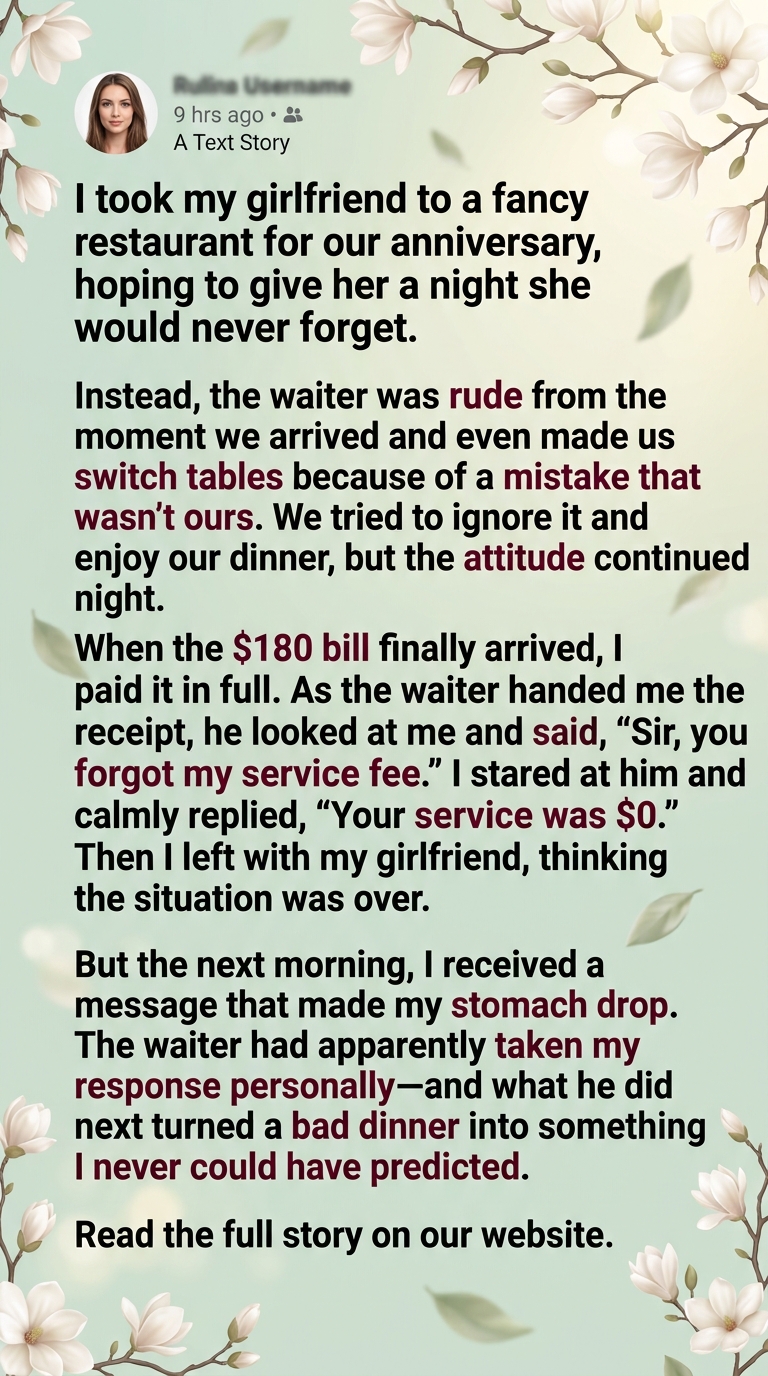
I took my girlfriend to a fancy restaurant for our anniversary.
I had planned the night for weeks.
I made the reservation.
I ordered flowers.
I even requested a quiet table because I wanted us to have a romantic evening.
Instead, the night went wrong almost immediately.
Our waiter was rude from the moment we arrived.
He barely looked at us when he took our order.
When he brought the drinks, he slammed them down.
Then, about twenty minutes later, he came back and told us we had to move.
“Why?” I asked.
“That table is reserved.”
I showed him our reservation.
“We were assigned this table.”
He shrugged.
“Doesn’t matter. Move.”
My girlfriend squeezed my hand.
“Let’s just go,” she whispered.
So we moved.
I tried to ignore it.
It was our anniversary.
I wasn’t going to let one rude employee ruin the night.
But the attitude continued.
He forgot my girlfriend’s drink.
He brought the wrong appetizer.
When we pointed it out, he rolled his eyes.
At one point, my girlfriend quietly said:
“Is everything okay?”
He replied:
“Maybe if you people knew what you wanted, we’d have fewer problems.”
I stared at him.
My girlfriend looked embarrassed.
I wanted to leave.
But she had been looking forward to this dinner.
So I stayed.
We finished our meal.
The food was actually good.
The company was even better.
And for the last few minutes, I managed to forget about the waiter.
Then the bill arrived.
$180.
I paid it in full.
When the waiter returned with the receipt, he placed it in front of me.
Then he looked at me.
“Sir, you forgot my service fee.”
I looked at the receipt.
Then at him.
“You mean the tip?”
He smiled.
“Yes.”
I stared at him for a moment.
Then I calmly said:
“Your service was $0.”
My girlfriend’s eyes widened.
The waiter froze.
I signed the receipt and stood up.
We left.
I assumed that was the end of it.
I was wrong.
The next morning, I woke up to a message from the restaurant.
At first, I thought it was an apology.
It wasn’t.
The manager said there had been an incident involving my table.
Apparently, the waiter had complained about me.
He claimed I had deliberately humiliated him and refused to pay a mandatory service charge.
I checked my receipt.
There was no mandatory service charge.
The manager confirmed it.
Then he told me something that made my stomach drop.
The waiter had taken a photograph of my credit card receipt.
He had also written down my name.
And he had tried to contact me through social media.
I immediately blocked him.
But that wasn’t the end.
Later that morning, my girlfriend received a message from an unfamiliar account.
It was the waiter.
He had found her social media profile.
The message said:
“Your boyfriend thinks he’s better than everyone.”
She blocked him.
Then another message appeared.
This time, he had contacted me directly from a different account.
“You should learn to respect people who serve you.”
I didn’t respond.
I forwarded everything to the restaurant manager.
The manager called me immediately.
“Please don’t respond to him.”
Apparently, this wasn’t the first time.
The restaurant had received previous complaints about the waiter contacting customers after disagreements.
But they had never realized how far he was going.
The manager told me they were investigating.
I thought that would be enough.
Then I received another message.
This time, it included a photo of my car.
Taken outside my apartment building.
My blood ran cold.
I called the police.
An officer took screenshots of everything and advised us not to engage with him.
The restaurant also provided security footage showing the waiter leaving work around the same time.
For the first time, I realized this wasn’t about a tip anymore.
It was about someone who had taken a simple disagreement and turned it into harassment.
A few days later, the restaurant called.
The waiter had been fired.
More importantly, they had discovered that he had accessed customer information he wasn’t authorized to use.
He had used the reservation system to find names and contact details.
That explained how he found us.
The restaurant cooperated with the investigation.
My girlfriend and I were relieved.
But something about the entire experience stayed with me.
The waiter had been angry because I didn’t give him money.
But the truth was, he wasn’t entitled to my gratitude.
A tip is supposed to reflect service.
It isn’t a fee someone gets to demand because they feel offended.
I could have argued with him.
I could have yelled.
Instead, I simply said:
“Your service was $0.”
I never imagined those four words would lead to all of this.
Months later, the restaurant manager called again.
He apologized personally.
Then he offered us a complimentary dinner.
I almost refused.
But my girlfriend smiled.
“Maybe we should give them another chance.”
So we went back.
This time, the manager greeted us at the door.
He personally showed us to our table.
Our new waiter was polite.
The food was excellent.
At the end of the evening, the manager stopped by.
“Everything okay?”
I smiled.
“Perfect.”
He laughed.
“I’m glad.”
When the bill arrived, I paid it.
Then I left a generous tip.
Not because anyone demanded it.
Because this time, the service earned it.
On the way home, my girlfriend looked at me.
“Do you remember what you said that night?”
I laughed.
“Unfortunately.”
She smiled.
“Maybe it was for the best.”
I looked at her.
“How?”
“Because if he hadn’t acted that way, we never would have learned what he was capable of.”
She was right.
That terrible anniversary dinner taught me something I didn’t expect.
Sometimes the right response isn’t to fight harder.
It’s to stay calm, document what happened, and let the people responsible handle it.
And sometimes, saying “no” to unreasonable behavior isn’t rude.
It’s simply a boundary.
Our anniversary wasn’t ruined.
We still had each other.
And in the end, the $0 service fee was the least important part of the story.
The real lesson was that no one is entitled to your money, your attention, or your respect simply because they demand it.
Respect goes both ways.
And good service earns appreciation.
It doesn’t threaten you into giving it.