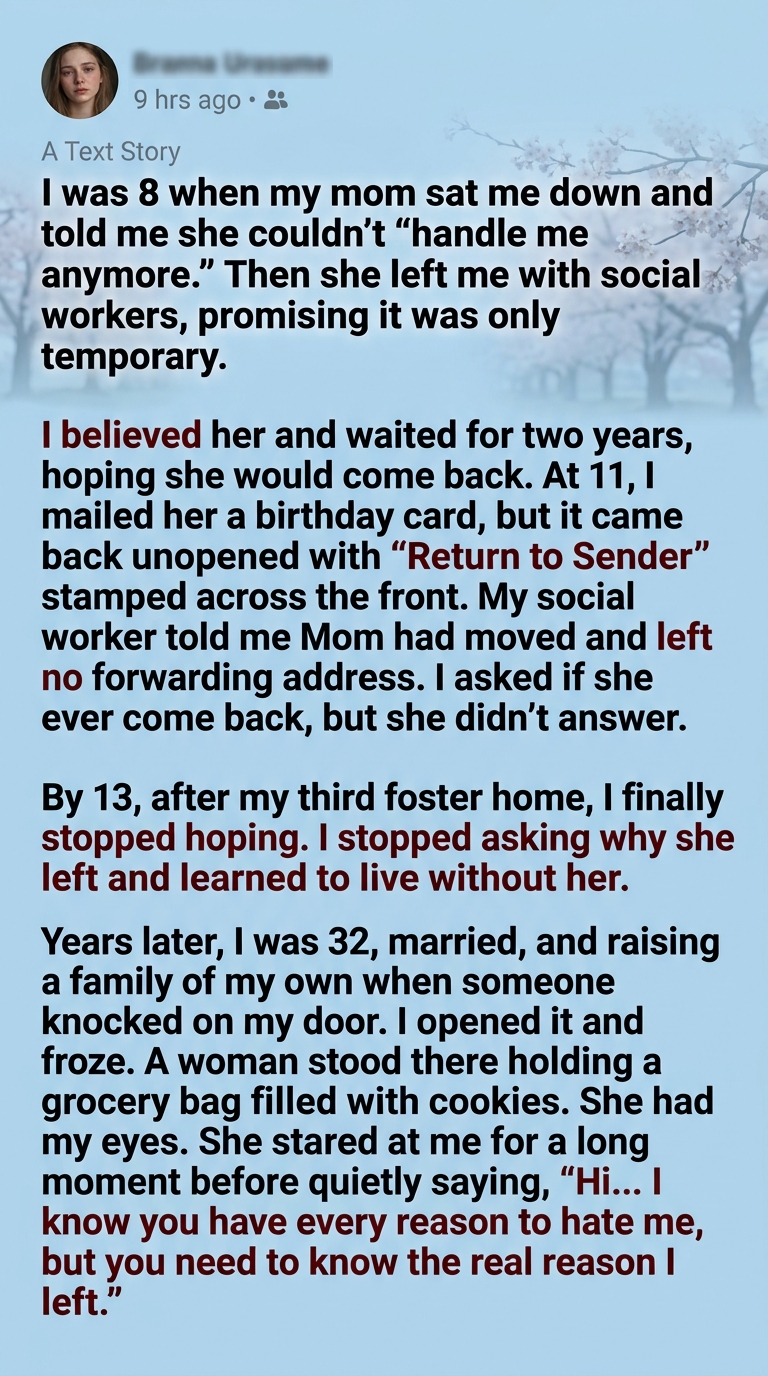
I was eight years old when my mother sat me down at the kitchen table and told me she couldn’t “handle me anymore.”
I remember staring at the chipped blue mug in front of her while she talked.
She said she was tired.
She said she needed help.
She said social workers would take care of me “for a little while.”
And then she promised the words I clung to for years:
“I’ll come back for you.”
I believed her.
That afternoon, a social worker came to our apartment. I packed a small suitcase with my favorite sweater, two books, and a photograph of Mom and me at the beach.
I kept asking when she was coming.
“Soon,” Mom said.
She hugged me quickly, kissed my forehead, and walked out.
I watched from the window until her car disappeared.
I thought that was the hardest day of my childhood.
I was wrong.
Two years passed.
I moved through foster homes, schools, and unfamiliar bedrooms. Every time a car stopped outside, I wondered if it was Mom.
When I turned eleven, I spent nearly all the money I’d saved from doing small chores on a birthday card for her.
I drew a picture of us holding hands.
Inside, I wrote:
Happy Birthday, Mom. I still love you. Please come home.
I mailed it to the last address I had.
A week later, the envelope came back.
Across the front were two words in red ink:
RETURN TO SENDER.
I ran to my social worker.
“Where is she?”
She sighed.
“Your mother moved.”
“Where?”
“She didn’t leave a forwarding address.”
“Can you find her?”
“I’ll try.”
I looked at her face.
“Will she come back?”
For several seconds, she said nothing.
That silence answered me.
By thirteen, I had lived in my third foster home.
That’s when I finally stopped waiting.
I stopped asking about my mother.
I stopped drawing pictures of us.
I stopped telling people she was coming back.
I learned how to make myself small when adults were angry. I learned not to get attached to bedrooms because they might not be mine for long. I learned that promises didn’t mean much when the person making them could simply disappear.
Eventually, I built a life.
I went to college.
I became a teacher.
I married a kind man who knew my entire history and never asked me to pretend it didn’t hurt.
We had two children.
And for the first time, I understood what unconditional love was supposed to feel like.
That was when I realized something painful.
I could not imagine leaving my children.
Not for a day.
Not for a week.
Not ever.
So I made peace with the idea that my mother had simply chosen a life without me.
I was thirty-two when someone knocked on my front door.
It was a rainy Saturday afternoon.
My husband was upstairs with the kids, and I was carrying a basket of laundry when I heard the knock.
I opened the door.
And froze.
A woman stood on the porch holding a grocery bag filled with homemade cookies.
She was older.
Thinner.
Her hair was streaked with gray.
But she had my eyes.
For a moment, neither of us spoke.
Then she whispered,
“Hi.”
My hand tightened around the doorknob.
She swallowed.
“I know you have every reason to hate me.”
I couldn’t breathe.
“But you need to know the real reason I left.”
I wanted to slam the door.
Instead, I asked the question I’d carried for twenty-four years.
“Why?”
She looked down at the bag in her hands.
“Because I was trying to keep you alive.”
I stared at her.
She continued.
“Your father had become dangerous.”
I had almost no memories of my father. Mom had always told me he left when I was little.
But she told me the truth that afternoon.
He hadn’t left.
He had been arrested for hurting her.
Afterward, he became obsessed with finding us.
He threatened her.
He followed her.
And one night, he found our apartment.
My mother had called the police.
But before they arrived, she made a decision.
She believed that if she disappeared with me, he would keep looking.
So she asked social services to take me somewhere he couldn’t find.
She gave them instructions to keep my location confidential.
Then she disappeared herself.
“Why didn’t you ever come back?” I asked.
Her eyes filled with tears.
“I tried.”
She reached into her purse and pulled out a small plastic bag.
Inside were dozens of unopened letters.
Birthday cards.
Christmas cards.
Graduation cards.
Letters addressed to me over the years.
My name was written on every one.
“I sent them through the agency,” she whispered. “They told me they couldn’t guarantee you’d receive them.”
I shook my head.
“I never got anything.”
“I know.”
She pulled out another envelope.
This one was yellow and worn.
“My social worker gave me this years ago.”
I opened it.
Inside was the birthday card I’d mailed her when I was eleven.
The one that had come back to me stamped RETURN TO SENDER.
Except this time, there was something written on the back.
In my mother’s handwriting.
I love you. I am so sorry. I never stopped looking for you.
I sat down on the porch.
For twenty-four years, I’d believed she had thrown me away.
Now I was staring at proof that she had been searching for me all along.
But there was still one thing I couldn’t forgive.
“You could have told me,” I whispered.
She nodded.
“I know.”
“You could have found a way.”
“I know.”
“You promised you’d come back.”
She started crying.
“I wanted to. Every single day.”
Then she told me something that changed everything.
She had spent years tracking down information about me through the foster system, but every time she got close, she was warned that contacting me could expose my location.
Eventually, she stopped searching openly.
Instead, she built a quiet life nearby.
She became a nurse.
She saved money.
And she waited.
“Why come now?”
She looked toward my house.
“Because your children are the age you were when I lost you.”
Her voice broke.
“And I realized I couldn’t die without telling you the truth.”
I looked at the woman in front of me.
She wasn’t the mother I’d spent twenty-four years imagining.
She wasn’t innocent.
She hadn’t made every decision correctly.
She had left me.
And no explanation could erase the years I spent believing I wasn’t worth staying for.
But she had also carried the weight of that decision for twenty-four years.
I invited her inside.
Not because everything was forgiven.
Not because the past suddenly disappeared.
But because I wanted my children to grow up knowing something I had learned far too late:
Sometimes people leave because they don’t love you.
And sometimes they leave because they love you in a way that looks unbearably like abandonment.
That night, my mother sat at my kitchen table.
The same place where she’d once told me she couldn’t handle me anymore.
My daughter brought her a cookie.
My son asked her if she liked chocolate chip.
She laughed through her tears.
And for the first time in my life, I saw my mother not as the woman who abandoned me—
but as the woman who had been carrying a secret she never knew how to explain.
We didn’t fix twenty-four years in one evening.
We didn’t pretend everything was okay.
There were still questions.
There were still wounds.
There were still things we both needed to say.
But when she stood to leave, I hugged her.
It wasn’t forgiveness.
Not yet.
It was simply a beginning.
At the door, she whispered,
“I never stopped loving you.”
I looked at her and finally said the words I’d been waiting my whole life to say:
“I never stopped waiting.”
She cried.
So did I.
And for the first time, neither of us walked away alone.