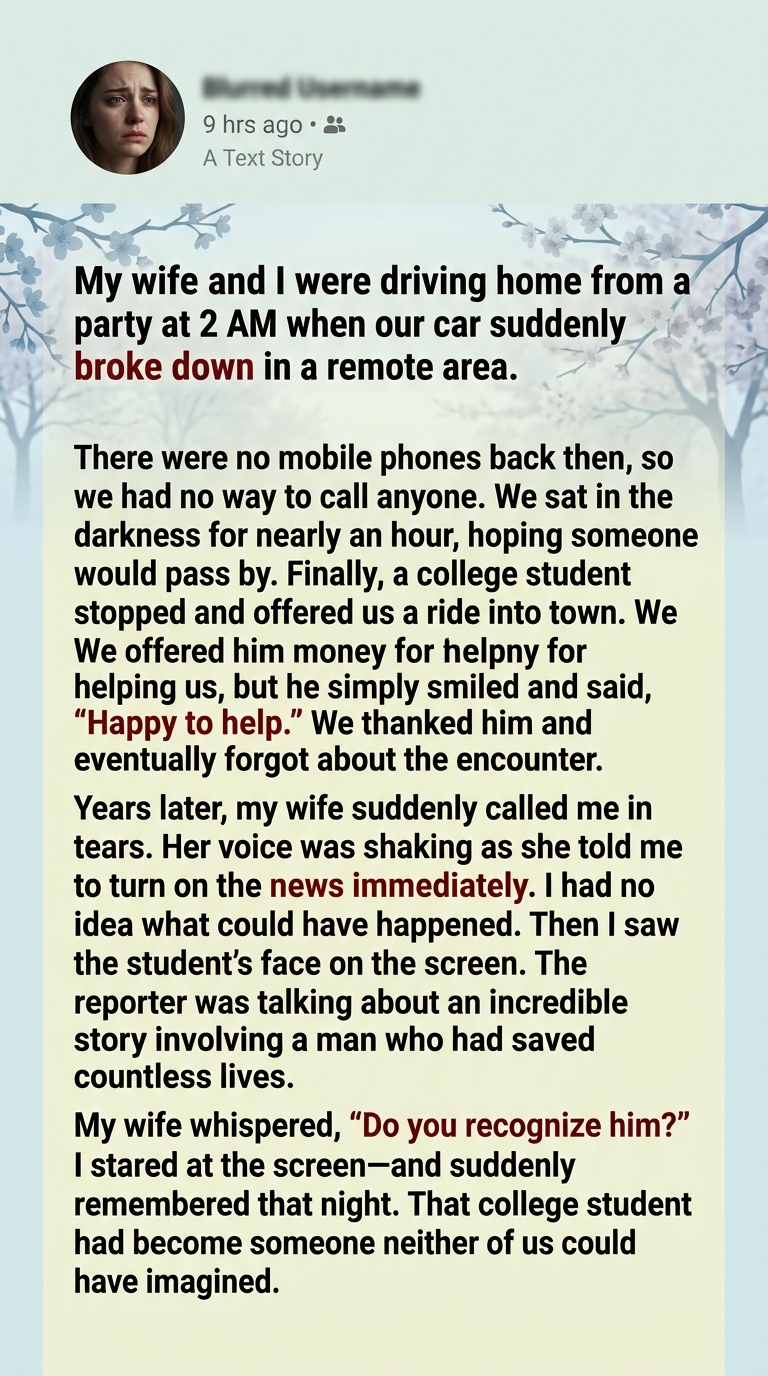
It was almost 2:00 in the morning when our car broke down.
My wife, Margaret, and I were driving home from a friend’s party, taking the old highway through the countryside.
It was the kind of road where you could drive for miles without seeing another house.
Then the engine coughed.
The headlights flickered.
And the car rolled to a stop.
I tried the ignition again.
Nothing.
I lifted the hood, stared at the engine, and immediately realized I had no idea what I was looking at.
This was before cell phones.
There was no GPS.
No roadside assistance.
No way to call anyone.
Margaret sat in the passenger seat with her arms crossed tightly over her chest.
“How long until someone comes by?”
“I don’t know.”
We waited.
Ten minutes.
Twenty.
Forty.
The darkness around us felt enormous.
Finally, after nearly an hour, headlights appeared in the distance.
A small car slowed down and pulled onto the shoulder.
A young man stepped out.
He looked like a college student.
Maybe twenty years old.
He wore a faded university sweatshirt and carried a backpack.
“Everything okay?” he asked.
“Our car died,” I said.
He looked under the hood.
Then he shook his head.
“I don’t think we’re getting this started tonight.”
He offered us a ride into town.
I hesitated.
Margaret looked nervous.
But the young man was polite, calm, and genuinely concerned.
So we locked our car and climbed into his vehicle.
During the drive, we learned he was a college student studying engineering.
He was heading back to campus after visiting his parents.
When we reached town, I pulled out my wallet.
“How much do I owe you?”
He laughed.
“Nothing.”
“At least let me give you something for gas.”
He shook his head.
“Happy to help.”
We thanked him repeatedly.
He dropped us at a small motel where we could call a mechanic in the morning.
Before he drove away, Margaret leaned through the window.
“What’s your name?”
He smiled.
“David.”
Then he disappeared into the night.
And, like so many moments in life, we eventually forgot about it.
Years passed.
Our children grew up.
We moved to another city.
The old car was long gone.
Even the road where we’d broken down had probably changed.
David became nothing more than a strange memory from our younger years.
Until one evening, nearly twenty years later, my wife called me from the kitchen.
I was watching television when I heard her scream.
Not loudly.
But enough to make me jump out of my chair.
“John!”
I ran into the kitchen.
Margaret was standing beside the television.
Her face was pale.
Tears were streaming down her cheeks.
“What happened?”
She pointed at the screen.
“Turn it up.”
I grabbed the remote.
The news reporter was standing outside a hospital.
Behind him were firefighters, ambulances, police officers, and dozens of people.
The headline at the bottom of the screen read:
LOCAL ENGINEER CREDITED WITH SAVING HUNDREDS OF LIVES.
Then the camera showed the man being interviewed.
I froze.
Margaret whispered,
“Do you recognize him?”
I stared at the television.
The man was older now.
His hair was gray around the temples.
His face was thinner.
But the smile was unmistakable.
It was David.
The college student who had stopped for us on that lonely highway.
The reporter explained that David had become a structural engineer specializing in emergency infrastructure.
Years earlier, he’d helped design a warning system for aging bridges.
When a major storm struck the region, one of those bridges began showing signs of catastrophic failure.
David noticed the data.
He immediately contacted emergency officials.
The bridge was closed less than an hour before it collapsed.
Without that warning, hundreds of people would have been on it.
But that wasn’t the end of his story.
The reporter continued.
David had spent years volunteering with disaster-response organizations.
He’d helped evacuate communities during floods.
He’d trained rescue teams.
He’d designed temporary shelters.
He’d worked through hurricanes, earthquakes, and wildfires.
And according to the report, his work had directly contributed to saving countless lives.
Margaret covered her mouth.
“Oh my God.”
I couldn’t take my eyes off the screen.
The reporter asked David why he devoted so much of his life to helping strangers.
David smiled.
“I was lucky enough to have people help me when I was young,” he said. “Someone once told me that if you have the chance to make another person’s night a little less frightening, you should.”
Margaret and I looked at each other.
Neither of us spoke.
We knew.
That night, the reporter showed an old photograph from David’s college years.
It was the same young man who had stood beside our broken car.
The same man who had refused our money.
The same man who had simply smiled and said,
“Happy to help.”
Margaret began crying again.
“I can’t believe it.”
I put my arm around her.
“We have to find him.”
We spent the next few days searching.
Eventually, we found an address through a professional organization.
I wrote him a letter.
I told him who we were.
I told him about the broken-down car.
I told him we’d never forgotten his kindness, even though we’d forgotten his name.
Three weeks later, the phone rang.
It was David.
“Is this John?”
My heart started pounding.
“Yes.”
There was a pause.
Then he laughed.
“I’ve been wondering when you two would find me.”
I smiled.
“You remember us?”
“Of course.”
“You remember that night?”
“I remember thinking you both looked terrified.”
We laughed.
Then Margaret got on the phone.
“David, you changed our lives.”
He was quiet for a moment.
Then he said something I’ll never forget.
“You changed mine too.”
We didn’t understand.
He explained.
That night, when he drove us into town, he was struggling.
He’d been considering dropping out of college.
He was working two jobs.
He wasn’t sure he could afford another semester.
But after helping us, something changed.
“You kept thanking me,” he said. “You told me that there were still good people in the world.”
Margaret remembered.
She had said exactly that.
David continued.
“I went back to school the next morning.”
He graduated.
Then he became an engineer.
Then he started working in disaster safety.
“Your car breaking down that night wasn’t a big deal,” he said.
“But the way you thanked me made me realize something.”
“What?”
“That helping one person matters.”
I looked at Margaret.
Neither of us could speak.
We had thought David saved us that night.
We never imagined that, in some small way, we had helped shape the man who would eventually save so many others.
A few months later, David visited us.
We sat around our kitchen table for hours, talking about that night.
Before he left, I handed him an envelope.
He opened it.
Inside was the exact amount of money I’d offered him twenty years earlier.
He laughed.
“You kept this?”
“No.”
I shook my head.
“I saved something else.”
I showed him a photograph Margaret had taken that night.
It was blurry and dark.
But in the background, you could just barely see a young college student standing beside our broken car.
David stared at it.
Then he smiled.
“I’d forgotten what I looked like back then.”
Margaret touched the photograph.
“We hadn’t.”
David hugged us both before leaving.
And as I watched his car disappear down the street, I realized something I’d never understood before.
Sometimes the people who change your life don’t know they’ve done it.
And sometimes the smallest act of kindness—a ride home at 2 AM, a door held open, a meal shared, a stranger helped on a dark road—can travel farther than you will ever know.
That young college student had stopped for two frightened strangers because he thought he was simply helping someone.
Years later, we discovered he had become the kind of man who dedicated his entire life to doing exactly that.
He never asked for money.
He never asked for recognition.
He simply stopped.
And helped.
And somehow, that was enough to change everything.