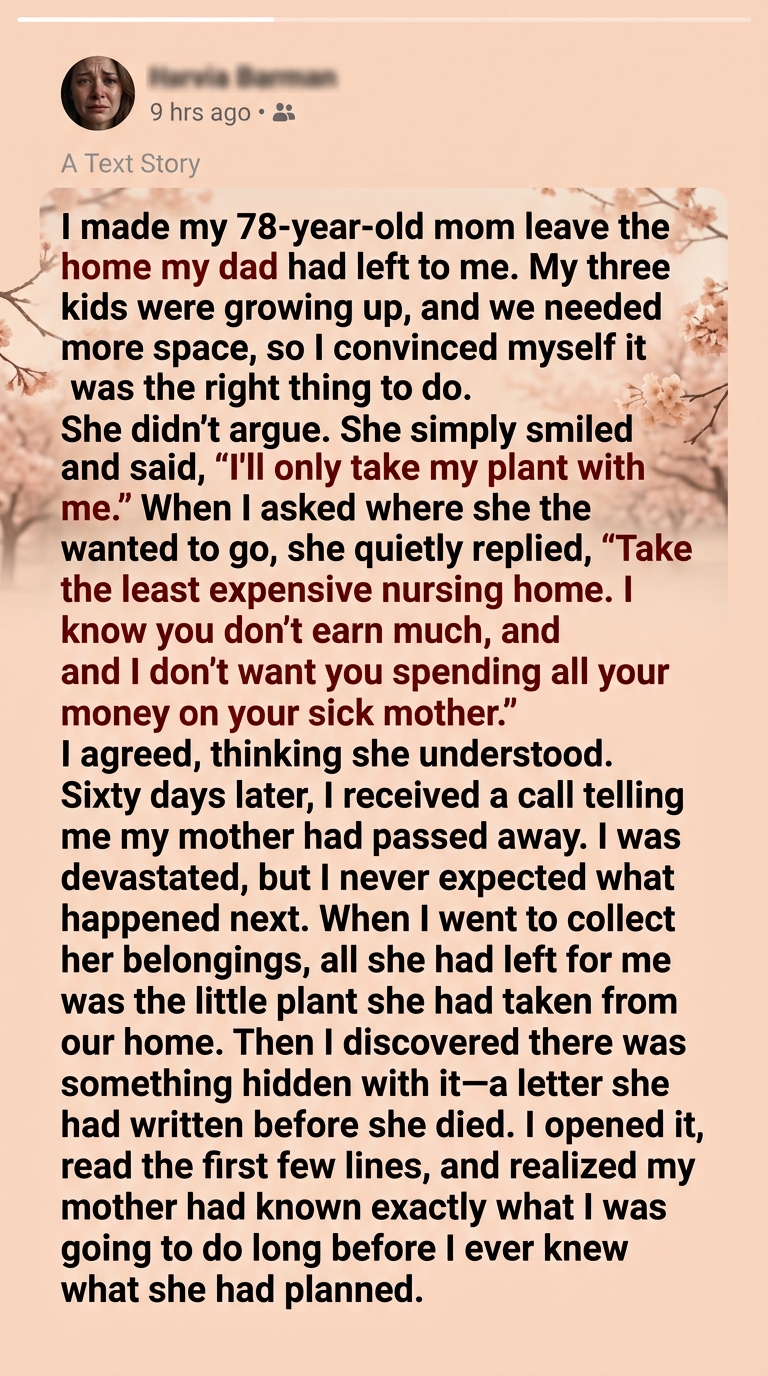
I was the one who asked my seventy-eight-year-old mother to leave the house my father had left me.
Even now, admitting that makes my stomach hurt.
My husband and I had three children.
They were growing.
The house felt smaller every year.
There were toys everywhere, backpacks in the hallway, arguments over bedrooms, and nowhere for anyone to breathe.
The house had belonged to my father.
After he died, he left it to me.
I told myself I needed to think about my children.
I told myself Mom was getting older and needed professional care anyway.
And eventually, I convinced myself that asking her to leave was the practical thing to do.
One evening, I sat across from her at the kitchen table.
“Mom, we need the space.”
She looked at me for a long time.
Then she smiled.
She didn’t argue.
She didn’t ask where she was supposed to go.
She simply said,
“I’ll only take my plant with me.”
I looked toward the windowsill.
It was a small green plant in a cracked ceramic pot.
I’d seen it my entire life.
Mom had brought it into the house when I was a little girl.
I shrugged.
“Fine.”
Then I asked,
“Where do you want to go?”
She lowered her eyes.
“Take me to the least expensive nursing home.”
I stared at her.
She continued softly,
“I know you don’t earn much, and I don’t want you spending all your money on your sick mother.”
Those words made me uncomfortable.
I told myself she understood.
I told myself she was being reasonable.
Two days later, I drove her to a small nursing home on the edge of town.
The building was old.
The room was tiny.
There was one bed, one dresser, and a window overlooking a parking lot.
Mom carried only a small suitcase.
And that little plant.
Before I left, she hugged me.
“Take care of my grandchildren.”
“I will.”
“And take care of yourself.”
“I will, Mom.”
She smiled.
“I know.”
I walked out.
I didn’t know those would be the last words we’d ever exchange.
For the next two months, I was busy.
The children had school.
Bills needed to be paid.
My husband worked long hours.
I told myself I’d visit Mom on Sunday.
Then something came up.
The following weekend, someone got sick.
Then there was a school event.
Then another bill.
I kept postponing the visit.
Sixty days after I left her at the nursing home, my phone rang.
It was the facility director.
My heart sank before she even spoke.
“I’m sorry.”
My mother had died during the night.
She had been seventy-eight years old.
I couldn’t breathe.
I dropped the phone.
Then I sat on the kitchen floor and cried.
For the first time, I understood what I’d done.
I had asked my mother to leave her home.
And then I hadn’t even been there when she died.
The funeral passed in a blur.
A few days later, I went back to the nursing home to collect her belongings.
There wasn’t much.
A sweater.
Two books.
A photograph of my father.
A pair of slippers.
And the little plant.
That was it.
The nurse handed it to me.
“She wanted you to have this.”
I took the pot.
My fingers brushed against something underneath it.
A small envelope had been taped to the bottom.
My name was written on it.
I froze.
I sat in the parking lot and opened it.
The letter began:
My daughter,
If you’re reading this, then I’ve already gone.
I couldn’t continue for several seconds.
Then I forced myself to read.
I knew you would eventually ask me to leave.
My hands started shaking.
I read the next line.
Not because I think you’re a bad daughter.
Because I know you are my daughter.
She explained that she’d noticed the changes long before I ever spoke to her.
The way I looked at the house.
The way I talked about the children’s need for space.
The way I avoided discussing her future.
She knew.
She had known.
But then came the part that broke me.
Your father left this house to you for a reason.
But he also left something else.
My heart started pounding.
Mom explained that years earlier, Dad had placed a second document in a safety deposit box.
She had been the only person who knew about it.
It was a letter he’d written to me.
He had instructed Mom to give it to me only if I ever decided to sell the house or remove her from it.
I stared at the page.
I asked him why he would make such a strange condition.
He told me, “Because one day she may forget what a home is.”
Tears blurred the words.
Mom continued.
A house is walls, windows, and a roof.
A home is the people you refuse to leave behind.
I covered my face.
Then I read the sentence that destroyed me.
I didn’t leave because you asked me to. I left because I didn’t want you to hate yourself later.
She had chosen the nursing home.
She had chosen the cheapest one.
She had chosen not to fight.
Not because she didn’t care.
Because she loved me enough to make leaving easier.
But there was one final surprise.
Mom had arranged for the house to be inspected after her death.
She had discovered that Dad had quietly placed a portion of the property into a trust for his grandchildren.
I couldn’t sell the house without protecting their share.
And then I found out something even more painful.
Mom had been paying for part of my children’s expenses for years.
School supplies.
Winter coats.
Medical bills.
Little things I had assumed were covered by our own income.
She had been helping us from the little money she had.
And I had thanked her by sending her away.
At the bottom of the letter, she wrote:
Please don’t punish yourself forever.
You made a terrible decision.
But you are not a terrible daughter.
Come home.
Take care of my grandchildren.
And put my little plant somewhere near the window.
I cried for hours.
Then I drove home.
I carried the plant into the house.
I placed it on the same windowsill where Mom had kept it.
My oldest child walked into the room.
“Mom, why are you crying?”
I looked at the plant.
“Because Grandma loved this house.”
My child looked confused.
“Is she coming back?”
I couldn’t answer.
I just hugged my child.
From that day forward, I changed.
I stopped treating the house as something I owned.
I started treating it as something I had been trusted with.
I kept Mom’s room exactly as it was.
Her books stayed on the shelf.
Her photograph stayed beside the bed.
And the little plant grew.
Year after year.
My children grew up knowing exactly who their grandmother was.
Not the woman we sent away.
The woman who had spent her entire life making sure we had somewhere to come home to.
Years later, that plant was enormous.
Every spring, it produced tiny white flowers.
My youngest child once asked me,
“Why do you always look at Grandma’s plant when you’re sad?”
I smiled through my tears.
“Because your grandmother left me one last lesson.”
“What lesson?”
I touched one of the leaves.
“That you can make a terrible mistake and still choose to become a better person afterward.”
I never got another chance to apologize to Mom.
I never got to tell her I was sorry.
But I could honor her.
So I did.
I kept the house.
I raised my children there.
And every morning, when sunlight came through the kitchen window, I watered the little plant she carried away when I asked her to leave.
She had taken almost nothing with her.
Just a plant.
And somehow, she had left me everything I needed to understand what a mother really gives her child.
Not a house.
Not money.
Not possessions.
A way home.
And I will spend the rest of my life trying to deserve it.