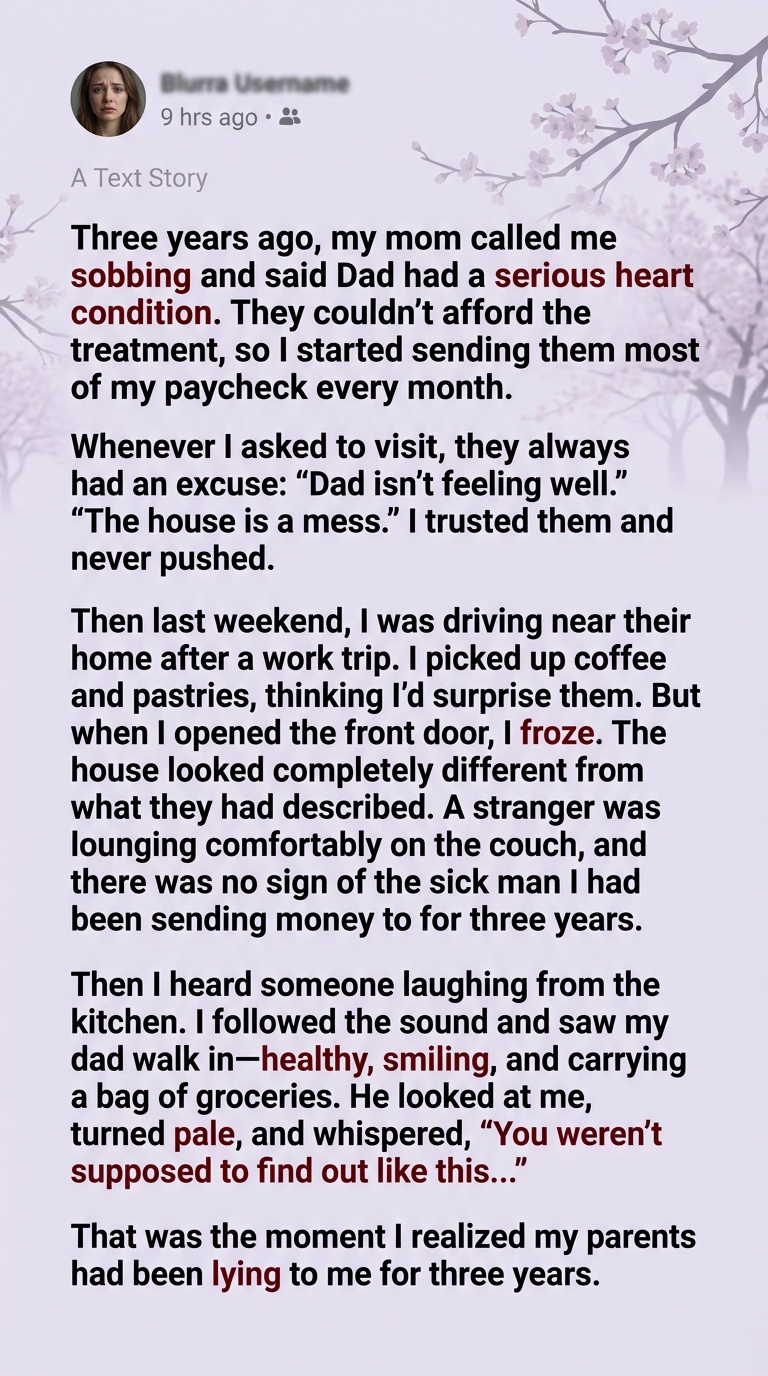
Three years ago, my mother called me crying.
I could barely understand her through the sobs.
“Your father is very sick.”
I froze.
“What happened?”
“He has a serious heart condition. The doctors say he needs treatment, but we don’t have enough money.”
My father had always been the strongest person I knew.
He rarely complained.
He never admitted when he was in pain.
So hearing that he was seriously ill terrified me.
“How much do you need?”
My mother hesitated.
“Whatever you can spare.”
I didn’t think twice.
I had a steady job and lived alone.
I started sending them most of my paycheck every month.
At first, I told myself it would only be temporary.
A few months.
Maybe a year.
Until Dad got better.
But the months became years.
Every time I asked if I could visit, there was another reason I shouldn’t come.
“Dad isn’t feeling well.”
“The house is a mess.”
“He’s sleeping.”
“The doctor said he shouldn’t have visitors.”
I worried constantly.
I’d ask my mother for updates.
She always gave me the same answer.
“He’s hanging in there.”
So I kept sending money.
I canceled vacations.
Stopped eating out.
Put off buying a new car.
I even took extra shifts at work.
Whenever my friends asked why I was working so much, I’d simply say,
“My dad needs me.”
I never complained.
They were my parents.
What else was I supposed to do?
Then last weekend, everything changed.
I had been away on a work trip.
On the drive home, I realized I was only twenty minutes from my parents’ neighborhood.
I smiled.
I stopped at a bakery and bought their favorite coffee and pastries.
I imagined surprising them.
Maybe Dad would be sitting in his chair.
Maybe I’d finally get to hug him.
I pulled into their driveway.
The house looked different.
Not abandoned.
Not sick.
Different.
There were two new cars outside.
The lawn was perfectly maintained.
Fresh flowers lined the walkway.
I frowned.
My mother had spent the last three years telling me they could barely afford groceries.
I walked to the front door.
It was unlocked.
“Mom?”
No answer.
I stepped inside.
And froze.
The house looked nothing like the home I’d imagined.
The furniture was new.
The walls had been freshly painted.
There was a large television I’d never seen before.
A man I didn’t recognize was lying comfortably on the couch watching television.
He looked at me.
I looked at him.
“Who are you?”
He sat up.
“Who are you?”
“I’m their daughter.”
His expression changed.
“Oh.”
Before I could ask anything else, I heard laughter from the kitchen.
I knew that laugh.
My father’s laugh.
The one I hadn’t heard in three years.
I followed the sound.
And there he was.
My father.
Walking into the kitchen carrying a bag of groceries.
Healthy.
Strong.
Smiling.
He was wearing jeans and a T-shirt.
No oxygen tank.
No hospital bracelet.
No sign of the heart condition I’d spent three years believing was slowly killing him.
He saw me.
The grocery bag slipped slightly in his hand.
His face went completely pale.
“Sarah?”
I couldn’t speak.
He stared at me.
Then whispered,
“You weren’t supposed to find out like this.”
My mother appeared behind him.
She stopped when she saw me.
Nobody moved.
Finally, I asked the question that had been burning inside me.
“Are you sick?”
My father looked down.
“No.”
My heart broke.
Not because he was healthy.
Because he wasn’t.
He had never been sick.
I looked at my mother.
She started crying.
“How long?”
Neither answered.
“How long have you been lying to me?”
My father sat down.
“Three years.”
I felt like the floor had disappeared beneath me.
“Three years?”
He nodded.
I put the bakery bag on the counter.
“I sent you money every month.”
“I know.”
“How much?”
My mother whispered,
“About $94,000.”
I stared at her.
Nearly one hundred thousand dollars.
Gone.
Money I’d earned working long hours.
Money I’d sacrificed everything for.
Money I’d sent because I thought my father was dying.
“What did you spend it on?”
My mother covered her face.
My father finally answered.
“The house.”
I looked around.
The new furniture.
The television.
The renovated kitchen.
The new roof.
The cars outside.
“You used my money to renovate this house?”
“Some of it.”
“Some?”
My father was silent.
Then the man from the living room walked into the kitchen.
I looked at him.
“Who is he?”
My mother wiped her eyes.
“My brother.”
My uncle.
Apparently, he had been living with them for almost a year.
And suddenly the pieces started falling into place.
My parents hadn’t just been spending my money on the house.
They had been paying off debts.
Credit cards.
Loans.
Medical bills that weren’t Dad’s.
And my uncle’s failed business.
I stared at them.
“You let me believe my father was dying so you could pay your debts?”
My father shook his head.
“It wasn’t supposed to go this far.”
“When did you plan to tell me?”
He didn’t answer.
“When?”
My mother finally whispered,
“Never.”
That word hurt more than everything else.
I walked outside.
My father followed me.
“Please.”
I turned around.
“Don’t.”
“I know what we did was wrong.”
“You didn’t make a mistake.”
I was crying now.
“You made a decision. Every month, you decided to lie to me again.”
He looked down.
“I was ashamed.”
“Then you should have told me the truth.”
“I thought you’d stop helping us.”
“I would have!”
He nodded.
“I know.”
That was the part that broke me.
They knew.
They knew the truth would make me stop.
So they kept me ignorant.
I drove home that night without saying goodbye.
For several days, I couldn’t sleep.
I kept looking through my bank statements.
Three years of transfers.
Three years of messages.
Three years of asking,
“How is Dad?”
And every time, my mother had replied,
“He’s doing okay.”
I finally hired an attorney.
Not because I wanted revenge.
Because I needed to know exactly where my money had gone.
The investigation uncovered something even worse.
My father hadn’t come up with the lie alone.
My mother had suggested it.
She had originally asked for help with their mortgage.
When I sent more money than expected, she realized how much I trusted her.
That’s when she told Dad,
“If she thinks you’re sick, she’ll keep helping.”
My father had agreed.
They had even created fake medical paperwork to make the story believable.
The documents weren’t real.
The diagnosis wasn’t real.
The hospital visits weren’t real.
For three years, I had been sending money to people who were perfectly healthy.
My parents eventually admitted everything.
They offered to repay me.
But they didn’t have the money.
Most of it was gone.
The house was worth more after the renovations, though.
So I made them a deal.
They would sell it.
Every dollar I had sent them would be returned to me.
Anything left over would be theirs.
My mother begged me not to do it.
“That’s your father’s home.”
I looked at her.
“No.”
“It was my home too.”
She started crying.
“You’re destroying our family.”
I shook my head.
“You destroyed it three years ago.”
The house was sold.
I recovered most of the money.
Not all of it.
Some debts had disappeared into other people’s accounts.
Some money was simply gone.
But I stopped sending them anything.
For the first time in three years, I didn’t wake up wondering if my father had survived the night.
And strangely, that relief hurt almost as much as the betrayal.
A few months later, my father called.
I almost didn’t answer.
When I did, he was quiet for a long time.
Then he said,
“I really am sorry.”
I closed my eyes.
“I believe that you’re sorry.”
“Can we fix this?”
I thought about everything.
The money.
The lies.
The fake medical records.
The years I spent terrified that I was going to lose my father.
“No.”
He started crying.
“Not yet.”
I continued.
“Maybe someday I can forgive you.”
“Maybe.”
“But forgiveness doesn’t mean pretending nothing happened.”
He understood.
Before hanging up, he said something I’ll never forget.
“You were the best daughter we could have asked for.”
I answered,
“And you were the parents I trusted most.”
Neither of us spoke after that.
Then I ended the call.
I still haven’t decided whether I’ll ever fully rebuild that relationship.
Maybe I will.
Maybe I won’t.
But I learned something I wish I had understood three years earlier.
Helping your family is an act of love.
But love should never require you to ignore your instincts, sacrifice your entire life, or accept lies without question.
My father wasn’t dying.
My parents weren’t struggling to afford his treatment.
They were struggling with their own choices.
And I had spent three years paying for choices I never made.
The last time I drove past their old house, I remembered that first phone call.
My mother crying.
My father supposedly fighting for his life.
And me saying,
“Whatever you need.”
I thought those words meant love.
Now I understand that love also means knowing when to say:
“I will help you, but I won’t let you lie to me.”