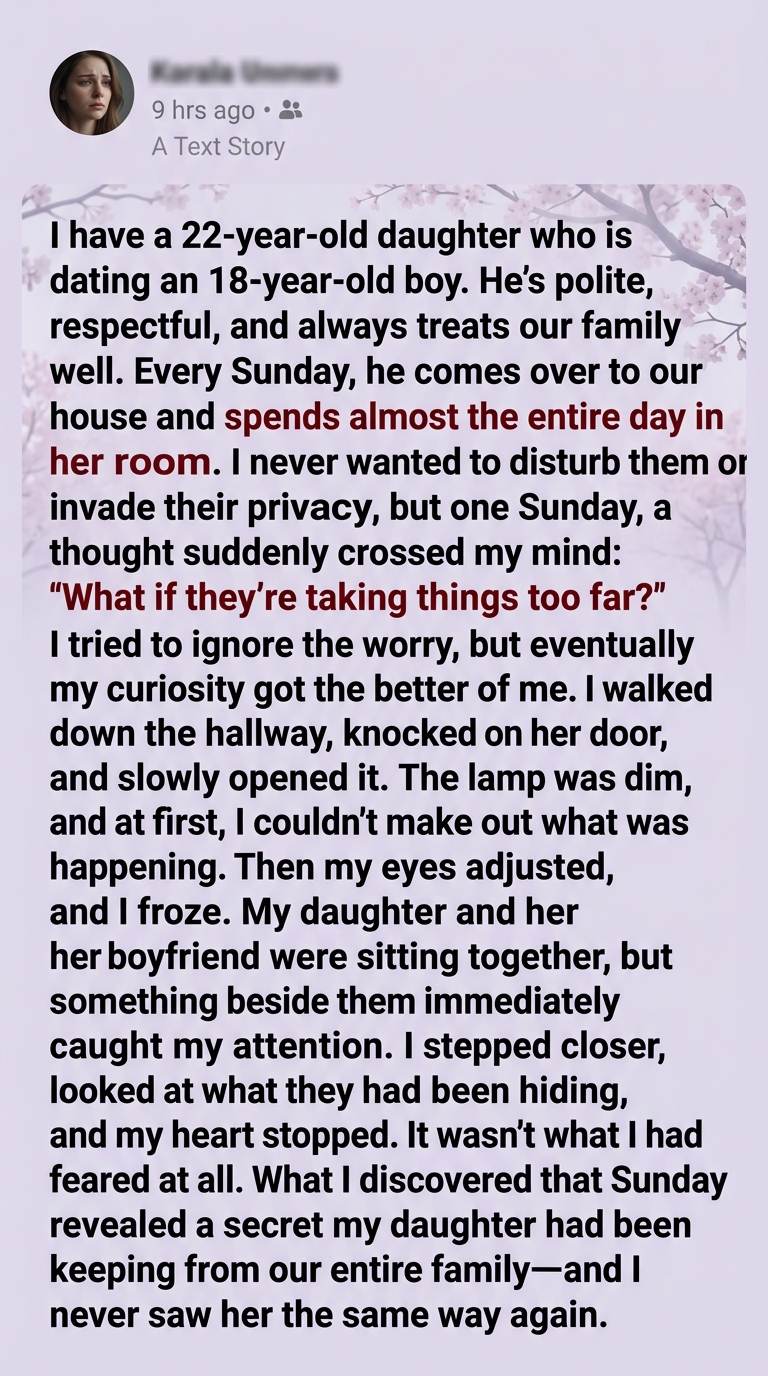
My daughter was twenty-two.
Her boyfriend was eighteen.
I’ll admit that, when they first started dating, I wasn’t sure what to think.
Not because he was a bad kid.
Actually, it was the opposite.
He was polite.
Respectful.
He always greeted me when he came into the house.
He helped carry groceries.
He thanked my wife for dinner.
And whenever he left, he made sure to say goodbye to everyone.
The only thing that made me uneasy was how much time they spent together.
Every Sunday, he came over in the morning and stayed almost the entire day.
And almost every Sunday, they disappeared into my daughter’s bedroom.
The door wasn’t locked.
They weren’t loud.
They weren’t doing anything that gave me a reason to interfere.
So I respected their privacy.
Still, I was a father.
And fathers worry.
One Sunday afternoon, I was sitting in the living room when I glanced at the clock.
They’d been upstairs for nearly four hours.
A thought crossed my mind.
What if they’re taking things too far?
I immediately felt guilty for even thinking it.
My daughter was an adult.
Her boyfriend was also legally an adult.
But that didn’t stop the protective voice in my head.
I tried to ignore it.
Then I heard something fall upstairs.
A few seconds later, my daughter laughed.
I stood up.
I walked toward the hallway.
I stopped outside her door.
I knocked.
“Come in,” my daughter called.
I slowly opened the door.
The room was dim.
The curtains were closed.
A small lamp on the desk was the only light.
At first, I couldn’t make out what was happening.
My daughter and her boyfriend were sitting on the floor beside her bed.
They both looked up at me.
And then I noticed something beside them.
A large cardboard box.
Several notebooks were scattered across the floor.
There were photographs.
Receipts.
Medicine bottles.
And what looked like dozens of handwritten letters.
I froze.
“What is all this?”
My daughter immediately stood up.
“Dad…”
Her boyfriend looked nervous.
I stepped closer.
And that’s when I saw the photograph on top of the box.
It was my mother.
My daughter’s grandmother.
She had died six years earlier.
I picked up the photograph.
“What does Grandma have to do with this?”
My daughter started crying.
“I wanted to tell you.”
“Tell me what?”
She looked at her boyfriend.
He gently took her hand.
Then she finally said:
“I’ve been taking care of Grandma’s secret.”
I didn’t understand.
“She didn’t leave you a secret.”
“Yes, she did.”
My daughter picked up one of the notebooks.
“She left me these.”
I opened it.
The handwriting was unmistakably my mother’s.
It was a journal.
But not a personal diary.
It was a record.
Names.
Dates.
Amounts.
Addresses.
And beside almost every name was a note.
I looked at my daughter.
“What is this?”
She wiped her eyes.
“Grandma spent the last ten years helping people.”
I stared at her.
She explained.
After my father died, my mother had quietly started helping families in our community.
She paid grocery bills.
Bought school supplies.
Covered medical expenses.
Paid utility bills.
Sometimes she gave people money anonymously.
She never told anyone.
Not even me.
I remembered how often Mom had complained that she was “spending too much on groceries.”
I’d assumed she meant herself.
I was wrong.
My daughter had discovered the notebooks while cleaning out Grandma’s house after her funeral.
She had initially planned to throw them away.
Then she found the letters.
Each one thanked my mother for something.
One woman wrote that Mom had paid for her son’s surgery.
Another thanked her for keeping their electricity on during winter.
A man wrote that my mother had paid his tuition after he lost his job.
My daughter had spent six years trying to find the people mentioned in the notebooks.
“And the box?” I asked.
She opened it.
Inside were envelopes.
Hundreds of them.
She had been contacting the families.
Not to tell them what Grandma had done.
To continue it.
I looked at her.
“You’ve been giving them money?”
She nodded.
“How?”
She hesitated.
“Every month.”
I felt my stomach tighten.
“Where did you get the money?”
She looked down.
“From my salary.”
“You’ve been doing this since you were sixteen?”
She nodded.
I couldn’t speak.
Her boyfriend finally said something.
“She wanted to stop when she started college.”
My daughter looked at him.
“But I told her she didn’t have to do everything alone.”
He pointed toward the notebooks.
“So every Sunday, we organize the letters, update the records, and prepare the envelopes.”
I stared at him.
All those Sundays.
All those hours in her bedroom.
I had thought they were hiding something inappropriate.
They had been hiding something beautiful.
My daughter reached into the box and handed me an envelope.
It had my name on it.
I recognized my mother’s handwriting.
My hands began shaking.
I opened it.
Inside was a short letter.
It said:
My son,
If you’re reading this, then I didn’t tell you everything.
Please don’t be angry.
I knew you would have tried to stop me from giving away so much. You would have told me to save the money.
But I never wanted my money to sit in a bank while someone else was wondering how they would feed their children.
I stopped reading.
My eyes filled with tears.
Then came the sentence that broke me.
If your daughter ever discovers what I’ve been doing, don’t tell her she has to continue it. Just let her decide what kind of person she wants to be.
I looked at my daughter.
“You found this?”
She nodded.
“She knew I’d find it eventually.”
I read the final lines.
And if she chooses to continue, then I will know the best thing I ever left behind wasn’t money.
It was her.
I couldn’t hold back my tears.
My daughter started crying too.
“I didn’t want you to think I was wasting money,” she whispered.
I hugged her.
“I never thought that.”
She laughed through her tears.
“You thought I was doing something else.”
I closed my eyes.
“I was worried.”
Her boyfriend laughed softly.
“I told her you were going to find out eventually.”
I looked at him.
“And you’ve been helping her all this time?”
He nodded.
“Every Sunday.”
I smiled.
“Thank you.”
He looked embarrassed.
“I just wanted to help.”
Then I noticed something else on the floor.
A small envelope addressed to someone named Elena.
“Who is Elena?”
My daughter looked at me.
“She was Grandma’s last person.”
“What happened to her?”
“She died last year.”
My daughter opened the envelope.
Inside was a photograph of Elena and her children.
“She left behind two kids.”
I looked at my daughter.
“And you’re helping them?”
She nodded.
“I’m trying.”
I sat down on the floor.
For years, I’d thought of my mother as a generous woman.
I hadn’t realized how generous.
And I had never imagined my daughter had inherited the same heart.
I looked around her bedroom.
The notebooks.
The photographs.
The envelopes.
The little stacks of groceries she’d purchased.
Suddenly, every Sunday made sense.
The closed door.
The whispers.
The long hours.
They hadn’t been hiding a secret relationship.
They had been building a legacy.
My daughter had been quietly continuing something her grandmother started.
And the boy I had worried about?
He had been helping her.
That afternoon, I told them both they didn’t need to hide it anymore.
My daughter smiled.
“But Dad, Grandma specifically told me not to make a big deal about it.”
I laughed.
“She clearly underestimated how emotional her son would become.”
We sat together for the rest of the afternoon.
She told me everything.
The families she’d helped.
The people she’d found.
The ones she couldn’t reach.
The ones who had written back.
And the ones who had never known who had helped them.
Before dinner, I asked her one question.
“Why didn’t you tell me?”
She looked down.
“Because I was afraid you’d say I was too young to understand.”
I shook my head.
“No.”
I put my hand on her shoulder.
“You understood something I didn’t.”
“What?”
“That money isn’t the most valuable thing a person can leave behind.”
She smiled.
Then she handed me another notebook.
On the first page, she’d written:
Grandma’s List — Continued.
Underneath it was a new name.
Mine.
I looked at her.
“What does this mean?”
She smiled.
“It means you’re helping now.”
I laughed.
“I thought you were going to ask me for money.”
“I am.”
“How much?”
She pointed toward the kitchen.
“Enough for groceries for the Wilson family.”
I smiled.
“Then let’s go shopping.”
And that was the day I realized my daughter had grown up without me noticing.
I had spent years thinking my job was to protect her from the world.
But sometimes, your children don’t need you to protect them.
Sometimes they quietly become the kind of person who makes the world a little better.
And that Sunday, I opened my daughter’s bedroom door expecting to discover something I would regret seeing.
Instead, I discovered something that made me proud.
She wasn’t hiding a reckless secret.
She was hiding a legacy.
And for the first time, I understood exactly what my mother had left behind.
Not money.
Not property.
Not possessions.
A reason for the people she loved to keep choosing kindness.
And my daughter had chosen it.